MCQ
A ray passes through a prism of angle 60° in minimum deviation position and suffers a deviation of 30°. What is the angle of incidence on the prism
  • A
    30°
  • 45°
  • C
     60°
  • D
     90°

Answer

Correct option: B.
45°
 45°

Need a full question paper?

Generate a complete, print-ready paper with questions like this in minutes — across 16+ boards, with answer keys.

Start Generating Free

Similar questions

A body is suspended from a spring balance kept in a satellite. The reading of the balance is $W_1$ when the satellite goes in an orbit of radius $R$ and is $W_2$ when it goes in an orbit of radius $R_2$.
$H \propto  I$ and  $\chi  = \frac{I}{H}$ is not applicable for the substances
The radius of the shortest orbit in a one $-$ electron system is $18 \ pm$. It may be
A circular coil ‘$A$’ has a radius $R$ and the current flowing through it is $I$. Another circular coil ‘$B$’ has a radius $2R$ and if $2I$ is the current flowing through it, then the magnetic fields at the centre of the circular coil are in the ratio of (i.e.${B_A}$ to ${B_B}$)
Assertion : An artificial satellite with a metal surface is moving above the earth in a circular orbit. A current will be induced in satellite if the plane of the orbit is inclined to the plane of the equator.
Reason : The current will be induced only when the speed of satellite is more than 8 km/sec.
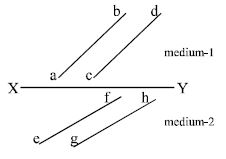
The figure shows a surface $XY$ separating two transparent media, medium - $1$ and medium- $2$. The lines $ab$ and $cd$ represent wavefronts of a light wave traveling in medium- $1$ and incident on $XY$. The lines $ef$ and $gh$ represent wavefronts of the light wave in medium- $2$ after refraction.

The phases of the light wave at $c, d, e$ and $f$ are $\phi_c,\phi_d, \phi_e$ and $\phi_f$  respectively. It is given that $\phi_c \neq \phi_f.$
In the Boolean algebra, the following one is wrong:
When photon of energy 4.25 eV strike the surface of a metal A, the ejected photoelectrons have maximum kinetic energy $\mathrm{T}_{\mathrm{A}} ~\mathrm{eV}$ and de-Brolie wavelength $\lambda_{\mathrm{A}}$. The maximum kinetic energy of photoelectrons liberated from another metal B by photon of energy 4.70 eV is $\mathrm{T}_{\mathrm{B}}=\left(\mathrm{T}_{\mathrm{A}}-1.50\right) \mathrm{eV}$. If the de-Broglie wavelength of these photoelectrons is $\lambda_{\mathrm{A}}=2 \lambda_{\mathrm{B}}$, then
The self inductance of a straight conductor is
When the wavelength of radiation falling on a metal is changed from $500 \,nm$ to $200\, nm ,$ the maximum kinetic energy of the photoelectrons becomes three times larger. The work function of the metal is close to$.....eV$