Question
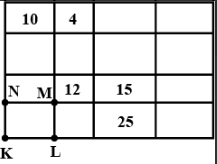
A rectangle is divided into $16$ sub-rectangles as in the figure, the number in each sub-rectangle represents the area of that sub-rectangle. What is the area of the rectangle $K L M N$ ?
Answer

d
(d)

Area of rectangles are

$a c=10$

$b c=4$

$b d=12$

$d e=15$

$e f=25$

$\therefore \frac{a c}{b c} \times \frac{b d}{d e} \times e f =\frac{10}{4} \times \frac{12}{15} \times 25$

$\Rightarrow a f =50$

Need a full question paper?

Generate a complete, print-ready paper with questions like this in minutes — across 16+ boards, with answer keys.

Start Generating Free

Similar questions

If $|a|\, = 2,\,\,|b|\, = 3$ and $a, b$  are mutually perpendicular, then the area of the triangle whose vertices are $0,\,\,a + b,\,\,a - b$ is
Let $R =\{ a , b , c , d , e \}$ and $S =\{1,2,3,4\}$. Total number of onto function $f: R \rightarrow S$ such that $f(a) \neq$ 1 , is equal to $.............$.
Let $\vec{a}=3 \hat{i}+\hat{j}-\hat{k}$ and $\overrightarrow{ c }=2 \hat{ i }-3 \hat{ j }+3 \hat{k}$. If $\vec{b}$ is $a$ vector such that $\vec{a}=\vec{b} \times \vec{c}$ and $|\vec{b}|^2=50$, then $|72-| \vec{b}+\left.\vec{c}\right|^2 \mid$ is equal to $..........$.
Let $\mu$ be the mean and $\sigma$ be the standard deviation of the distribution 

$X_i$ $0$ $1$ $2$ $3$ $4$ $5$
$f_i$ $k+2$ $2k$ $K^{2}-1$ $K^{2}-1$ $K^{2}-1$ $k-3$

where $\sum f_i=62$. if $[x]$ denotes the greatest integer $\leq x$, then $\left[\mu^2+\sigma^2\right]$ is equal $.........$.

The remainder when $19^{200}+23^{200}$ is divided by $49$ , is  $.........$.
Let $M=2^{30}-2^{15}+1$, and $M^2$ be expressed in base $2$.The number of $1$'s in this base $2$ representation of $M^2$ is
The magnitudes of mutually perpendicular forces $a, b $ and  $c $ are $2, 10 $ and $11 $ respectively. Then the magnitude of its resultant is
$\mathop {\lim }\limits_{n \to \infty } {({3^n} + {4^n})^{\frac{1}{n}}} = $
Let $\{x\}$ denote the fractional part of $\mathrm{x}$ and $f(x)=\frac{\cos ^{-1}\left(1-\{x\}^2\right) \sin ^{-1}(1-\{x\})}{\{x\}-\{x\}^3}, x \neq 0$. If $L$ and $\mathrm{R}$ respectively denotes the left hand limit and the right hand limit of $f(x)$ at $x=0$, then $\frac{32}{\pi^2}\left(L^2+R^2\right)$ is equal to..........................
If the variance of the first $n$ natural numbers is $10$ and the variance of the first m even natural numbers is $16$, then $m + n$ is equal to