MCQ
A rectangular block is heated from $0^{\circ} C$ to $100^{\circ} C$. The percentage increase in its length is $0.10 \%$. What will be the percentage increase in its volume?
  • A
    $0.03 \%$
  • B
    $0.10 \%$
  • C
    $0.30 \%$
  • D
    $0.50 \%$

Answer

C. $0.30 \%$
Explanation:
As $\frac{\Delta L}{L}=0.10 \%=0.001$ and $\Delta T=100^{\circ} C$, hence using $\frac{\Delta L}{L}= a \Delta T$,
we get; $a =\frac{0.001}{100}=\frac{10^{-5}}{{ }^{\circ} C }$
$\therefore \gamma=3 \alpha=\frac{3 \times 10^{-5}}{{ }^{\circ} C }$
and $\frac{\Delta V}{V}=\gamma \Delta T=3 \times 10^{-5} \times 100=3 \times 10^{-3}=0.30 \%$

Need a full question paper?

Generate a complete, print-ready paper with questions like this in minutes — across 16+ boards, with answer keys.

Start Generating Free

Similar questions

A man balances himself in a horizontal position by pushing his hands and feet against two parallel walls. His centre of mass lies midway between the walls. The coefficients of friction at the walls are equal. Which of the following is not correct?
A missile is fired for maximum range at your town from a place $100\, km$ away from you. If the missile is first detected at its half way point, how much warning time will you have ? (Take $g = 10\, m/s ^2$) the maximum height of the missile is
When yellow light is incident on a surface, no electrons are emitted while green light can emit. If red light is incident on the surface, then
A cricketer can throw a ball to a maximum horizontal distance of $100 \,m$. With the same effort, he throws the ball vertically upwards. The maximum height attained by the ball is  ......... $m$
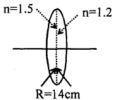
A bi-convex lens is formed with two thin plano-convex lenses as shown in the figure. Refractive index of the first lens is $1.5$ and that of the second lens is $1.2$. Both the curved surfaces are of the same radius of curvature $R = 14\; cm$. For this bi-convex lens, for an object distance of $40\; cm$, the image distance will be
A charged particle is released from rest in a region of steady and uniform electric and magnetic fields which are parallel to each other. The particle will move in a
$A$ projectile of mass $"m"$ is projected from ground with a speed of $50 \,m/s$ at an angle of $53^o$ with the horizontal. It breaks up into two equal parts at the highest point of the trajectory. One particle coming to rest immediately after the explosion. The ratio of the radii of curvatures of the moving particle just before and just after the explosion are:
For a charged spherical ball, electrostatic potential inside the ball varies with $r$ as $V =2 ar ^2+ b$. Here, $a$ and $b$ are constant and $r$ is the distance from the center. The volume charge density inside the ball is $-\lambda a \varepsilon$. The value of $\lambda$ is $...........$. $\varepsilon=$ permittivity of medium.
A bullet of mass $20 \,g$ leaves a riffle at an initial speed $100 \,m / s$ and strikes a target at the same level with speed $50 \,m / s$. The amount of work done by the resistance of air will be ......... $J$
Two discs of same moment of inertia rotating about their regular axis passing through centre and perpendicular to the plane of disc with angular velocities $\omega_1$ and $\omega_2$ They are brought into contact face to face coinciding the axis of rotation. The expression for loss of energy during this process is