Question
A rectangular coil of $100$ turns has length $5\ cm$ and width $4\ cm$. It is placed with its plane parallel to a uniform magnetic field and a current of $2A$ is sent through the coil. Find the magnitude of the magnetic field $B$ if the torque acting on the coil is $0.2\ N m^{-1}.$
Answer

$\tau=\text{ni}\overrightarrow{\text{A}}\times\overrightarrow{\text{B}}$
$\Rightarrow\tau=\text{ni}\text{ AB}\sin90^\circ$
$\Rightarrow0.2=100\times2\times5\times4\times10^{-4}\times\text{B}$
$\Rightarrow\text{B}=\frac{0.2}{100\times2\times5\times4\times10^{-4}}=0.5$ Tesla

Need a full question paper?

Generate a complete, print-ready paper with questions like this in minutes — across 16+ boards, with answer keys.

Start Generating Free

Similar questions

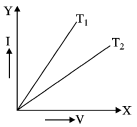
I-V graph at two different temperatures $T _1$ and $T _2$ for a metallic wire. Which temperature is greater and why? Image
The energy of electron in hydrogen atom in its ground state is - 13.6 eV. Calculate kinetic energy and potential energy of electron in this state.
Obtain the equation of electric potential energy of a system of two electric charges in external electric field.
Complete the following decay schemes.
  1. $\text{ }^{226}_{88}\text{Ra}\rightarrow\alpha+$
  2. $\text{ }^{19}_8\text{O}\rightarrow\text{ }^{19}_9\text{F}+$
  3. $\text{ }^{25}_{13}\text{Al}\rightarrow\text{ }^{25}_{12}\text{Mg}+$
A load of $10\ kg$ is suspended by a metal wire $3m$ long and having a cross$-$sectional area $4\ mm^2$. Find.
  1. The stress.
  2. The strain and.
  3. The elongation. Young's modulus of the metal is $2.0 \times 10\ N^{11}\ N/ m^2.$
A parallel beam of monochromatic light falls normally on a single narrow slit. How does the angular width of the principal maximum in the resulting diffraction pattern depend on the width of the slit?
A steel rod of length $1m$ rests on a smooth horizontal base. If it is heated from $0^\circ C$ to $100^\circ C,$ what is the longitudinal strain developed?
If the resultant torque of all the forces acting on a body is zero about a point, is it necessary that it will be zero about any other point?
Plot a graph showing variation of de Broglie wavelength $(\lambda)$ associated with a charged particle of mass m, versus $\frac{1}{\sqrt{\text{V}}},$ where V is the potential difference through which the particle is accelerated. How does this graph give us the information regarding the magnitude of the charge of the particle?
Answer the following questions:
In any ac circuit, is the applied instantaneous voltage equal to the algebraic sum of the instantaneous voltages across the series elements of the circuit? Is the same true for rms voltage?