Question
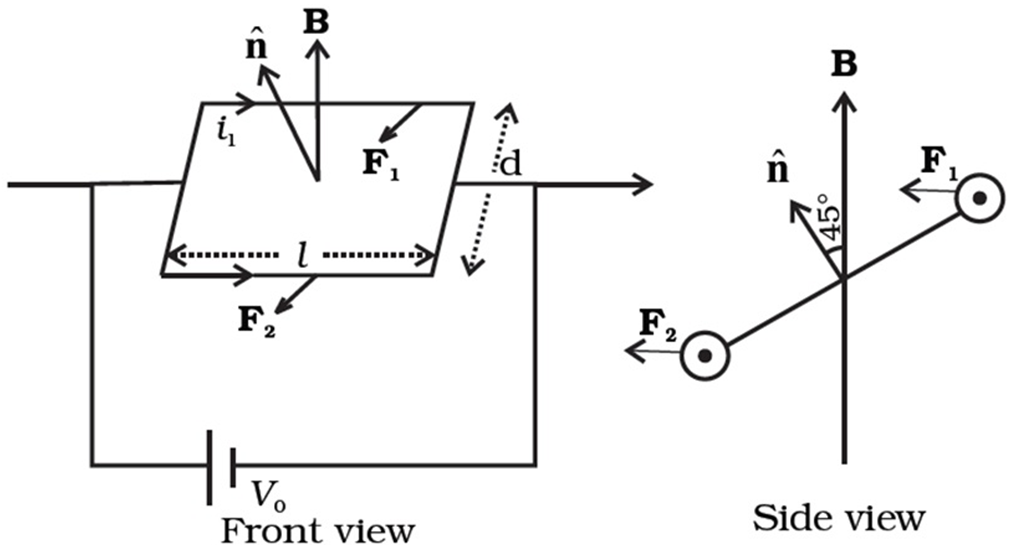
A rectangular conducting loop consists of two wires on two opposite sides of length l joined together by rods of length d. The wires are each of the same material but with cross-sections differing by a factor of 2. The thicker wire has a resistance R and the rods are of low resistance, which in turn are connected to a constant voltage source $V_0.$ The loop is placed in uniform a magnetic field B at 45° to its plane. Find $\tau$, the torque exerted by the magnetic field on the loop about an axis through the centres of rods.
Answer


Torque on the first wire is given by,
$\text{F}_1=\text{i}_1\text{lB}=\frac{\text{V}_0}{\text{R}}\text{lB},\tau_1=\frac{\text{d}}{2\sqrt{2}}\text{F}_1=\frac{\text{V}_0\text{ldB}}{4\sqrt{2}\text{R}}$
Torque on the second wire is given by,
$\text{F}_2=\text{i}_2\text{lB}=\frac{\text{V}_0}{2\text{R}}\text{lB},\tau_2=\frac{\text{d}}{2\sqrt{2}}\text{F}_2=\frac{\text{V}_0\text{ldB}}{4\sqrt{2}\text{R}}$
Net torque, $\tau=\tau_1-\tau_2$
$\Rightarrow\ \tau=\frac{1}{4\sqrt{2}}\frac{\text{V}_0\text{AB}}{\text{R}}.$

Need a full question paper?

Generate a complete, print-ready paper with questions like this in minutes — across 16+ boards, with answer keys.

Start Generating Free

Similar questions

  1. Draw the circuit diagrams of a p-n junction diode in (i) forward bias, (ii) reverse bias. How are these circuits used to study the V - I characteristics of a silicon diode? Draw the typical V - I characteristics.
  2. What is a light emitting diode (LED)? Mention two important advantages of LEDs over conventional lamps.
  1. Draw the circuit arrangement for studying the input and output characteristics of an n-p-n transistor in CE configuration. With the help of these characteristics define (i) input resistance, (ii) current amplification factor.
  2. Describe briefly with the help of a circuit diagram how an n-p-n transistor is used to produce self-sustained oscillations.
A capacitance C, a resistance R and an emf $\in$ are connected in series at t = 0. What is the maximum value of (a) the potential difference across the resistor (b) the current in the circuit (c) the potential difference across the capacitor (d) the energy stored in the capacitor (e) the power delivered by the battery and (f) the power converted into heat?
Consider a wire of length 4m and cross-sectional area $1mm^2$ carrying a current of 2A. If each cubic metre of the material contains $10^{29}$ free electrons, find the average time taken by an electron to cross the length of the wire.
Consider $N = n_1n_2$ identical cells, each of emf $\in$ and internal resistance r. Suppose $n_1$ cells are joined in series to form a line and $n_2$ such lines are connected in parallel. The combination drives a current in an external resistance R. (a) Find the current in the external resistance. (b) Assuming that $n_1$ and $n_2$ can be continuously varied, find the relation between $n_1, n_2, R$ and r for which the current in R is maximum.
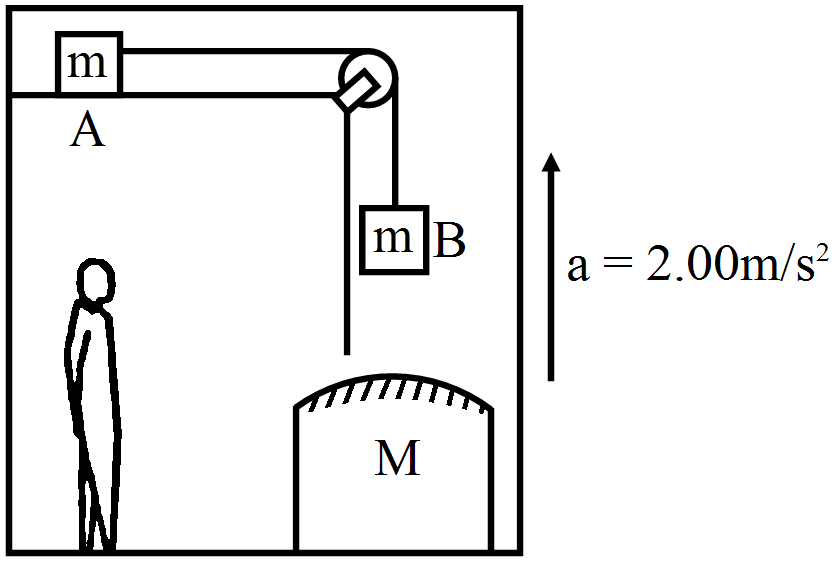
Consider the situation shown in figure. The elevator is going up with an acceleration of $2.00m/s^2$ and the focal length of the mirror is 12.0cm. All the surfaces are smooth and the pulley is light. The mass-pulley system is released from rest (with respect to the elevator) at t = 0 when the distance of B from the mirror is 42.0cm. Find the distance between the image of the block B and the mirror at $t = 0.200s$. Take $g = 10m/s^2$.
(i) Obtain an expression for torque acting on a rectangular current carrying coil in a uniform magnetic field. (ii) Calculate magnetic dipole of a circular electric current loop.
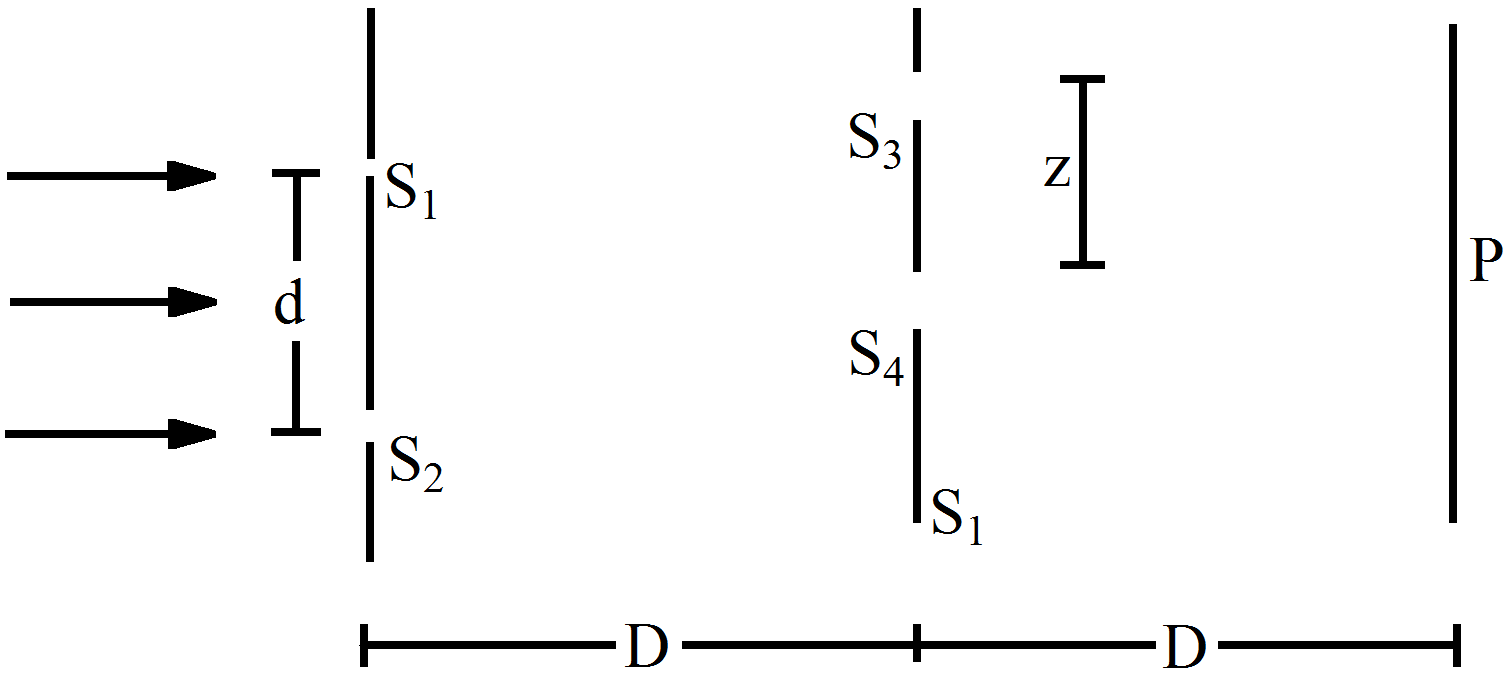
Consider the arrangement shown in figure. By some mechanism, the separation between the slits $S_3$ and $S_4$ can be changed. The intensity is measured at the point P which is at the common perpendicular bisector

of $S_1S_2$ and $S_3S_4.$ When $\text{z}=\frac{\text{D}\lambda}{2\text{d}},$ intensity measured at P is I. Find this intensity when z is equal to:
  1. $\frac{\text{D}\lambda}{\text{d}}$
  2. $\frac{3\text{D}\lambda}{2\text{d}}$
  3. $\frac{2\text{D}\lambda}{\text{d}}$
By explaining diamagnetic, paramagnetic and ferromagnetic substances, analyse their characteristic properties.###Define diamagnetic, paramagnetic and ferromagnetic substances and analyse their characteristics on the basis of (a) reason for magnetic property (b) relative magnetic permeability (c) magnetic susceptibility (d) intensity of magnetisation (e) magnetic induction.
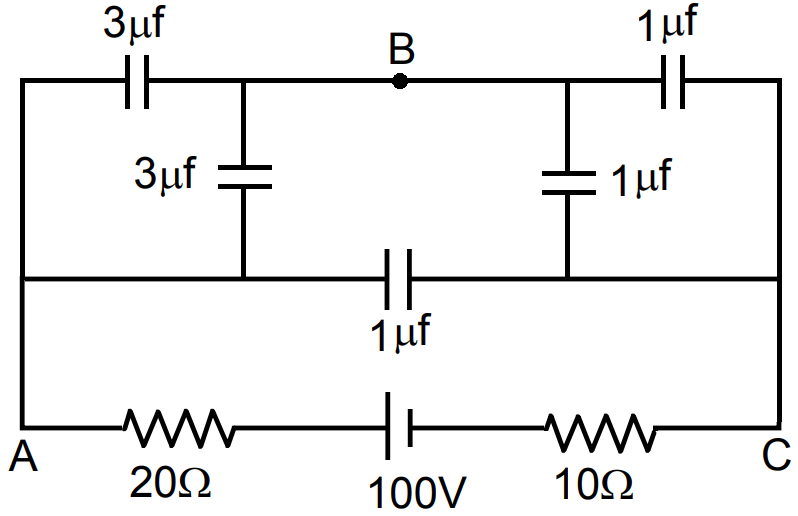
Find the potential difference between the points A and B and between the points B and C of the figure. in steady state.