MCQ
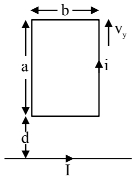
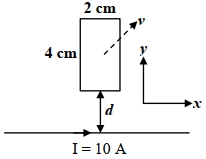
A rectangular conducting loop of length $4 \mathrm{~cm}$ and width $2 \mathrm{~cm}$ is in the $x y$-plane, as shown in the figure. It is being moved away from a thin and long conducting wire along the direction $\frac{\sqrt{3}}{2} \hat{x}+\frac{1}{2} \hat{y}$ with a constant speed $v$. The wire is carrying a steady current $\mathrm{I}=10 \mathrm{~A}$ in the positive $x$-direction. A current of $10 \mu \mathrm{A}$ flows through the loop when it is at a distance $d=4 \mathrm{~cm}$ from the wire. If the resistance of the loop is $0.1 \Omega$, then the value of $v$ is. . . . . . .$\mathrm{ms}^{-1}$.

[Given: The permeability of free space $\mu_0=4 \pi \times 10^{-7} \mathrm{NA}^{-2}$ ]
  • $4$
  • B
    $5$
  • C
    $7$
  • D
    $10$

Answer

Correct option: A.
$4$
a
$\mathrm{R}=0.1 \Omega$

$\varepsilon=\left(\mathrm{B}_1-\mathrm{B}_2\right) \mathrm{bv}_y$

(image)

$\mathrm{i}=\frac{\varepsilon}{\mathrm{R}}=\frac{\mu_0 \mathrm{I}}{2 \pi \mathrm{R}}\left(\frac{1}{\mathrm{~d}}-\frac{1}{\mathrm{~d}+\mathrm{a}}\right) \mathrm{bv}_y$

$\Rightarrow 10^{-5}=\frac{2 \times 10^{-7} \times 10}{0.1}\left[\frac{1}{4}-\frac{1}{8}\right] \times 2 . \mathrm{v}_y$

$\therefore \mathrm{v}_{\mathrm{y}}=2$

$\tan \theta=\frac{\mathrm{v}_z}{\mathrm{v}_z}=\frac{1}{\sqrt{3}}$

(image)

$\therefore \mathrm{v}_{\mathrm{x}}=2 \sqrt{3}$

$\therefore \mathrm{v}=\sqrt{\mathrm{v}_x^2+\mathrm{v}_z^2}=4$

Need a full question paper?

Generate a complete, print-ready paper with questions like this in minutes — across 16+ boards, with answer keys.

Start Generating Free

Similar questions

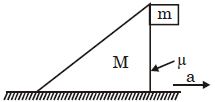
As shown in the figure, block m and wedge $M$ move together with a horizontal acceleration of $20\, m/s^2$. Given $m = 1\, kg$, $\mu = 0.6$ (between $m$ and $M$) and $g = 10\, m/s^2$. Choose the $CORRECT$ alternative :-
In a hydrogen atom, the radius of $n^{th}$ Bohr orbit is $r_n$. The graph between $\log \,\left( {\frac{{{r_n}}}{{{r_1}}}} \right)$ and logn will be
Two waves are propagating to the point $P$ along a straight line produced by two sources $A$ and $B$ of simple harmonic and of equal frequency. The amplitude of every wave at $P$ is $‘a’$ and the phase of $A$ is ahead by $\frac{\pi }{3}$ than that of $B$ and the distance $AP$ is greater than $BP$ by $50 cm.$ Then the resultant amplitude at the point $P$ will be, if the wavelength is $1$ meter
The number of significant figures in all the given numbers $25.12, 2009, 4.156$ and $1.217 \times {10^{ - 4}}$ is
Given below are two statements: One is labelled as Assertion $A$ and the other is labelled as Reason $R$.

Assertion $A:$ Two metallic spheres are charged to the same potential. One of them is hollow and another is solid, and both have the same radii. Solid sphere will have lower charge than the hollow one.

Reason $R:$ Capacitance of metallic spheres depend on the radii of spheres.

In the light of the above statements, choose the correct answer from the options given below.

Coherent sources are characterized by the same
The horizontal range is four times the maximum height attained by a projectile. The angle of projection is  .......... $^o$
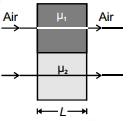
Two light rays initially in same phase travel through two media of equal length $L$ having refractive index $m _1$ and $m_2\left(m_1 > m_2\right)$ as shown in figure. If the wave length of light rays in air is $1$ , the phase difference of the emerging rays is given by
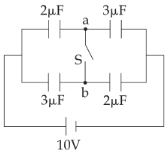
In figure a system of four capacitors connected across a $10\, V$ battery is shown. Charge that will flow from switch $S$ when it is closed is
Consider a parallel plate capacitor of area A (of each plate) and separation 'd' between the plates. If $E$ is the electric field and $\varepsilon_{0}$ is the permittivity of free space between the plates, then potential energy stored in the capacitor is :-