Question
A rectangular courtyard is $18\ m\ 72\ cm$ long and $13\ m\  20\ cm$ broad. it is to be paved with square tiles of the same size. Find the least possible number of such tiles.

Answer

Length of the yard $= 18\ m\ 72\ cm = 1800\ cm + 72\ cm = 1872\ cm$
Breadth of the yard $= 13\ m\ 20\ cm = 1300\ cm + 20\ cm = 1320\ cm$
Area of the yard $= 1872 × 1320 = 2471040$
The size of the square tile of same size needed to the pave the rectangular yard is equal the $HCF$ of the length and breadth of the rectangular yard.
Prime factorisation of length and breadth
$ \therefore 1872=2^4 \times 3^2 \times 13 $
$\therefore 1320=2^3 \times 3 \times 5 \times 11$
$\text { HCF of } 1872 \text { and } 1320=2^3 \times 3=24$
Therefore, length of side of the square tile $= 24\ cm$
Area of the tile $= 24 × 24 = 576cm^2$
Number of tiles required $=\frac{\text{Area of courtyard}}{\text{Area of each tile}}$
$= \frac{2471040}{576} = 4290.$

Need a full question paper?

Generate a complete, print-ready paper with questions like this in minutes — across 16+ boards, with answer keys.
Start Generating Free

Similar questions

$15$ pastries and $12$ biscuit packets have been donated for a school fete. These are to be packed in several smaller identical boxes with the same number of pastries and biscuit packets in each. How many biscuit packets and how many pastries will each box contain$?$
Solve the following quadratic equations by factorization:
$3 x^2=-11 x-10$
A vertical tower stands on a horizontal plane and is surmounted by a vertical flag-staff. At a point on the plane $70$ metres away from the tower, an observer notices that the angles of elevation of the top and the bottom of the flagstaff are respectively $60^\circ $ and $45^\circ $. Find the height of the flag-staff and that of the tower.
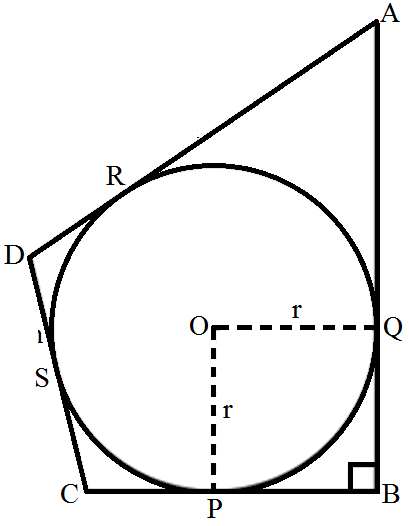
In the given figure, a circle is inscribed in a quadrilateral $ABCD$ in which $\angle\text{B}=90^{\circ}.$ It $AD = 23\ cm, AB = 29\ cm$ and $DS = 5\ cm,$ find the radius $r$ of the circle.
Prove that parallelogram circumscribing a circle is a rhombus.
Find the quadratic polynomial, sum of whose zeros is $\Big(\frac{5}{2}\Big)$ and their product is $1.$ Hence, find the zeros of the polynomial.
A statue, $1.6\ m$ tall, stands on the top of a pedestal. From a point on the ground, the angle of elevation of the top of the statue is $60^\circ$ and from the same point the angle of elevation of the top of the pedestal is $45^\circ$. Find the height of the pedestal.
For what value of k does the system of equations:
$kx + 2y = 5, 3x - 4y = 10$
have;
  1. A unique solution,
  2. No solution?
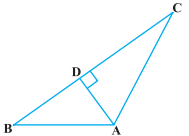
In the given figure, if $AD \bot BC$, prove that $AB^2 + CD^2 = BD^2 + AC^2.$
A solid metallic sphere of diameter $21\ cm$ is melted and recast into a number of smaller cones, each of diameter $3.5\ cm$ and height $3\ cm$ Find the number of cones so formed.