Question
A rectangular current carrying loop is placed 1cm away from a long straight current-carrying conductor as shown.
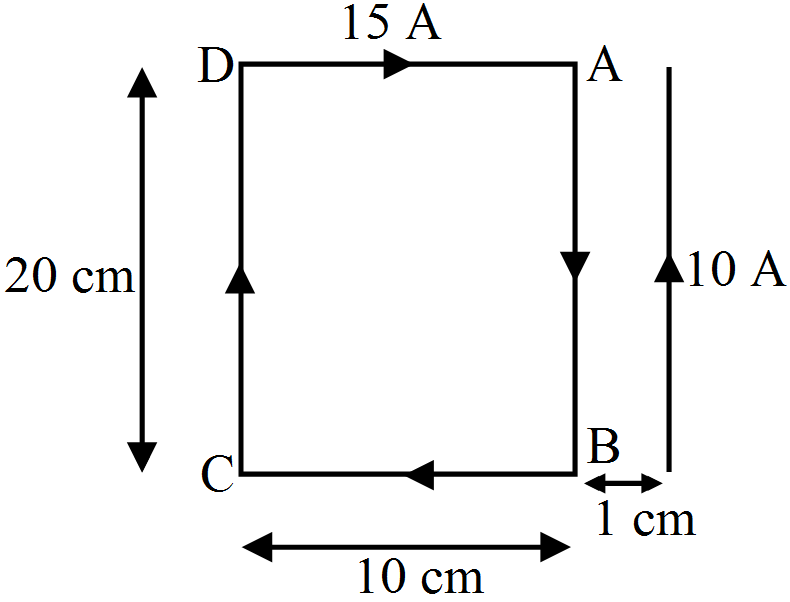
  1. Will the net force acting on the loop due to straight conductor be attractive or repulsive in nature? Justify your answer. Calculate the magnitude of this force.
Answer

The net force acting on the loop will be repulsive in nature.
Justification:
Part AB of the loop will experience a force of repulsion whereas part CD will experience attraction. Parts BC and AD will not experience any force. Thus, the overall force will be a force of repulsion because AB is closer to the straight conductor than CD and the force between two current carrying conductors is inversely proportional to the distance between them.
$\text{F}=\frac{\mu_0}{2\pi}\frac{\text{I}_1\text{I}_2}{\text{r}}\text{l}$
Net Force
Force $F_1 $ on AB due to current in the straight conductor.
$\text{F}_1=\frac{\mu_0}{2\pi}\times\frac{2\times10\times15}{1\times10^{-2}}\times20\times10^{-2}$
$= 3 \times 10^{-4}N$ towards left $\Big(\frac{\mu_0}{2\pi}=10^{-7}\Big)$
Force $F_2$ on CD due to current in thw straight conductor.
$\text{F}_2=\frac{\mu_0}{2\pi}\times\frac{2\times10\times15}{11\times10^{-2}}\times20\times10^{-2}$
$= 0.2725 \times 10^{-4}N$ towards right.
Hence, net force on the loop $= 2.72N$ towards left.

Need a full question paper?

Generate a complete, print-ready paper with questions like this in minutes — across 16+ boards, with answer keys.

Start Generating Free

Similar questions

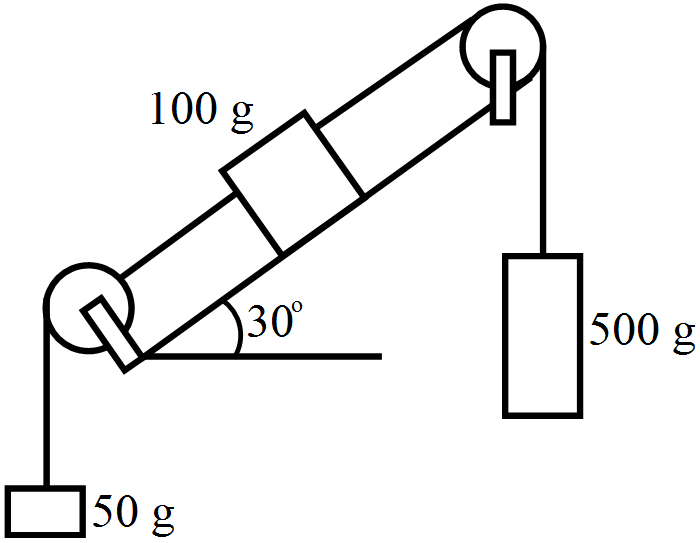
Find the acceleration of the 500g block in figure.
For a glass prism $(\mu=\sqrt{3})$ the angle of minimum deviation is equal to the angle of the prism. Find the angle of the prism.
One mole of an ideal gas undergoes a process $\text{p}=\frac{\text{p}_0}{1+\Big(\frac{\text{V}}{\text{V}_0}\Big)^2}$ where $P_0$ and $V_0$ are constants. Find the temperature of the gas when $V = V_0.$
Sea water at frequency $ν = 4 \times 10^8$Hz has permittivity $\in\approx80\in_0$, permeability $\mu \approx\mu_0$ and resistivity $\rho=0.25\Omega-\text{m}$. Imagine a parallel plate capacitor immersed in sea water and driven by an alternating voltage source $\text{V(t)}=\text{V}_0\sin(2\pi\text{vt})$. What fraction of the conduction current density is the displacement current density?
A small object is placed at the centre of the bottom of a cylindrical vessel of radius 3cm and height 4cm filled completely with water. Consider the ray leaving the vessel through a corner. Suppose this ray and the ray along the axis of the vessel are used to trace the image. Find the apparent depth of the image and the ratio of real depth to the apparent depth under the assumptions taken. Refractive index of water = 1.33
To ensure almost 100 per cent transmittivity, photographic lenses are often coated with a thin layer of dielectric material. The refractive index of this material is intermediated between that of air and glass (which makes the optical element of the lens). A typically used dielectric film is $MgF_2 (n = 1.38).$ What should the thickness of the film be so that at the center of the visible speetrum $(5000\mathring{\text{A}})$ there is maximum transmission.
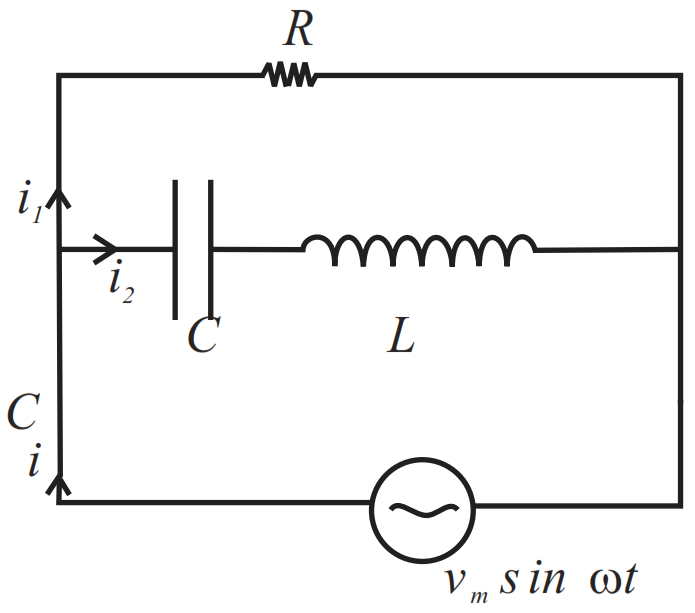
Consider the LCR circuit shown in Fig. Find the net current i and the phase of i. Show that . Find the impedence Z for this circuit.
Find the circuit in the three resistors shown in the figure.
In beta decay, an electron (or a positron) is emitted by a nucleus. Does the remaining atom get oppositely charged?
Mrs. Rashmi Singh broke her reading glasses. When she went to the shopkeeper to order new spects, he suggested that she should get spectacles with plastic lenses instead of glass lenses. On getting the new spectacles, she found that the new ones were thicker than the earlier ones. She asked this question to the shopkeeper but he could not offer satisfactory explanation for this. At home, Mrs. Singh raised the same question to her daughter Anuja who explained why plastic lenses were thicker.
  1. Write two qualities displayed each by Anuja and her mother.
  2. How do you explain this fact using lens maker's formula?