MCQ
A rectangular loop carrying a current $i$ is placed in a uniform magnetic field $B$. The area enclosed by the loop is $A$. If there are n turns in the loop, the torque acting on the loop is given by
  • $ni\,\overrightarrow A \times \overrightarrow B $
  • B
    $ni\,\overrightarrow A \cdot \overrightarrow B $
  • C
    $\frac{1}{n}(i\overrightarrow A \times \overrightarrow B )$
  • D
    $\frac{1}{n}(i\overrightarrow A \cdot \overrightarrow B )$

Answer

Correct option: A.
$ni\,\overrightarrow A \times \overrightarrow B $
a
(a) $\vec{\tau}=\vec{M} \times \vec{B}$

$=n i(\vec{A} \times \vec{B})(\because \vec{M}=n i \vec{A})$

Need a full question paper?

Generate a complete, print-ready paper with questions like this in minutes — across 16+ boards, with answer keys.

Start Generating Free

Similar questions

In photoelectric effect when photons of energy $h \nu$ fall on a photosensitive surface (work function $h v_0$ ) electrons are emitted from the metallic surface. It is possible to say that
The figure shows a bar magnet and a metallic coil. Consider four situations:

$(I)$ Moving the magnet away from the coil.

$(II)$ Moving the coil towards the magnet.

$(III)$ Rotating the coil about the vertical diameter.

$(IV)$ Rotating the coil about its axis.

An emf in the coil will be generated for the following situations.

An e.m.f. of 12 volt is produced in a coil when the current in it changes at the rate of 45 amp/minute. The inductance of the coil is
A conducting circular loop is placed in a uniform magnetic field of $0.4\,T$ with its plane perpendicular to the field. Somehow, the radius of the loop starts expanding at a constant rate of $1\,mm / s$. The magnitude of induced emf in the loop at an instant when the radius of the loop is $2\,cm$ will be $...........\,\mu V$.
A $220V$ main supply is connected to a resistance of $100\text{k}\Omega$ The effective current is?
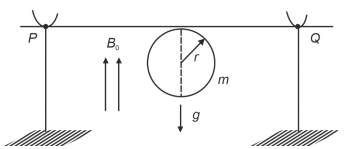
A thin stiff insulated metal wire is bent into a circular loop with its two ends extending tangentially from the same point of the loop. The wire loop has mass $m$ and radius $r$ and it is in a uniform vertical magnetic field $B_0$, as shown in the figure. Initially, it hangs vertically downwards, because of acceleration due to gravity $g$, on two conducting supports at $P$ and $Q$. When a current $/$ is passed through the loop, the loop turns about the line $P Q$ by an angle $\theta$ given by
A double convex thin lens made of glass (refractive index $\mu  = 1.5$) has both radii of curvature of magnitude $20 cm$. Incident light rays parallel to the axis of the lens will converge at a distance $L$ such that......$cm$
Sodium has body centred packing. If the distance between two nearest atoms is 3.7 Å, then its lattice parameter is
Given below are two statements : one is labelled as Assertion $A$ and the other is labelled as Reason $R$.

Assertion $A$: A bar magnet dropped through a metallic cylindrical pipe takes more time to come down compared to a non-magnetic bar with same geometry and mass.

Reason $R$: For the magnetic bar, Eddy currents are produced in the metallic pipe which oppose the motion of the magnetic bar.

In the light of the above statements, choose the correct answer from the options given below

The phenomenon of diffraction of light was discovered by