Question
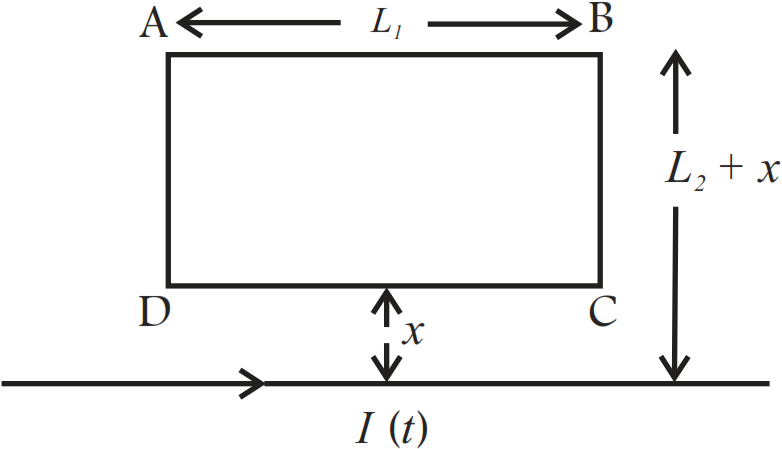
A rectangular loop of wire ABCD is kept close to an infinitely long wire carrying a current $\text{I}(\text{t})=\text{I}_0\Big(1-\frac{\text{t}}{\text{T}}\Big)$ for 0 and I(0) = 0 for t > T (Fig). Find the total charge passing through a given point in the loop, in time T. The resistance of the loop is R.
Answer

To find the charge that passes through the circuit first we have to find the relation between instantaneous current and instantaneous magnetic flux linked with it. The emf induced can be obtained by differentiating the expression of magnetic flux linked w.r.t. t and then applying Ohm's law, we get
$\text{I}=\frac{\text{E}}{\text{R}}=\frac{1}{\text{R}}\frac{\text{d}\phi}{\text{dt}}$
According to the problem electric current is given as a function of time.
$\text{I(t)}=\frac{\text{dQ}}{\text{dt}}\text{ or }\frac{\text{dQ}}{\text{dt}}=\frac{1}{\text{R}}\frac{\text{d}\phi}{\text{dt}}$
Integrating the variable separately in the form of differential equation for finding the charge Q that passed in time t, we have
$\text{Q}(\text{t}_1)=\text{Q}(\text{t}_2)=\frac{1}{\text{R}}\big[\phi(\text{t}_1)-\phi(\text{t}_2)\big]$
$\phi(\text{t}_1)\text{L}_1\frac{\mu_0}{2\pi}\int_\text{x}^{\text{L}_2+\text{x}}\frac{\text{dx}'}{\text{x}'}\text{I}(\text{t}_1)$ [Refer to the Eq. (i) of answer no. 25]
$=\frac{\mu_0\text{L}_1}{2\pi}\text{I}(\text{t}_1)\text{in}\frac{\text{L}_2+\text{x}}{\text{x}}$
Therefore the magnitude of charge is
$\text{Q}=\frac{1}{\text{R}}[\phi(\text{T})-\phi(0)]$
$\text{Q}=\frac{\mu_0\text{L}_1}{2\pi}\text{ in }\frac{\text{L}_2+\text{x}}{\text{x}}[\text{I}(\text{T})-\text{I}(0)]$
Now I(T) = 0 and I(0) = 1.
$\therefore\ \text{Q}=\frac{\mu_0\text{L}_1}{2\pi}\text{I}_0\text{ in }\bigg(\frac{\text{L}_2+\text{x}}{\text{x}}\bigg)$
This is the required expression.

Need a full question paper?

Generate a complete, print-ready paper with questions like this in minutes — across 16+ boards, with answer keys.

Start Generating Free

Similar questions

Is it possible that in a Coolidge tube characteristic $\text{L}_\alpha$ X-rays are emitted but not $\text{K}_\alpha$ X-rays?
Two current-carrying wires may attract each other. In absence of other forces, the wires will move towards each other increasing the kinetic energy. Does it contradict the fact that the magnetic force cannot do any work and hence cannot increase the kinetic energy?
The work function of a photoelectric material is 4.0eV.
  1. What is the threshold wavelength?
  2. Find the wavelength of light for which the stopping potential is 2.5V.
What is a voltmeter? How can a galvanometer be converted into a voltmeter of given range? Explain.
Assume that a tunnel is dug across the earth (radius = R) passing through its centre. Find the time a particle takes to cover the length of the tunnel if,
  1. It is projected into the tunnel with a speed of $\sqrt{\text{gR}}.$
  2. It is released from a height R above the tunnel.
  3. It is thrown vertically upward along the length of tunnel with a speed of $\sqrt{\text{gR}}.$
Two parallel coaxial circular coils of equal radius ‘R’ and equal number of turns ‘N’, carry equal currents ‘I’ in the same direction and are separated by a distance ‘2R’. Find the magnitude and direction of the net magnetic field produced at the mid-point of the line joining their centres.
Two wires carrying equal currents i each, are placed perpendicular to each other, just avoiding a contact. If one wire is held fixed and the other is free to move under magnetic forces, what kind of motion will result?
If the nucleons of a nucleus are separated from each other, the total mass is increased. Where does this mass come from?
When a proton is released from rest in a room, it starts with an initial acceleration a0 towards west. When it is projected towards north with a speed v0, it moves with an initial acceleration 3a0 towards west. Find the electric field and the maximum possible magnetic field in the room.
A reference frame attached to the earth:
  1. Is an inertial frame by definition.
  2. Cannot be an inertial frame because the earth is revolving around the sun.
  3. Is an inertial frame because Newton's laws are applicable in this frame.
  4. Cannot be an inertial frame because the earth is rotating about its axis.