A resistor dissipates $192\, {J}$ of energy in $1\, {s}$ when a current of $4\, {A}$ is passed through it. Now, when the current is doubled, the amount of thermal energy dissipated in $5 \,{s}$ in $.....\,J.$
JEE MAIN 2021, Medium


Download our appand get started for free
Experience the future of education. Simply download our apps or reach out to us for more information. Let's shape the future of learning together!No signup needed.*
Similar Questions
- 1View SolutionIdentify the set in which all the three materials are good conductors of electricity
- 2$n$ identical bulbs, each designed to draw a power $p$ from a certain voltage supply, are joined in series across that supply. The total power which they will draw isView Solution
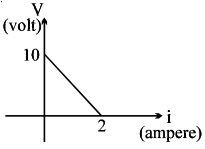
- 3$A$ battery of $\mathrm{emf}$ $E$ and internal resistance $r$ is connected across a resistance $R$. Resistance $R$ can be adjusted to any value greater than or equal to zero. Agraph is plotted between the current $(i)$ passing through the resistance and potential difference $(V) $ across it. Select the correct alternative $(s)$.View Solution
- 4A wire of resistance $R$ is divided in $10$ equal parts. These parts are connected in parallel, the equivalent resistance of such connection will beView Solution
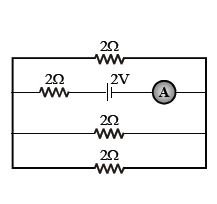
- 5View SolutionThe reading of the ammeter as shown in figure
- 6A heater draws a current of $2\,A$ when connected to a $250\,V$ source. The rate of energy dissipation is ............. $W$View Solution
- 7Two rods of same material and length have their electric resistance in ratio $1:2$. When both rods are dipped in water, the correct statement will beView Solution
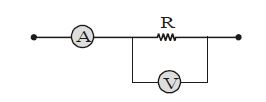
- 8In the circuit shown the readings of ammeter and voltmeter are $4\,\, A$ and $20\,\, V$ respectively. The meters are non ideal, then $R$ isView Solution
- 9View SolutionConsider four circuits shown in the figure below. In which circuit power dissipated is greatest (Neglect the internal resistance of the power supply)
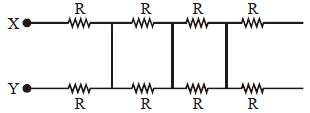
- 10Net resistance between $X$ and $Y$ isView Solution