MCQ
A resistor $R_1$ dissipates the power P when connected to a certain generator. If the resistor $R_2$ is put in series with $R_1$, the power dissipated by $R_1$
  • Decreases
  • B
    Increases
  • C
    Remains the same
  • D
    Any of the above depending upon the relative values of $R_1$ and v
Answer

Correct option: A.
Decreases
(a) Decreases

Need a full question paper?

Generate a complete, print-ready paper with questions like this in minutes — across 16+ boards, with answer keys.

Start Generating Free

Similar questions

If atmospheric electric field is approximately $150 \,volt / m$ and radius of the earth is $6400 \,km$, then the total charge on the earth's surface is .......... coulomb
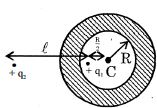
A solid conducting sphere has cavity, as shown in figure. A charge $+ {q_1}$ is situated away from the centre. A charge $+q_2$ is situated outside the sphere then true statement is
2μF capacitance has potential difference across its two terminals 200 volts. It is disconnected with battery and then another uncharged capacitance is connected in parallel to it, then P.D. becomes 20 volts. Then the capacity of another capacitance will be
Gauss’s law is true only if force due to a charge varies as:
In the Young's double slit experiment, the ratio of intensities of bright and dark fringes is 9. This means that
The grid in a triode valve is used
A charge of Q coulomb is placed on a solid piece of metal of irregular shape. The charge will distribute itself
Two identical coils of radius $R$ and number of turns $N$ are placed perpendicular to each others in such a way that they have common centre. The current through them are $I$ and $I\sqrt 3$ . The resultant intensity of magnetic field at the centre of the coil will be  (in $weber/m^2)2$
The space inside a straight current carrying solenoid is filled with a magnetic material having magnetic susceptibility equal to $1.2 \times 10^{-5}$. What is fractional increase in the magnetic field inside solenoid with respect to air as medium inside the solenoid?
In an inductor of self-inductance $L = 2\,mH,$ current changes with time according to relation $i = t^2e^{-t}$. At what time $emf$ is zero?.....$s$