Question
A resistor R and an inductor L are connected in series to a source $\text{V}=\text{V}_0\sin\omega\text{t}.$
Find:
  1. Peak value of the voltage drops across R and across L,
  2. Phase difference between the applied voltage and current. Which of them is ahead?
Answer

$\text{V}=\text{v}_0\sin\omega\text{t}$
$\text{X}_\text{L}=\omega\text{L}$
$\text{z}=\sqrt{\text{R}^2+\text{X}_\text{L}^2}=\sqrt{\text{R}^2+(\omega\text{L)}^2}$
Now,
Current $=\frac{\text{V}_0}{\sqrt{\text{R}^2+(\omega\text{L})^2}}$
  1. Now, voltage drope accurs resestev = R
$=\frac{\text{V}_0\text{R}}{\sqrt{\text{R}^2+\omega^2\text{L}^2}}$

Voltage drop accurs, reduse,

$=1\text{X}_\text{L}$

$=\frac{(\omega\text{L)}}{\sqrt{\text{X}^2+\omega^2\text{L}^2}}$
  1. Phase Difference,
$\tan\theta=\frac{\text{X}_\text{L}}{\text{R}}$

And resistance lead to the Inductance.

Need a full question paper?

Generate a complete, print-ready paper with questions like this in minutes — across 16+ boards, with answer keys.

Start Generating Free

Similar questions

(a) Determine the electrostatic potential energy of a system consisting of two charges $7 \mu C$ and $-2 \mu C$ (and with no external field) placed at ( $-9 cm , 0,0)$ and $(9 cm , 0,0)$ respectively.
(b) How much work is required to separate the two charges infinitely away from each other?
(c) Suppose that the same system of charges is now placed in an external electric field $E=A\left(1 / r^2\right) ; A=9 \times 10^5 NC ^{-1} m ^2$. What would the electrostatic energy of the configuration be?
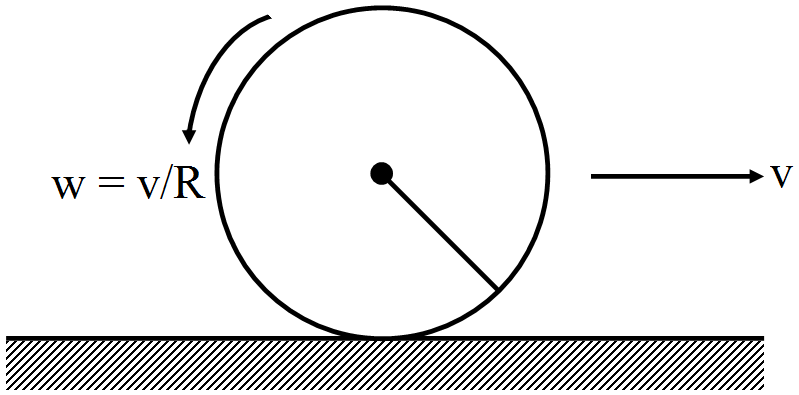
A solid sphere is set into motion on a rough horizontal surface with a linear speed v in the forward direction and an angular speed $\frac{\text{v}}{\text{R}}$ in the anticlockwise direction as shown in figure. Find the linear speed of the sphere:
  1. When it stops rotating.
  2. When slipping finally ceases and pure rolling starts.
Write Einstein's Photoelectric equation and mention which important features in photoelectric effect can be explained with the help of this equation.
The maximum kinetic energy of the photoelectrons gets doubled when the wavelength of light incident on the surface changes from $\lambda_{1}$to $\lambda_{2}$. Derive the expressions for the threshold wavelength $\lambda_{\circ}$ and work function for the metal surface.
Explain the shortcomings of Bohr's Theory.
Suppose the platform with the kid in the previous problem is rotating in anticlockwise direction at an angular speed $\omega.$ The kid starts walking along the rim with a speed v relative to the platform also in the anticlockwise direction. Find the new angular speed of the platform.
  1. Draw a schematic diagram of a reflecting telescope.
  2. State the advantages of reflecting telescope over refracting telescope.
Radioactive isotopes are produced in a nuclear physics experiment at a constant rate $\frac{\text{dN}}{\text{dt}}=\text{R}.$ An inductor of inductance 100mH, a resistor of resistance $100\Omega$ and a battery are connected to form a series circuit. The circuit is switched on at the instant the production of radioactive isotope starts. It is found that $\frac{\text{i}}{\text{N}}$ remains constant in time where i is the current in the circuit at time t and N is the number of active nuclei at time t. Find the half-life of the isotope.
What is the power dissipated in an ac circuit in which voltage and current are given by $\text{V}=230\sin(\omega\text{t}+\frac{\pi}{2})$ and $\text{I}=10\sin\omega\text{t}?$
A capacitor of unknown capacitance, a resistor of 100 $\Omega$ and an inductor of self inductance L = $( 4 /\pi^{2})$henry are connected in series to an ac source of 200V and 50 Hz. Calculate the value of the capacitance and impedance of the circuit when the current is in phase with the voltage. Calculate the power dissipated in the circuit.
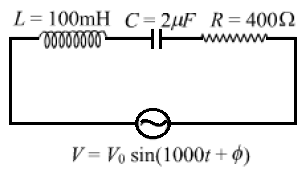
  1. Find the value of the phase difference between the current and the voltage in the series LCR circuit shown below. Which one leads in phase: current or voltage?
  2. Without making any other change, find the value of the additional capacitor $C_1,$ to be connected in parallel with the capacitor C, in order to make the power factor of the circuit unity.