Question
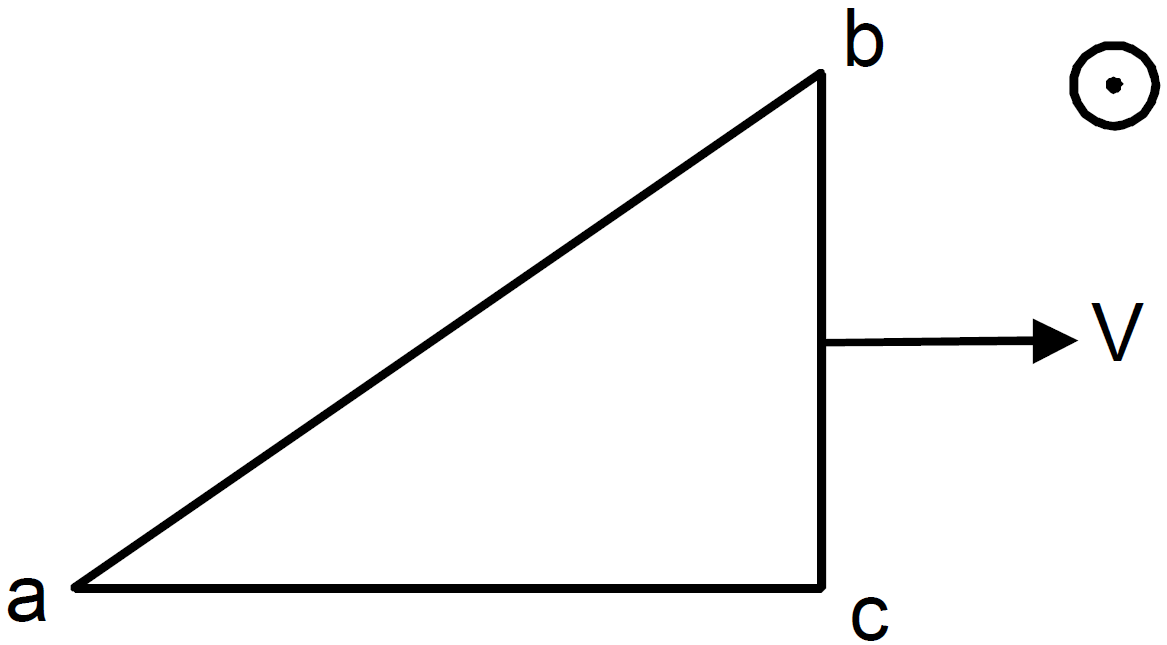
A right-angled triangle abc, made from a metallic wire, moves at a uniform speed v in its plane as shown in figure. A uniform magnetic field B exists in the perpendicular direction. Find the emf induced:
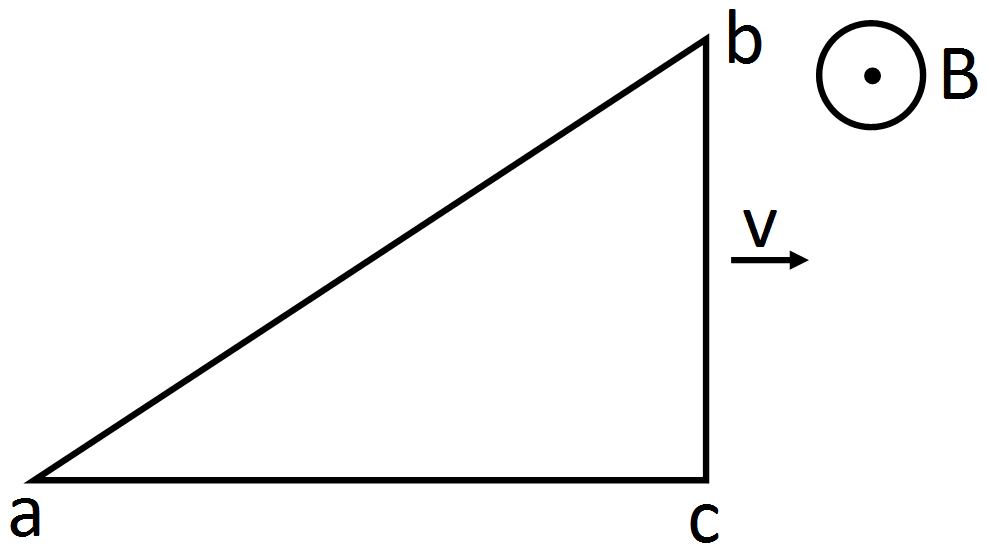
  1. In the loop abc.
  2. In the segment bc.
  3. In the segment ac.
  4. In the segment ab.

Answer


  1. Zero as the components of ab are exactly opposite to that of bc. So they cancel each other. Because velocity should be perpendicular to the length.
  2. e = Bv × l

= Bv(bc) + ve at C

  1. e = 0 as the velocity is not perpendicular to the length.
  2. e = Bv(bc) positive at ‘a’.

i.e. the component of ‘ab’ along the perpendicular direction.

Need a full question paper?

Generate a complete, print-ready paper with questions like this in minutes — across 16+ boards, with answer keys.

Start Generating Free

Similar questions

A paisa coin is made up of Al-Mg alloy and weighs 0.75g. It has a square shape and its diagonal measures 17mm. It is electrically neutral and contains equal amounts of positive and negative charges.
Treating the paisa coins made up of only Al, find the magnitude of equal number of positive and negative charges. What conclusion do you draw from this magnitude?
Positive charge Q is distributed uniformly over a circular ring of radius R. A particle having a mass m and a negative charge q, is placed on its axis at a distance x from the centre. Find the force on the particle. Assuming x << R, find the time period of oscillation of the particle if it is released from there.
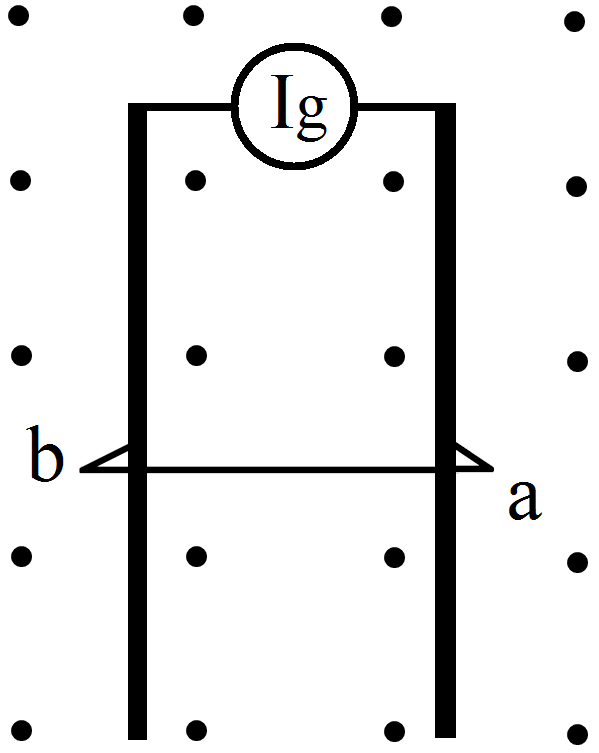
The system containing the rails and the wire of the previous problem is kept vertically in a uniform horizontal magnetic field B that is perpendicular to the plane of the rails (figure). It is found that the wire stays in equilibrium. If the wire ab is replaced by another wire of double its mass, how long will it take in falling through a distance equal to its length?

A parallel-plate capacitor of plate area 40cm2 and separation between the plates 0.10mm, is connected to a battery of emf 2.0V through a $16\Omega$ resistor. Find the electric field in the capacitor 10ns after the connections are made.
  1. In the explanation of photo electric effect, we asssume one photon of frequency ν collides with an electron and transfers its energy. This leads to the equation for the maximum energy Emax of the emitted electron as,

$\text{E}_\text{max}=\text{hv}-\phi_0$

where $\phi_0$ is the work function of the metal. If an electron absorbs 2 photons (each of frequency ν ) what will be the maximum energy for the emitted electron?

  1. Why is this fact (two photon absorption) not taken into consideration in our discussion of the stopping potential?
A simple pendulum is constructed by hanging a heavy ball by a 5.0m long string. It undergoes small oscillations.
  1. How many oscillations does it make per second?
  2. What will be the frequency if the system is taken on the moon where acceleration due to gravitation of the moon is 1.67m/s2.
  1. Deduce an expression for the frequency of revolution of a charged particle in a magnetic field and show that it is independent of velocity or energy of the particle.
  2. Draw a schematic sketch of a cyclotron. Explain, giving the essential details of its construction, how it is used to accelerate the charged particles.
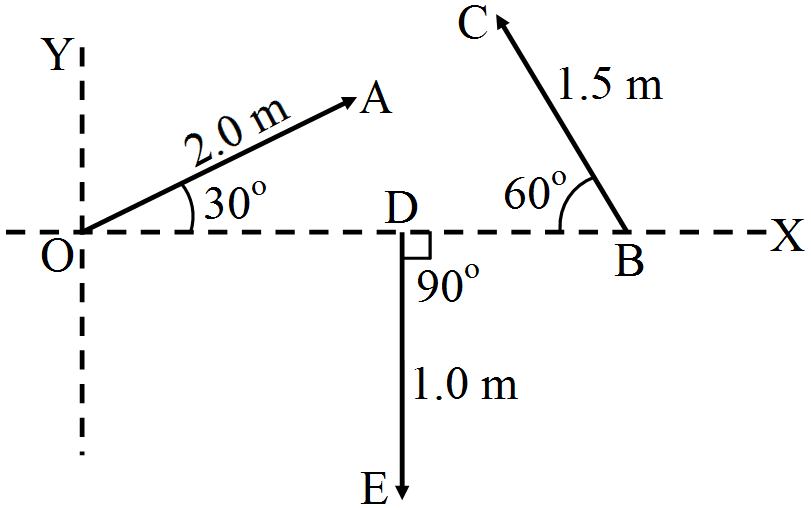
Refer to figure. Find
  1. The magnitude.
  2. x and y components
  3. The angle with the X-axis of the resultant of $\overrightarrow{\text{OA}},\overrightarrow{\text{BC}}$ and $\overrightarrow{\text{DE}}.$
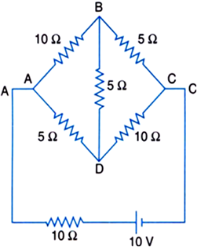
Determine the current in each branch of the network shown in Fig.:

An electron is projected horizontally with a kinetic energy of 10keV. A magnetic field of strength 1.0 × 10⁻⁷T exists in the vertically upward direction.
  1. Will the electron deflect towards the right or left of its motion?
  2. Calculate the sideways deflection of the electron while travelling through 1m. Make appropriate approximations.