Question
A right angled triangle with sides 3cm and 4cm is revolved around its hypotenuse. Find the volume of the double cone thus generated.
Answer

In right angled $\triangle\text{ABC}$ ,$ \angle\text{B}=90°$
AB = 3cm and BC = 4cm
$\therefore$ Diagonal CA $=\sqrt{\text{AB}^2+\text{BC}^2}$ (pythagoras theorem)
$=\sqrt{(3)^2+(4)^2}=\sqrt{9+16}=\sqrt{25}=5\text{cm}$

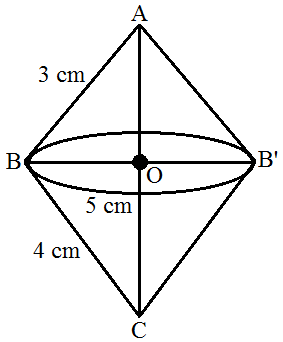
We get double cones as shown in the figure BB' is joined which bisects by AC ar O at right angles
In $\triangle\text{ABC},\angle\text{B}=90^\circ$
$\therefore$ area $(\triangle\text{ABC})=\frac{3\times4}{2}=6\text{cm}^2$
and area $(\triangle\text{ABC})=\frac{1}{2}\text{AC}\times\text{BO}$
$\Rightarrow6=\frac{1}{2}\times5\times\text{BO}$
$\Rightarrow\text{BO}=\frac{6\times2}{5}=\frac{12}{5}=2.4\text{cm}$
$\therefore$ Radius of cone along AO is BO which iscm and Also along CO is BO which is 2.4cm Now volumes of two cones so formes
$=\frac{1}{3}\pi\text{r}^2\times\text{AO}+\frac{1}{3}\pi\text{r}^2\times\text{CO}$
$=\frac{1}{3}\pi\text{r}^2(\text{AO}+\text{CO})=\frac{1}{3}\pi\text{r}^2\times\text{AC}$
$=\frac{1}{3}\times\frac{22}{7}\times(2.4)^2\times5\text{cm}^3$
$=\frac{22}{21}\times5.76\times5\times\text{cm}^3=\frac{110\times1.92}{7}\text{cm}^2$
$=\frac{211.20}{7}\text{cm}^3$
$=\frac{21120}{7\times100}=\frac{1056}{35}\text{cm}^3$
$=30\frac{6}{35}\text{cm}^3$

Need a full question paper?

Generate a complete, print-ready paper with questions like this in minutes — across 16+ boards, with answer keys.

Start Generating Free

Similar questions

Solve the following quadratic equation: $4 x^2-4 a^2 x+\left(a^4-b^4\right)=0$
To find out the concentration of $S0_2$​​​​​​​ in the air (in parts per million, i.e., ppm), the data was collected for 30 localities in a certain city and is presented below:
Concentration of $SO_2$ (in ppm)
Frequency
0.00-0.04
4
0.04-0.08
9
0.08-0.12
9
0.12-0.16
2
0.16-0.20
4
0.20-0.24
2
Find the mean concentration of $SO_2$​​​​​​​ in the air.
A solid iron pole consists of a solid cylinder of height $200 \ cm$ and base diameter $28 \ cm$ , which is surmounted by another cylinder of height $50 \ cm$ and radius $7 \ cm$ . Find the mass of the pole, given that $1 \ cm^3$ of iron has approximately $8 g$ mass.
The first and the last terms of an A.P. are 7 and 49 respectively. If sum of all its terms is 420, find its common difference.
What is the sum of first n terms of the AP a, 3a, 5a, ....
Find the zeros of the following quadratic polynomial and verify the relationship between the zeros and their coefficients:
$\text{q(y)}=7\text{y}^2+\frac{11}{3}\text{y}-\frac{2}{3}$
An observer 1.5m talI is 30m away from a chimney. the angle of elevation of the top of the chimney from his eye is 60°. Find the height of the chimney.
If the roots of the equation$ (a^2 + b^2)x^2 - 2(ac + bd)x + (c^2 + d^2) = 0$ are equal, prove that $\frac{\text{a}}{\text{b}}=\frac{\text{c}}{\text{d}}$
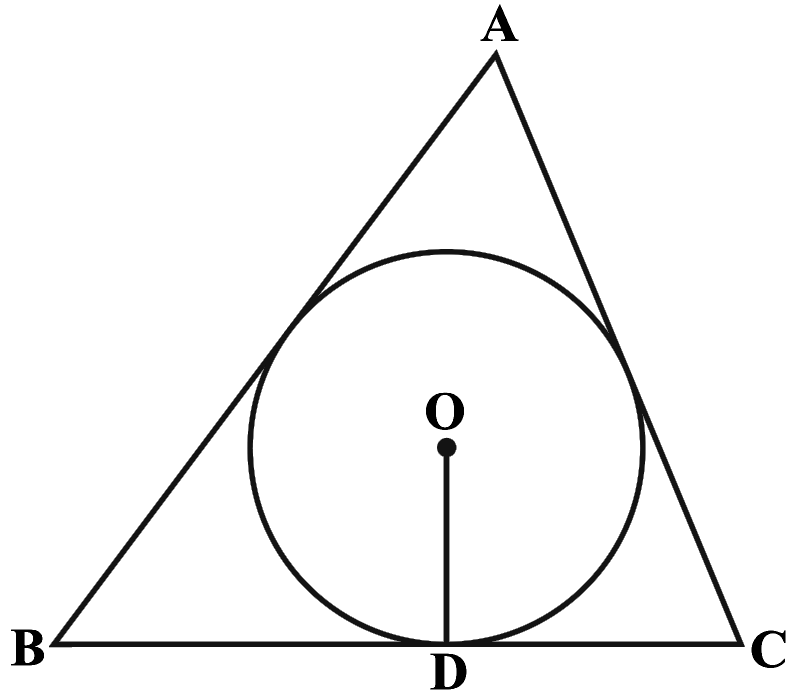
In the given figure, a triangle ABC is drawn to circumscribe a circle of radius 2cm such that the segments BD and DC into which BC is divided by the point of contact D, are of lengths 4cm and 3cm respectively. If the area of $\triangle\text{ABC} = 21\text{cm}^2$ then find the lengths of sides of AB and AC.
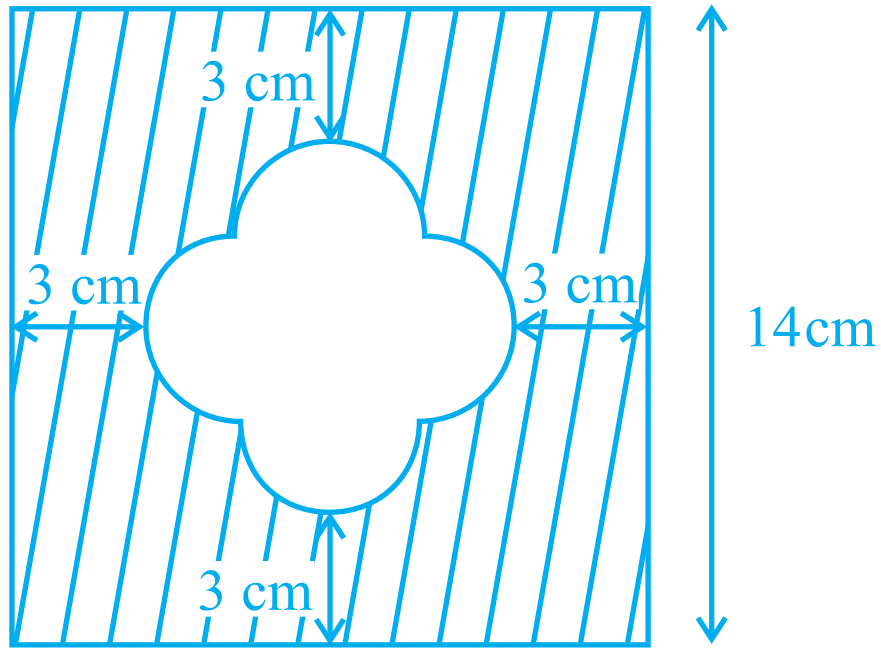
Find the area of the shaded region given in Fig.