Question
A right triangle whose sides are $15\ cm$ and $20\ cm$ (other than hypotenuse), is made to revolve about its hypotenuse. Find the volume and surface area of the double cone so formed. (Choose value of $\pi$ as found appropriate)
Answer


We have,
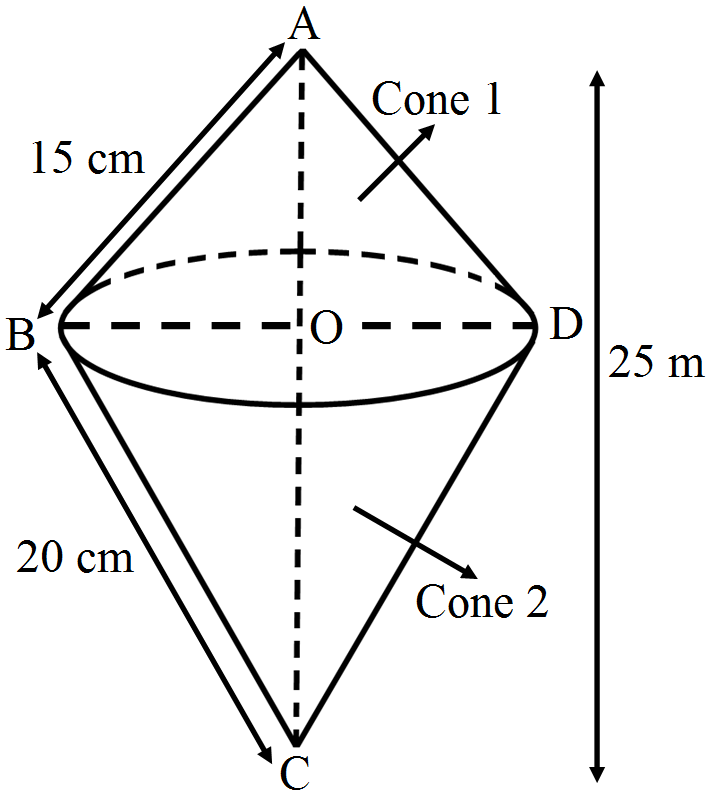
In $\Delta\text{ABC},\ \angle\text{B}=90^\circ,\ \text{AB}=\text{l}_1=15\text{cm}$ and $\text{BC}=\text{l}_2=20\text{cm}$
Let $\text{OD}=\text{OB}=\text{r},\ \text{AO}=\text{h}_1$ and $\text{CO}=\text{h}_2$
Using Pythagoras theorem,
$\text{AC}=\sqrt{\text{AB}^2+\text{BC}^2}$
$=\sqrt{15^2+20^2}$
$=\sqrt{225+400}$
$=\sqrt{625}$
$\Rightarrow\text{h}=25\text{cm}$
As, ar $(\Delta\text{ABC})=\frac{1}{2}\times\text{AC}\times\text{BO}=\frac{1}{2}\times\text{AB}\times\text{BC}$
$\Rightarrow\text{AC}\times\text{BO}=\text{AB}\times\text{BC}$
$\Rightarrow25\text{r}=15\times20$
$\Rightarrow\text{r}=\frac{15\times20}{25}$
$\Rightarrow\text{r}=12\text{cm}$
Now,
Volume of the double cone so formed = Volume of cone $1 +$ Volume of cone $2$
$=\frac{1}{3}\pi\text{r}^2\text{h}_1+\frac{1}{3}\pi\text{r}^2\text{h}_2$
$=\frac{1}{3}\pi\text{r}^2(\text{h}_1+\text{h}_2)$
$=\frac{1}{3}\pi\text{r}^2\text{h}$
$=\frac{1}{3}\times\times3.14\times12\times12\times25$
$=3768\text{cm}^3$
Also,
Surace area of the solid so formed $= CAS$ of cone $1 + CSA$ of cone $2$
$=\pi\text{rl}_1+\pi\text{rl}_2$
$=\pi\text{r}(\text{l}_1+\text{l}_2)$
$=\frac{22}{7}\times12\times(15+20)$
$=\frac{22}{7}\times12\times35$
$=1320\text{cm}^2$

Need a full question paper?

Generate a complete, print-ready paper with questions like this in minutes — across 16+ boards, with answer keys.
Start Generating Free

Similar questions

A train covered a certain distance at a uniform speed. If the train could have been $10\ km/hr$. faster, it would have taken $2$ hours less than the scheduled time. And, if the train were slower by $10\ km/hr$. it would have taken $3$ hours more than the scheduled time. Find the distance covered by the train.
The sum of the first $7$ terms of an $AP$ is $182$. If its $4^{th}$ and $17^{th}$ terms are in the ratio $1 : 5,$ find the $AP.$
In the given figure, $PQ = 24\ cm, PR = 7\ cm$ and $O$ is the centre of the circle. Find th area of the shaded region. $\big[\text{Take }\pi=3.14\big]$
Calculate the missing frequency from the following distribution, it being given that the median of the distribution
Age in years $0-10$ $10-20$ $20-30$ $30-40$ $40-50$
No. of persons $5$ $25$ $?$ $18$ $7$
The first term of an $A.P$. is $5$ and its $100^{th}$ term is -292. Find the $50^{th}$ term of this $A.P.$
The following table shows the marks scored by $140$ students in an examination of a certain paper:
Marks $0-12$ $10-20$ $20-30$ $30-40$ $40-50$
Number of students $20$ $24$ $40$ $36$ $20$
Calculate the average marks by using all the three methods: direct method, assumed mean deviation and shortcut method.
The following table gives the literacy rate $($in percentage$)$ of $35$ cities. Find the mean literacy rate.
Literacy rate $($in $\%)$ $45-55$ $55-65$ $65-75$ $75-85$ $85-95$
Number of cities $3$ $10$ $11$ $8$ $3$
If $12^{th}$ term of an $A.P$. is -$13$ and the sum of the first four terms is $24$, what is the sum of first $10$ terms?
$D$ and $E$ are points on the sides $A B$ and $A C$ respectively of a $\triangle A B C$. In the following cases, determine whether $D E \| B C$ or not.
$AB=11.7 cm, AC=11.2 cm, BD=6.5 cm \text { and } AE=4.2 cm .$

Find the values of a and b for which the following system of equations has infinitely many solutions:
$(a - 1)x + 3y = 2$
$6x + (1 - 2b)y = 6$