Question
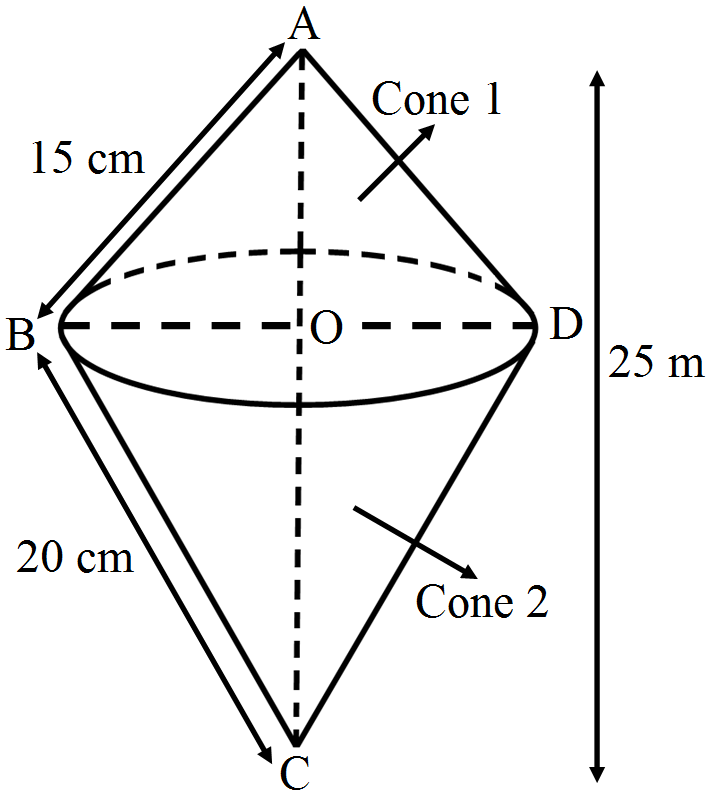
A right triangle whose sides are 15cm and 20cm (other than hypotenuse), is made to revolve about its hypotenuse. Find the volume and surface area of the double cone so formed. (Choose value of $\pi$ as found appropriate)
Answer


We have,
In $\Delta\text{ABC},\ \angle\text{B}=90^\circ,\ \text{AB}=\text{l}_1=15\text{cm}$ and $\text{BC}=\text{l}_2=20\text{cm}$
Let $\text{OD}=\text{OB}=\text{r},\ \text{AO}=\text{h}_1$ and $\text{CO}=\text{h}_2$
Using Pythagoras theorem,
$\text{AC}=\sqrt{\text{AB}^2+\text{BC}^2}$
$=\sqrt{15^2+20^2}$
$=\sqrt{225+400}$
$=\sqrt{625}$
$\Rightarrow\text{h}=25\text{cm}$
As, ar $(\Delta\text{ABC})=\frac{1}{2}\times\text{AC}\times\text{BO}=\frac{1}{2}\times\text{AB}\times\text{BC}$
$\Rightarrow\text{AC}\times\text{BO}=\text{AB}\times\text{BC}$
$\Rightarrow25\text{r}=15\times20$
$\Rightarrow\text{r}=\frac{15\times20}{25}$
$\Rightarrow\text{r}=12\text{cm}$
Now,
Volume of the double cone so formed = Volume of cone 1 + Volume of cone 2
$=\frac{1}{3}\pi\text{r}^2\text{h}_1+\frac{1}{3}\pi\text{r}^2\text{h}_2$
$=\frac{1}{3}\pi\text{r}^2(\text{h}_1+\text{h}_2)$
$=\frac{1}{3}\pi\text{r}^2\text{h}$
$=\frac{1}{3}\times\times3.14\times12\times12\times25$
$=3768\text{cm}^3$
Also,
Surace area of the solid so formed = CAS of cone 1 + CSA of cone 2
$=\pi\text{rl}_1+\pi\text{rl}_2$
$=\pi\text{r}(\text{l}_1+\text{l}_2)$
$=\frac{22}{7}\times12\times(15+20)$
$=\frac{22}{7}\times12\times35$
$=1320\text{cm}^2$

Need a full question paper?

Generate a complete, print-ready paper with questions like this in minutes — across 16+ boards, with answer keys.
Start Generating Free

Similar questions

A bucket is in the form of a frustum of a cone with a capacity of $12308.8cm^3$​​​​​​​ of water. The radii of the top and bottom circular ends are 20cm and 12cm, respectively. Find the height of the bucket. [Use $\pi$ = 3.14]
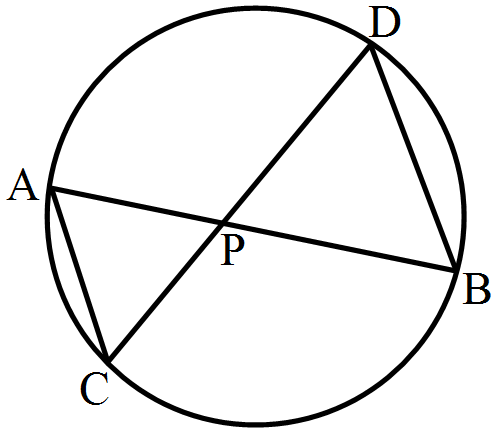
In a circle, two chords AB and CD intersect a point P inside the circle. Prove that
  1. $\triangle\text{PAC}\sim\triangle\text{PDB}$
  2. $\text{PA}.\text{PB}=\text{PC}.\text{PD}$
Show that the following points are the vertices of a square:
P(0, -2), Q(3, 1), R(0, 4) and S(-3, 1)
As observed from the top of a 100 m high light house from sea level, the angles of depression of two ships are $30^{\circ}$ and $45^{\circ}$. If one ship is exactly behind the other on the same side of the light house, find the distance between the two ships.
[Use $\sqrt{3}=1.732$]
Sum of the area of two squares is 400cm$^2$. If the difference of their perimeters is 16cm, find the sides of two squares.
Name the quadrilateral formed, if any, by the following points, and given reason for your answers:
A(-3, 5), B(3, 1), C(0, 3), D(-1, -4).
A building is in the form of a cylinder surmounted by a hemispherical dome. The base diameter of the dome is equal to $\Big(\frac{2}{3}\Big)$ of the total height of the building. Find the height of the building, if it contains $67\Big(\frac{1}{21}\Big)\text{m}^3$of air.
A solid right circular cone of height 120cm and radius 60cm is placed in a right circular cylinder full of water of height 180cm such that it touches the bottom. Find the volume of water left in the cylinder, if the radius of the cylinder is equal to the radius of the cone.
Prove the following identities:
$\frac{\sin\theta-\cos\theta}{\sin\theta+\cos\theta}+\frac{\sin\theta+\cos\theta}{\sin\theta-\cos\theta}=\frac{2}{\big(2\sin^2\theta-1\big)}$
The difference between the outer and inner curved surface areas of a hollow right circular cylinder 14 cm long is $88 cm^2$. If the volume of metal used in making the cylinder is $176 cm^3$, find the outer and inner diameters of the cylinder. (use $\pi=\frac{22}{7}$ )