Question
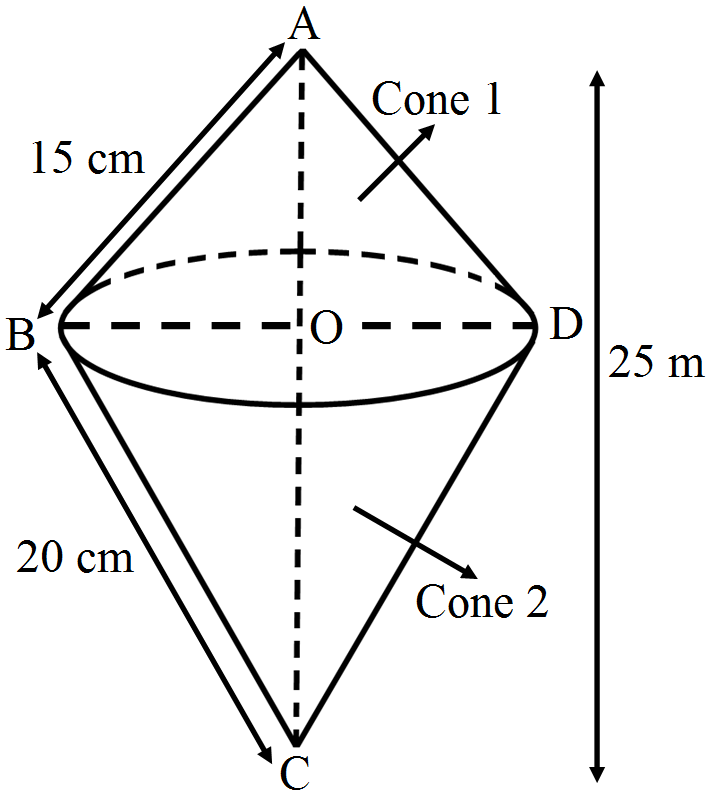
A right triangle whose sides are 15cm and 20cm (other than hypotenuse), is made to revolve about its hypotenuse. Find the volume and surface area of the double cone so formed. (Choose value of $\pi$ as found appropriate)
Answer


We have,
In $\Delta\text{ABC},\ \angle\text{B}=90^\circ,\ \text{AB}=\text{l}_1=15\text{cm}$ and $\text{BC}=\text{l}_2=20\text{cm}$
Let $\text{OD}=\text{OB}=\text{r},\ \text{AO}=\text{h}_1$ and $\text{CO}=\text{h}_2$
Using Pythagoras theorem,
$\text{AC}=\sqrt{\text{AB}^2+\text{BC}^2}$
$=\sqrt{15^2+20^2}$
$=\sqrt{225+400}$
$=\sqrt{625}$
$\Rightarrow\text{h}=25\text{cm}$
As, ar $(\Delta\text{ABC})=\frac{1}{2}\times\text{AC}\times\text{BO}=\frac{1}{2}\times\text{AB}\times\text{BC}$
$\Rightarrow\text{AC}\times\text{BO}=\text{AB}\times\text{BC}$
$\Rightarrow25\text{r}=15\times20$
$\Rightarrow\text{r}=\frac{15\times20}{25}$
$\Rightarrow\text{r}=12\text{cm}$
Now,
Volume of the double cone so formed = Volume of cone 1 + Volume of cone 2
$=\frac{1}{3}\pi\text{r}^2\text{h}_1+\frac{1}{3}\pi\text{r}^2\text{h}_2$
$=\frac{1}{3}\pi\text{r}^2(\text{h}_1+\text{h}_2)$
$=\frac{1}{3}\pi\text{r}^2\text{h}$
$=\frac{1}{3}\times\times3.14\times12\times12\times25$
$=3768\text{cm}^3$
Also,
Surace area of the solid so formed = CAS of cone 1 + CSA of cone 2
$=\pi\text{rl}_1+\pi\text{rl}_2$
$=\pi\text{r}(\text{l}_1+\text{l}_2)$
$=\frac{22}{7}\times12\times(15+20)$
$=\frac{22}{7}\times12\times35$
$=1320\text{cm}^2$

Need a full question paper?

Generate a complete, print-ready paper with questions like this in minutes — across 16+ boards, with answer keys.

Start Generating Free

Similar questions

In an AP, the first term is $-4$, the last term is $29$ and the sum of all its terms is $150$. Find the common difference.
Write the steps of construction for drawing a pair of tangents to a circle of radius 3cm, which are inclined to each other at an angle of 60º.
Show that one and only one out of n, (n + 2) and (n + 4) is divisible by 3, where n is any positive integer.
The frequency distribution table of more than type is as follows:
Production yield (kg/ha) (lower class limits) Cumulative frequency (cf)
More than 50 2 + 98 = 100
More than 55 8 + 90 = 98
More than 60 12 + 78 = 90
More than 65 24 + 54 = 78
More than 70 38 + 16 = 54
More than 75 16
Taking the lower class limits on x-axis and their respective cumulative frequencies on y-axis, its ogive can be obtained as follows:
Construct a $\triangle\text{ABC},$ in which $BC = 6.5\ cm$, $AB = 4.5\ cm$ and $\angle\text{ABC}=60^\circ.$
Construct a triangle similar to this triangle whose sides are $\frac{3}{4}$ the corresponding sides of $\triangle\text{ABC}.$
There are two classrooms A and B. If 10 students are sent from A to B, the number of students in each room becomes the same. If 20 students are sent from B to A, the number of students in A becomes double the number of students in B. Find the number of students in each room.
In an AP, it is given that $S_5+ S_7 = 167$ and $S_{10} = 235$, then find the AP, where $S_n$​​​​​​​ denotes the sum of its first n terms.
Solve the following quadratic equation: $a^2b^2x^2 + b^2x - a^2x - 1= 0$
The following distribution shows the daily pocket allowance of children of a locality. If the mean pocket allowance is Rs. 18, find the missing frequency f.
Daily pocket allowance (in Rs.)
11-13
13-15
15-17
17-19
19-21
21-23
23-25
Number of children
7
6
9
13
f
5
4
How many terms of the AP 9, 17, 25, ..... must be taken so that their sum is 636?