Question
A rigid object is rolling down an inclined plane. Derive expressions for the acceleration along the track and the speed after falling through a certain vertical distance.
Answer

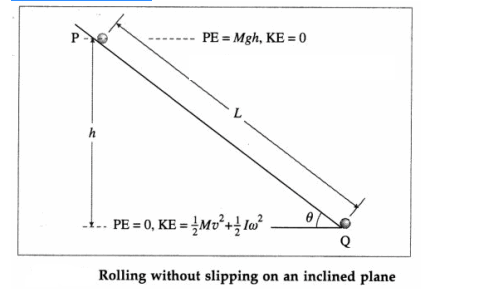
Consider a circularly symmetric rigid body, like a sphere or a wheel or a disc, rolling with friction down a plane inclined at an angle $9$ to the horizontal. If the frictional force on the body is large enough, the body rolls without slipping.
Let M and R be the mass and radius of the body. Let I be the moment of inertia of the body for rotation about an axis through its centre. Let the body start from rest at the top of the incline at a

Image
height h. Let v be the translational speed of the centre of mass at the bottom of the incline. Then, its kinetic energy at the bottom of the incline is
$E=\frac{1}{2} M v^2\left[1+\frac{I}{M R^2}\right]=\frac{1}{2} M v^2(1+\beta)$
where $\beta=\frac{I}{M R^2}$.
If $k$ is the radius of gyration of the body, $I=M k^2$ and $\beta=\frac{I}{M R^2}=\frac{k^2}{R^2}$
From conservation of energy,
$ ( KE + PE )_{\text {initial }}=( KE + PE )_{\text {final }}$
$\therefore 0+M g h=\frac{1}{2} M v^2(1+\beta)+0$
$ \therefore M g h=\frac{1}{2} M v^2(1+\beta)$
$\therefore v^2=\frac{2 g h}{1+\beta}$
$\therefore v=\sqrt{\frac{2 g h}{1+\beta}}=\sqrt{\frac{2 g h}{1+\left(k^2 / R^2\right)}} $
Since $h=L \sin \theta$,
$v=\sqrt{\frac{2 g L \sin \theta}{1+\left(k^2 / R^2\right)}}$
Let a be the acceleration of the centre of mass of the body along the inclined plane. Since the body starts from rest,
$L=\frac{1}{2} a t^2$
$\therefore t=\sqrt{\frac{2 L}{a}}=\sqrt{\frac{2 L}{g \sin \theta} \cdot\left(1+\frac{k^2}{R^2}\right)}$
[Note : For rolling without slipping, the contact point of the rigid body is instantaneously at rest relative to the surface of the inclined plane. Hence, the force of friction is static rather than kinetic, and does no work on the body. Thus, the force of static friction causes no decrease in the mechanical energy of the body and we can use the principle of conservation of energy.]

Need a full question paper?

Generate a complete, print-ready paper with questions like this in minutes — across 16+ boards, with answer keys.

Start Generating Free

Similar questions

Two metal spheres, of radii $2 \ cm$ and $1 \ cm$ with respective charge densities $5m\ C / m ^2$ and $-2m\ C / m ^2$, are inside a hypothetical closed surface in vacuum. What is the net electric flux through the surface?
Complete the following equations describing nuclear decays.
(a) ${ }_{86}^{226} Ra \rightarrow \alpha+$
(b) ${ }_8^{19} O \rightarrow e^{-}+$
(c) ${ }_{90}^{228} Th \rightarrow \alpha+$
(d) ${ }_7^{12} N \rightarrow{ }_6^{12} C +$
What about the kinetic friction between the road and the lyres?
Describe how a potentiometer is used to compare the emf's of two cells by the combination method.
What is the amount of ${ }_{27}^{60}$ Co necessary to provide a radioactive source of strength $10.0\ mCi$, its half-life being $5.3$ years?
A homogeneous (uniform) rod $X Y$ of length $L$ and mass $M$ is pivoted at the centre $C$ such that it can rotate freely in a vertical plane. Initially, the rod is horizontal. A blob of wax of the same mass $M$ as that of the rod falls vertically with speed $V$ and sticks to the rod midway between points $\mathrm{C}$ and $\mathrm{Y}$. As a result, the rod rotates with angular speed $\omega$. What will be the angular speed in terms of $\mathrm{V}$ and $\mathrm{L}$ ?
Represent graphically the variation of potential energy, kinetic energy and total energy of a particle performing SHM with time.
State the expression for the Ml of a thin spherical shell (i.e., a thin-walled hollow sphere) about its diameter. Hence obtain the expression for its $\mathrm{Ml}$ about a tangent.
With the help of a circuit diagram describe the experiment to study the characteristics of the photoelectric effect. Hence discuss any $2$ characteristics of the photoelectric effect.
A flywheel used to prepare earthenware pots is set into rotation at 100 rpm. It is in the form of a disc of mass 10 kg and
radius 0.4 m. A lump of clay (to be taken equivalent to a particle) of mass 1.6 kg falls on it and adheres to it at a certain
distance x from the centre. Calculate x if the wheel now rotates at 80 rpm.