MCQ
A ring, a solid sphere, a disc and a solid cylinder of same radii roll down an inclined plane, which would reach the bottom in the last
  • Ring
  • B
    Disc
  • C
    Solid sphere
  • D
    Solid cylinder

Answer

Correct option: A.
Ring
a

Need a full question paper?

Generate a complete, print-ready paper with questions like this in minutes — across 16+ boards, with answer keys.

Start Generating Free

Similar questions

The pressure of an ideal gas is written as $\text{p}=\frac{2\text{E}}{3\text{v}}.$ Here E refers to:
A constant potential difference is applied to the ends of a graphite rod, whose resistance decreases with a rise of temperature. The rod can be $(1)$ covered with asbestos or $(2)$ left open to atmosphere. Answer for steady state.
A container is divided into two chambers by a partition. The volume of first chamber is $4.5$ litre and second chamber is $5.5$ litre. The first chamber contain $3.0$ moles of gas at pressure $2.0\, atm$ and second chamber contain $4.0$ moles of gas at pressure $3.0\, atm$ .After the partition is removed and the mixture attains equilibrium, then, the common equilibrium pressure existing in the mixture is $x \times 10^{-1} atm$. Value of $x$ is.........
A rifle bullet loses $1/20^{th}$ of its velocity in passing through a wooden plank. The least number of planks required to stop the bullet is :-
A ball is dropped from a height $h$ above ground. Neglect the air resistance, its velocity $(v)$ varies with its height above the ground as
$List I$ describes thermodynamic processes in four different systems. $List II$ gives the magnitudes (either exactly or as a close approximation) of possible changes in the internal energy of the system due to the process.

$List-I$ $List-II$
($I$) $10^{-3} kg$ of water at $100^{\circ} C$ is converted to steam at the same temperature, at a pressure of $10^5 Pa$. The volume of the system changes from $10^{-6} m ^3$ to $10^{-3} m ^3$ in the process. Latent heat of water $=2250 kJ / kg$. ($P$) $2 kJ$
($II$) $0.2$ moles of a rigid diatomic ideal gas with volume $V$ at temperature $500 K$ undergoes an isobaric expansion to volume $3 V$. Assume $R=8.0 Jmol ^1 K^{-1}$. ($Q$) $7 kJ$
($III$) On mole of a monatomic ideal gas is compressed adiabatically from volume $V=\frac{1}{3} m^3$ and pressure $2 kPa$ to volume $\frac{v}{8}$ ($R$) $4 kJ$
($IV$) Three moles of a diatomic ideal gas whose molecules can vibrate, is given $9 kJ$ of heat and undergoes isobaric expansion. ($S$) $5 kJ$
  ($T$) $3 kJ$

Which one of the following options is correct?
Transverse wave propagates in a medium with a velocity of $1450\,m/s$ . The distance between the nearest points at which the oscillations of the particles carried in the opposite phase $\pi $ is $0.1\,m$ . What is the frequency of the wave ..... $Hz$ ?
Two vibrating tuning forks produce progressive waves given by $y_1= 4 \sin (500 \, \pi t)$  and $y_2= 2 \sin (506 \, \pi t)$. These tuning forks are held near the ear of a person.  The person will hear
A spring of force constant $800\, N/m$ has an extension of $5\,cm$. The work done in extending it from $ 5\,cm$ to $15 \,cm$ is ............. $\mathrm{J}$
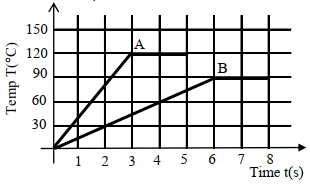
Two different metal bodies $A$ and $B$ of equal mass are heated at a uniform rate under similar conditions. The variation of temperature of the bodies is graphically represented as shown in the figure. The ratio of specific heat capacities is :