MCQ
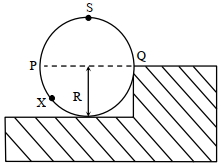
A ring whose diameter is $1\ meter$, oscillates simple harmonically in a vertical plane about a nail fixed at its circumference. The time period will be ....... $\sec$.
  • A
    $1/4$
  • B
    $1/2$
  • C
    $1$
  •  $2$

Answer

Correct option: D.
 $2$
d
$T = 2\pi \sqrt {\frac{{2R}}{g}} $$ = 2\pi \sqrt {\frac{1}{g}} $= $2\ sec$             

[As diameter $2R = 1$ $meter$ given]

Need a full question paper?

Generate a complete, print-ready paper with questions like this in minutes — across 16+ boards, with answer keys.

Start Generating Free

Similar questions

Two samples $A$ and $B$ of a gas initially at the same pressure and temperature are compressed from volume $ V$ to $ V/2$ ($A$ isothermally and adiabatically). The final pressure of $ A$ is
A particle moves on $x-$ axis according to the equation $x = x_0\,\,sin^2\,\omega t,$  the motion is simple harmonic
The second's hand of a watch has $6\, cm$ length. The speed of its tip and magnitude of difference in velocities of its at any two perpendicular positions will be respectively
The angular momentum of a particle performing uniform circular motion is $L$. If the kinetic energy of partical is doubled and frequency is halved, then angular momentum becomes
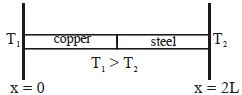
A copper rod and a steel rod of equal cross-sections and lengths $(L)$ are joined side by side and connected between two heat baths as shown in the figure

If heat flows through them from $x = 0$ to $x = 2L$ at a steady rate and conductivities of the metals are $K_{cu}$ and $K_{steel}$ $(K_{cu} > K_{steel}),$ then the temperature varies as (convection and radiation are negligible)
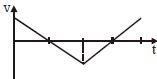
The graph below shows the velocity versus time graph for a body.

Which of the following graphs represents the corresponding acceleration $v/s$ time graph ?
Two solenoids have identical geometrical construction but one is made of thick wire and the other of thin wire. Which of the following quantities are different for the two solenoids?
$A$ system of $N$ particles is free from any external forces. Which of the following is true for the magnitude of the total momentum of the system?
Efficiency of Carnot engine is $100\%$ if
A wheel of radius $R$ and mass $M$ is placed at the bottom of a fixed step of height $R$ as shown in the figure. A constant force is continuously applied on the surface of the wheel so that it just climbs the step without slipping. Consider the torque $\tau$ about an axis normal to the plane of the paper passing through the point $Q$. Which of the following options is/are correct?

(image)