Question
A rocket accelerates straight up by ejecting gas downwards. In a small time interval $\Delta\text{t},$ it ejects a gas of mass $\Delta\text{m}$ at a relative speed u. Calculate KE of the entire system at $\text{t}+\Delta\text{t}$ and t and show that the device that gas does work $=\Big(\frac{1}{2}\Big)\Delta\text{mu}^2$ in this time interval (neglect gravity).

Answer

Let mass of rocket at any time t = M

Velocity of rocket at any time t = v

$\Delta\text{m}$ is the mass of gas ejected in time interval $\Delta\text{t}$

$(\text{KE})_{\text{t}+\Delta\text{t}}=\frac{1}{2}(\text{M}-\Delta\text{m})(\text{v}+\Delta\text{v})^2+\frac{1}{2}\Delta\text{m}(\text{v}-\text{u})^2$

$=\frac{1}{2}\Big[(\text{M}-\Delta\text{M})(\text{v}+\Delta\text{v})^2+\frac{1}{2}\Delta\text{m}(\text{v}-\text{u})^2\Big]$

$(\text{KE})_{\text{t}+\Delta\text{t}}=\frac{1}{2}\begin{bmatrix}\text{Mv}^2+\text{M}\Delta\text{v}^2+2\text{Mv}\Delta\text{v}-\Delta\text{Mv}^2\\-\Delta\text{m}\Delta\text{v}^2-2\text{v}\Delta\text{m}\Delta\text{v}+\Delta\text{mv}^2+\\\Delta\text{mu}^2-2\text{uv}\Delta\text{m}\end{bmatrix}$

$(\text{KE})_{\text{t}+\Delta\text{t}}=\frac{1}{2}\text{Mv}^2+\text{Mv}\Delta\text{v}+\frac{1}{2}\Delta\text{mu}^2-\text{uu}\Delta\text{m}$

$\big[$neglecting the very small terms $\text{M}\Delta\text{v}^2,\Delta\text{m}\Delta\text{v}^2,2\text{v}\Delta\text{m}\Delta\text{v}$ contains $\Delta\text{v}^2$ and $\Delta\text{m}\Delta\text{v}\big]$

$(\text{KE})_\text{t}=\frac{1}{2}\text{Mv}^2$

$(\text{KE)}_{\text{t}+\Delta\text{t}}-(\text{KE})_\text{t}=\frac{1}{2}\text{Mv}^2+\text{Mv}\Delta\text{v}+\frac{1}{2}\Delta\text{mu}^2-\text{uu}\Delta\text{m}-\frac{1}{2}\text{Mv}^2$

$\Delta\text{K}=\frac{1}{2}\Delta\text{mv}^2+\text{v}(\text{M}\Delta\text{v}-\text{v}\Delta\text{m})$

By Newton’s third law,

Reaction force on Rocket (upward) = Action force by burnt gases (downward)

$\text{M}\frac{\text{dv}}{\text{dt}}=\frac{\text{dm}}{\text{dt}}|\text{u}|\ (\because\text{ F}=\text{ma})$

Or $\text{M}\Delta\text{v}=\Delta\text{mu}$

$\text{M}\Delta\text{v}-\text{u}\Delta\text{m}=0$

Substitute this value in (i)

$\text{K}=\frac{1}{2}\text{u}^2\Delta\text{m}$

By work energy theorem $\Delta(\text{KE})=\text{WD}$

Or $\text{W}=\Delta\text{K}=\frac{1}{2}\Delta\text{mu}^2$
Need a full question paper?

Generate a complete, print-ready paper with questions like this in minutes — across 16+ boards, with answer keys.

Start Generating Free

Similar questions

Briefly describe the Cavendish torsion balance. How is it used to measure G?
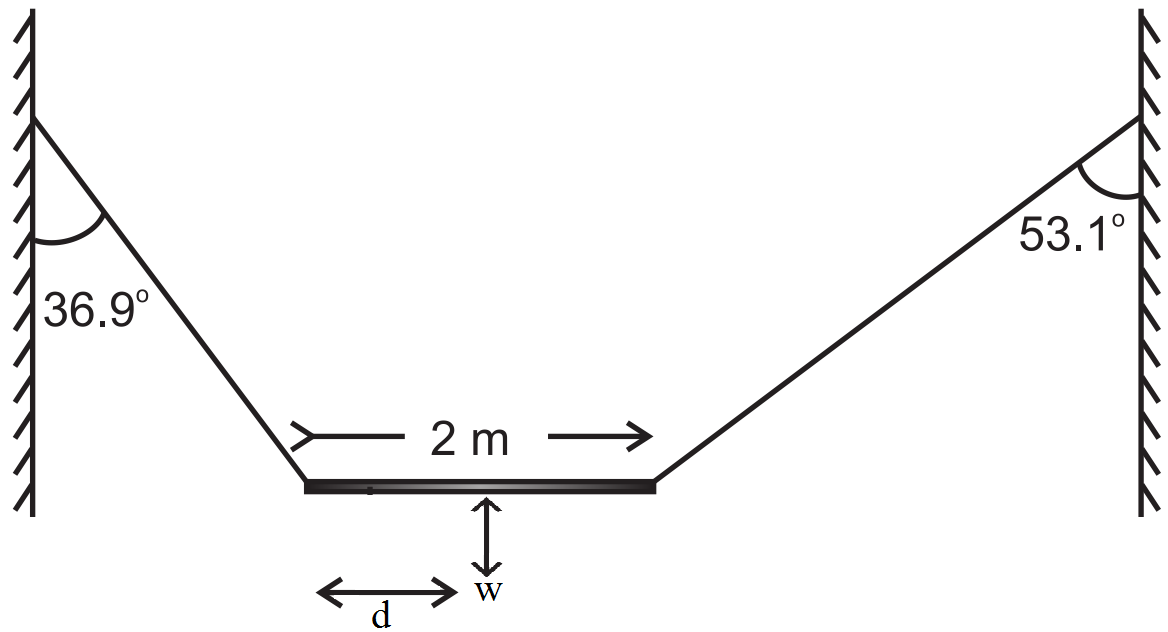
A non-uniform bar of weight W is suspended at rest by two strings of negligible weight as shown in. The angles made by the strings with the vertical are 36.9° and 53.1° respectively. The bar is 2m long. Calculate the distance d of the centre of gravity of the bar from its left end.

Show that a(b × c) is equal in magnitude to the volume of the parallelepiped formed on the three vectors a, b and c.
A tunnel is dug through the centre of the Earth. Show that a body of mass ‘m’ when dropped from rest from one end of the tunnel will execute simple harmonic motion.
Write a labelled diagram of resonance tube and explain it. With its help establish formulas to determine the velocity of sound.
OR
Make a labelled diagram of resonance tube and describe its structure and establish the formula to find the velocity of sound at room temperature.
A composite wire of diameter 1cm consisting of copper and steel wire of lengths 2.2m and 2.0m respectively. Total extension of the wire, when stretched by a force is 1.2mm. Calculate the force given that Young's modulus for copper is 1.1 × 10¹¹Pa and for steel is 2.0 × 10¹¹Pa.
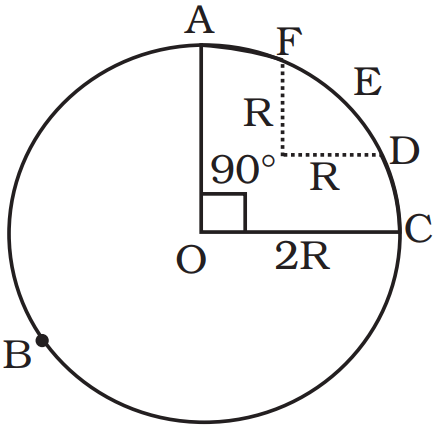
A racing car travels on a track (without banking) ABCDEFA ABC is a circular arc of radius 2 R. CD and FA are straight paths of length R and DEF is a circular arc of radius R = 100 m. The co-effecient of friction on the road is $\mu = 0.1.$ The maximum speed of the car is 50m s–1. Find the minimum time for completing one round.

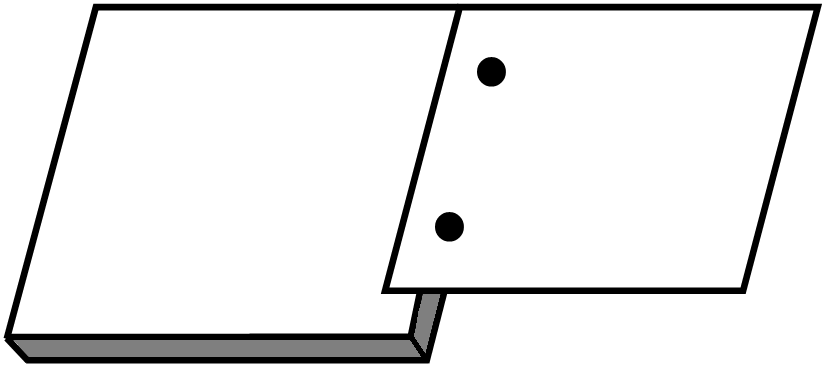
Two long metallic strips are joined together by two rivets each of radius 0.1cm (see Fig.).

Each rivet can withstand a maximum shearing stress of 3.0 × 10⁸Nm-2. Calculate the maximum tangential force a strip can exert.
The displacement vector of a particle of mass m is given by $\text{r}\text{(t})=\hat{\text{i}}\text{A}\cos\omega\text{t}+\hat{\text{j}}\text{B}\sin\omega\text{t}.$

Show that $\text{F}=-\text{m}\omega^2\text{r}.$

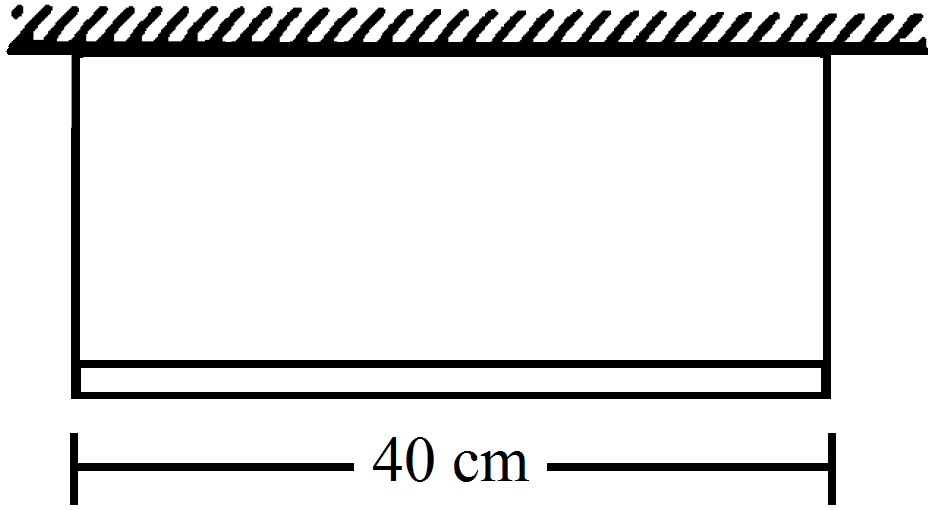
A uniform horizontal rod of length 40cm and mass 1.2kg is supported by two identical wires as shown in figure, Where should a mass of 4.8kg be placed on the rod so that the same tuning fork may excite the wire on left into its fundamental vibrations and that on right into its first overtone? Take g = 10m/s2.