MCQ
A rocket is fired upward from the earth's surface such that it creates an acceleration of $20\, m/s^2$. If after $5\, s$ its engine is switched off, the maximum height of the rocket  from the earth's surface would be......$m$
  • A
    $250$
  • B
    $500$
  • $750$
  • D
    $1000$

Answer

Correct option: C.
$750$
c
$\mathrm{H}=\mathrm{S}_{1}+\mathrm{S}_{2}$

$=\frac{1}{2} a t^{2}+\frac{u^{2}}{2 g}$

$=\frac{1}{2} \times 20 \times 5^{2}+\frac{100^{2}}{20}$

$=250+500$

$=750$

Need a full question paper?

Generate a complete, print-ready paper with questions like this in minutes — across 16+ boards, with answer keys.

Start Generating Free

Similar questions

The moment of inertia of a thin circular lamina of mass  $1\,\,kg$ and diameter $0.2\,\,metre$  rotating about one of its diameter is
A spherical body with radius $12\ cm$ radiates $450W$ power at $500K$. If the radius were halved and the temperature doubled, what would be the power radiated?
What is the phase difference between two successive crests in the wave
A body is dropped from a certain height $h$ ( $h$ is very large) and second body is thrown downward with velocity of $5 \,m / s$ simultaneouly. What will be difference in heights of the two bodies after $3 \,s$ is ....... $m$
The average density of Earth’s crust $10\ km$ beneath the surface is $2.7\ gm/cm^3$ . The speed of longitudinal seismic waves at that depth is $5.4\ km/s$ . The bulk modulus of Earth’s crust considering its behaviour as fluid at that depth is
A pin or a needle floats on the surface of water, the reason for this is
$A$ particle is moving in a circular orbit of radius $r_1$ with an angular velocity $\omega_1$ . It jumps to another circular orbit of radius $r_2$ and attains an angular velocity $\omega_2$ . If $r_2 = 0.5\, r_1$ and assuming that no external torque is applied to the system, then the angular velocity $\omega_2$, is given by :
Gas obey $P^2V =$ constant. The initial temperature and volume are $T_0$ and $V_0$. If gas expands to volume $2V_0$, the final temp is
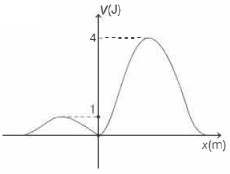
A point particle of mass $0.5 \,kg$ is moving along the $X$-axis under a force described by the potential energy $V$ shown below. It is projected towards the right from the origin with a speed $v$. What is the minimum value of $v$ for which the particle will escape infinitely far away from the origin?
The radii of circular orbits of two satellites around the earth are in the ratio $1 : 4,$ then ratio of their respective periods of revolution is: