MCQ
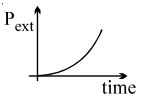
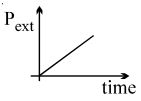
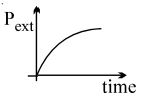
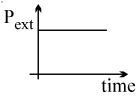
$A$ rod is hinged at its centre and rotated by applying a constant torque starting from rest. The power developed by the external torque as a function of time is :
  • A


  • C

  • D

Answer

Correct option: B.

b
$P=\tau, \omega \Rightarrow P=\tau \alpha t \Rightarrow P=\tau, \frac{\tau}{I} t \Rightarrow P=\frac{\tau^{2}}{I} t \Rightarrow P \propto t$

Need a full question paper?

Generate a complete, print-ready paper with questions like this in minutes — across 16+ boards, with answer keys.

Start Generating Free

Similar questions

A particle of mass $m$ with an initial velocity $u\hat i$ collides perfectly elastically with a mass $3m$ at rest. It moves with a velocity $v\hat j$ after collision, then, $v$ is given by
A $100 \,g$ of iron nail is hit by a $1.5\, kg$ hammer striking at a velocity of $60\, ms ^{-1}$. $............^{\circ}C$ will be the rise in the temperature of the nail if one fourth of energy of the hammer goes into heating the nail .

[Specific heat capacity of iron  $=0.42\, Jg ^{-1}{ }\,^{\circ}C ^{-1}$ ]
Force acting on a particle moving in a straight line varies with the velocity of the particle as $F = \frac {K}{v}$ . Here $K$ is a constant. The work done by this force in time $t$ is 
What is the mass of $22.4L$ of $CO_2$ at $\text{STP}?$
The displacement of a particle moving in $S.H.M.$ at any instant is given by $y = a\sin \omega t$. The acceleration after time $t = \frac{T}{4}$ is (where $T$ is the time period)
Two parallel wires carry currents of 20A and 40A in opposite directions. Another wire carying a current anti parallel to 20A is placed midway between the two wires. T he magnetic force on it will be:
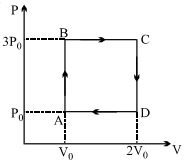
A ideal monoatomic gas is carried around the cycle $ABCDA$ as shown in the fig. The efficiency of the gas cycle is
The mass of water rises in capillary tube of radius $R$ is $M.$ The mass of water that rises in tube of radius $2R$ is:
If the kinetic energy of two objects is equal and the ratio of their masses is $1: 2$ then the ratio of their linear moment will be :
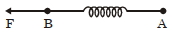
Two masses $A$ and $B ,$ each of mass $M$ are fixed together by a massless spring. $A$ force acts on the mass $B$ as shown in figure. If the mass $A$ starts moving away from mass $B$ with acceleration $'a',$ then the acceleration of mass $B$ wil be :-