Question
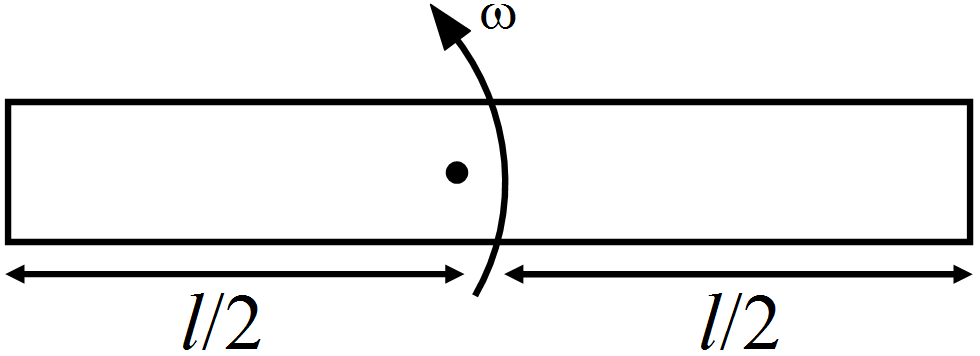
A rod of legth l rotates with a uniform angular velocity $\omega$ about its perpendicular bisector. A uniform magnetic field B exists parallel to the axis of rotation. The potential difference between the two ends of the rod is:
Answer

  1. $\text{zero}$
Explanation:

Emf at both end is same $=\frac{1}{8}\text{Bwl}^2$
So the potential difference between the two ends of therod is zero.

Need a full question paper?

Generate a complete, print-ready paper with questions like this in minutes — across 16+ boards, with answer keys.

Start Generating Free

Similar questions

An inductive coil has resistance of $100\Omega$ When an ac signal of frequency $1000 Hz$ is fed to the coil, the applied voltage leads the current by $45^\circ C.$ What is the inductance of the coil?
An $X-$ray has a wavelength of $0.010 \mathring A$ . Its momentum is
Substances in which the magnetic moment of a single atom is not zero, is known as(a) Diamagnetism(b) Ferromagnetism(c) Paramagnetism(d) Ferrimagnetism
       
The number of electrons to be put on a spherical conductor of radius $0.1m$ to produce an electric field of $0.036\ N/C$ just above its surface is
A convex lens forms a real image of a point object placed on its principal axis. If the upper half of the lens is painted black, the image will(a) Be shifted downwards(b) Be shifted upwards(c) Not be shifted(d) Shift on the principal axis
   
   
In a two slit experiment with monochromatic light fringes are obtained on a screen placed at some distance from the sits. If the screen is moved by $5 \times 10^{-2}$towards the slits, the change in fringe width is $3 \times 10^{-5} m$. If separation between the slits is $10^{-3} m$, the wavelength of light used is
A charged particle moves in a gravity-free space without change in velocity. Which of the following is are possible:
  1. $\text{E}=0,\ \text{B}=0$
  2. $\text{E}=0,\ \text{B}\not=0$
  3. $\text{E}\not=0,\ \text{B}=0$
  4. $\text{E}\not=0,\ \text{B}\not=0$
In an n-type silicon, which of the following statement is true :
One junction of a certain thermoelectric couple is at a fixed temperature $T_r$ and the other junction is at temperature $T.$ The thermo electromotive force for this is expressed by $E=K\left(T-T_r\right)\left[T_0-\frac{1}{2}\left(T+T_r\right)\right]$. . At temperature $T =\frac{1}{2} T_0$ the thermoelectric power is
An object can be negatively charged by: