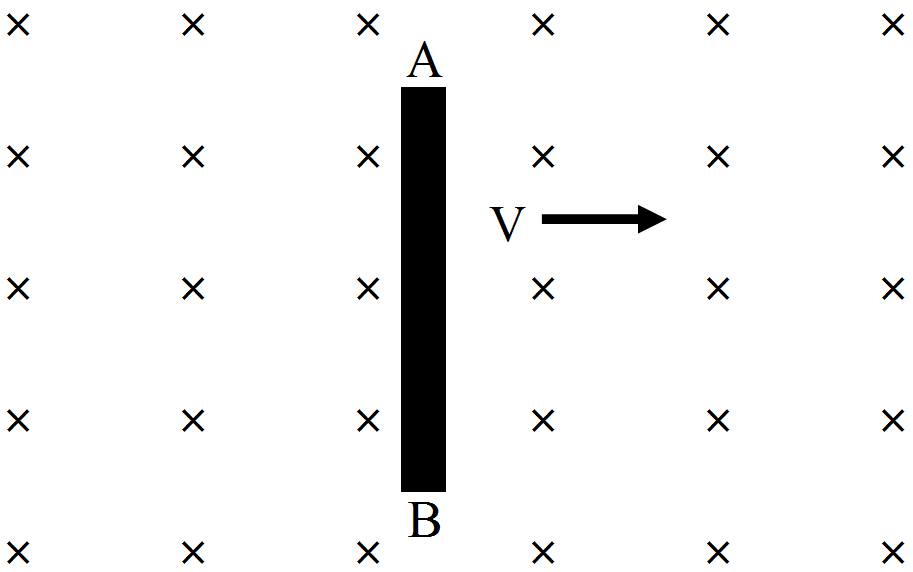
- $\text{zero}$
- $\frac{1}{2}\text{Bl}\omega^2$
- $\text{Bl}\omega ^2$
- $2\text{B}\text{l}\omega^2$
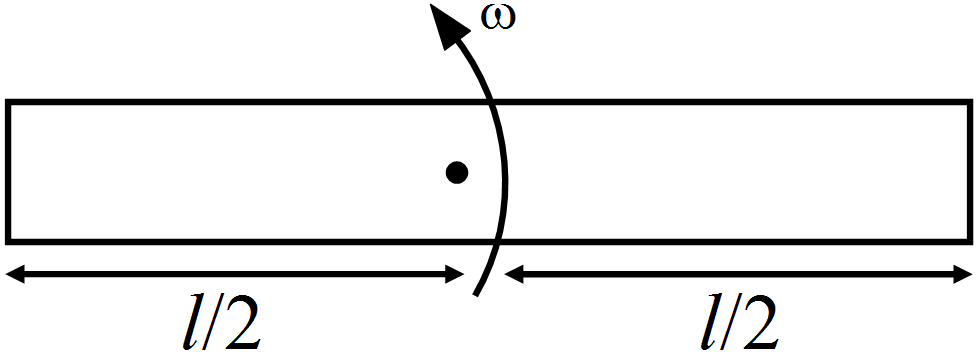
Explanation:

Emf at both end is same $=\frac{1}{8}\text{Bwl}^2$
So the potential difference between the two ends of therod is zero.
Generate a complete, print-ready paper with questions like this in minutes — across 16+ boards, with answer keys.
Assertion : Base in a transistor is made very thin as compared to collector and emitter regions.
Reason : Due to thin base power gain and voltage gain is obtained by a transistor.
|
(a) If both assertion and reason are true and the reason is the correct explanation of the assertion. |
|
(b) If both assertion and reason are true but reason is not the correct explanation of the assertion. |
|
(c) If assertion is true but reason is false. |
|
(d) If the assertion and reason both are false. |
Match List I with List II and select the correct answer using the codes given below the lists :
|
List I (Position of the object) |
List II (Magnification) |
|
(I) An object is placed at focus before a convex mirror |
(A) Magnification is -∞ |
|
(II) An object is placed at centre of curvature before a concave mirror |
(B) Magnification is 0.5 |
|
(III) An object is placed at focus before a concave mirror |
(C) Magnification is +1 |
|
(IV) An object is placed at centre of curvature before a convex mirror |
(D) Magnification is -1 |
|
|
(E) Magnification is 0.33 |
Codes :
|
(a) I-B, II-D, III-A, IV-E |
(b) I-A, II-D, III-C, IV-B |
|
(c) I-C, II-B, III-A, IV-E |
(d) I-B, II-E, III-D, IV-C |

If q is the charge per unit area on the surface of a conductor, then the electric field intensity at a point on the surface is
|
(a) |
(b) |
|
(c) |
(d) |
Two point charges Q and – 3Q are placed at some distance apart. If the electric field at the location of Q is E then at the locality of -3Q, it is
|
(a) - E |
(b) E/3 |
(c) -3E |
(d) -E/3 |
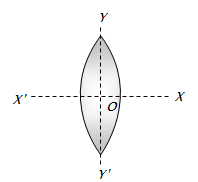
An equiconvex lens is cut into two halves along (i) XOX¢ and (ii) YOY¢ as shown in the figure. Let f, f ¢, f ¢¢ be the focal lengths of the complete lens, of each half in case (i), and of each half in case (ii), respectively

Choose the correct statement from the following
|
(a) |
(b) |
(c) |
(d) |
A achromatic combination is made with a lens of focal length f and dispersive power ω with a lens having dispersive power of 2ω. The focal length of second will be
|
(a) 2f |
(b) f/2 |
(c) -f/2 |
(d) – 2 f |