Question
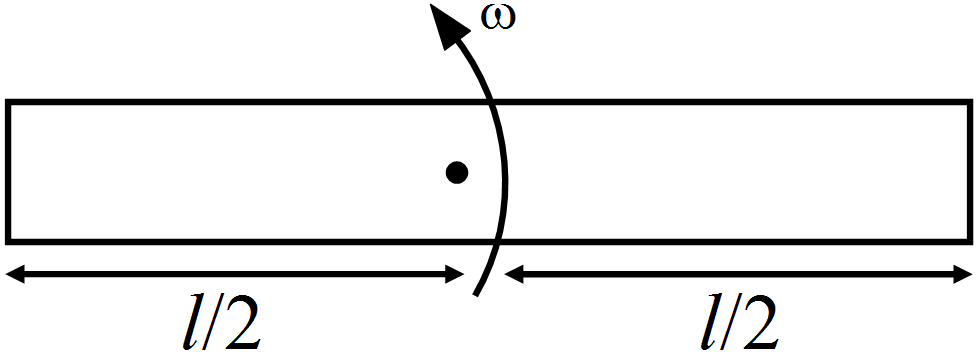
A rod of legth l rotates with a uniform angular velocity $\omega$ about its perpendicular bisector. A uniform magnetic field B exists parallel to the axis of rotation. The potential difference between the two ends of the rod is:
  1. $\text{zero}$
  2. $\frac{1}{2}\text{Bl}\omega^2$
  3. $\text{Bl}\omega ^2$
  4. $2\text{B}\text{l}\omega^2$ 

Answer

  1. $\text{zero}$

Explanation:

Emf at both end is same $=\frac{1}{8}\text{Bwl}^2$

So the potential difference between the two ends of therod is zero.

Need a full question paper?

Generate a complete, print-ready paper with questions like this in minutes — across 16+ boards, with answer keys.

Start Generating Free

Similar questions

The electric field at the origin is along the positive x-axis. A small circle is drawn with the centre at the origin cutting the axes at points A, B, C and D having coordinates (a, 0), (0, a), (-a, 0), (0, -a) respectively. Out of the points on the periphery of the circle, the potential is minimum at.

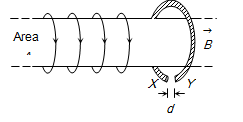
A highly conducting ring of radius R is perpendicular to and concentric with the axis of a long solenoid as shown in fig. The ring has a narrow gap of width d in its circumference. The solenoid has cross sectional area A and a uniform internal field of magnitude B0. Now beginning at t = 0, the solenoid current is steadily increased to so that the field magnitude at any time t is given by B(t) = B0 + at where α > 0. Assuming that no charge can flow across the gap, the end of ring which has excess of positive charge and the magnitude of induced e.m.f. in the ring are respectively

(a) X, A𝛼

(b) X, pR2𝛼

(c) Y, 𝜋A2𝛼

(d) Y, pR2𝛼

An electron (charge = 1.6 ) is accelerated through a potential of 100,000 V. The energy acquired by the electron is

(a) 1.6  

(b) 1.6 

(c) 0.53  

(d) 1.6  

In vacuum an electron of energy 10 keV hits tungsten target, then emitted radiation will be       

(a) Cathode rays

(b) X-rays

(c) Infrared rays

(d) Visible spectrum

In radioactive disintegration $\alpha$-particle, $\beta$-particle and $\gamma$-rays are emitted. Out of these which has highest ionisation power ?
Let the angle between two nonzero vectors $\overrightarrow{\text{A}}$ and $\overrightarrow{\text{B}}$ be 120° and its resultant be $\vec{\text{c}}:$
  1. C must be equal to $|\text{A}-\text{B}|$
  2. C must be less than $|\text{A}-\text{B}|$
  3. C must be greater than $|\text{A}-\text{B}|$
  4. C may be equal to $|\text{A}-\text{B}|$
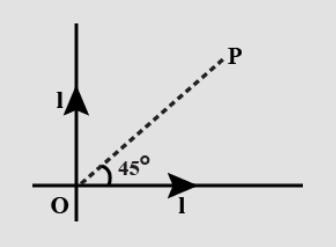
Two infinite long wires, each carrying current I, are lying along x - axis and y - axis, respectively. A charged particle, having a charge q and mass m, is projected with a velocity u along the straight line OP. The path of the particle is (neglect gravity) a:

Biaxial crystal among the following is

(a) Calcite

(b) Quartz

(c) Selenite

(d) Tourmaline

A certain charge liberates 0.8 gm of . The same charge will liberate how many gm of silver

(a) 108 gm

(b) 10.8 gm

(c) 0.8 gm

(d)  

The Gaussian surface: