MCQ
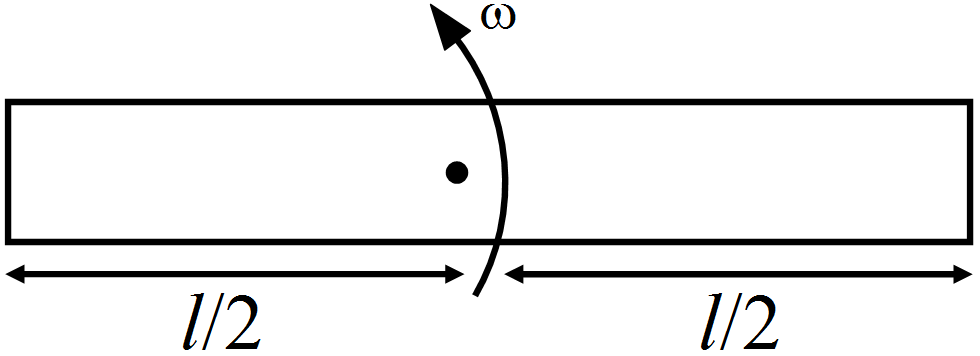
A rod of legth l rotates with a uniform angular velocity $\omega$ about its perpendicular bisector. A uniform magnetic field B exists parallel to the axis of rotation. The potential difference between the two ends of the rod is:
  • $\text{zero}$
  • B
    $\frac{1}{2}\text{Bl}\omega^2$
  • C
    $\text{Bl}\omega ^2$
  • D
    $2\text{B}\text{l}\omega^2$

Answer

Correct option: A.
$\text{zero}$

Emf at both end is same $=\frac{1}{8}\text{Bwl}^2$
So the potential difference between the two ends of therod is zero.

Need a full question paper?

Generate a complete, print-ready paper with questions like this in minutes — across 16+ boards, with answer keys.

Start Generating Free

Similar questions

Assuming the earth to be a sphere of uniform mass density, a body weighed $300 \mathrm{~N}$ on the surface of earth. How much it would weigh at $R / 4$ depth under surface of earth?
The period of a simple pendulum is doubled, when
A tuning fork gives $4$ beats with $50\, cm$ length of a sonometer wire if the length of  the wire is shortened by $1\, cm$. the no. of beats still the same. The frequency of the  fork is -............. $\mathrm{Hz}$
A parachutist after bailing out falls $20\,\,m$ without friction. When parachute opens, it decelerates at $2\,\,m/s^2.$  He reached the ground with a speed with a speed of $4\,\,m/s.$  At what height, did he bail out ?......$m$
A stationary particle explodes into two particles of a masses $m_1$ and $m_2$ which move in opposite directions with velocities ${v_1}$ and ${v_2}.$ The ratio of their kinetic energies ${E_1}/{E_2}$ is
Consider two containers $A$ and $B$ containing identical gases at the same pressure, volume and temperature. The gas in container $A$ is compressed to half of its original volume isothermally while the gas in container $B$ is compressed to half of its original value adiabatically. The ratio of final pressure of gas in $B$ to that of gas in $A$ is
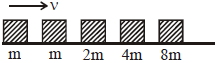
Blocks of masses $m , 2 m , 4 m$ and $8 m$ are arranged in a line on a frictionless floor. Another block of mass $m ,$ moving with speed $v$ along the same line (see figure) ollides with mass $m$ in perfectly inelastic manner. All the subsequent collisions are also perfectly inelastic. By the time the last block of mass $8 m$ starts moving the total energy loss is $p \%$ of the original energy. Value of $'p'$ is close to
A particle executes simple harmonic motion between $x = -A$ and $x = +A.$ The time taken for it to go from $0$ to $\frac{\text{A}}{2}$ is $T_1$ and to go from $\frac{\text{A}}{2}$ to $A$ is $T_2$ Then:
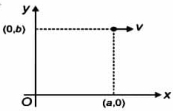
A particle is moving with constant speed $v$ in $x y$ plane as shown in figure. The magnitude of its angular velocity about point $O$ is .........
The temperature of a gas having $2.0 \times 10^{25}$ molecules per cubic meter at $1.38 \mathrm{~atm}$ (Given, $\mathrm{k}=$ $\left.1.38 \times 10^{-23} \mathrm{JK}^{-1}\right)$ is :