A rod of length $l$ with thermally insulated lateral surface is made of a material whose thermal conductivity $K$ varies as $K = C/T$ , where $C$ is a constant. The ends are at temperatures $T_1$ and $T_2$ . The heat current density is
Diffcult
Download our app for free and get started

Download our appand get started for free
Experience the future of education. Simply download our apps or reach out to us for more information. Let's shape the future of learning together!No signup needed.*
Similar Questions
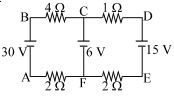
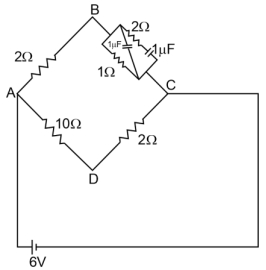
- 1For the given circuit, in the steady state, $\left| V _{ B }- V _{ D }\right|=.......V.$View Solution
- 2Two bulbs are in parallel and they together consume $48\, W$ from a battery of $6\, V$. The resistance of each bulb is ............ $\Omega$View Solution
- 3A $100\, watt$ bulb working on $200 \,volt$ and a $200\, watt$ bulb working on $100\, volt$ haveView Solution
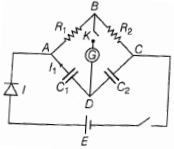
- 4ln the circuit in the figure, if no current flows through the galvanometer when the key $K$ is closed, the bridge is balanced. The balancing condition for bridge isView Solution
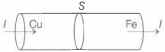
- 5Two rods of copper and iron with the same cross-sectional area are joined at $S$ and a steady current $I$ flows through the rods as shown in the figure. Choose the most appropriate representation of charges accumulated near the junction $S$.View Solution
- 6If a copper wire is stretched to increase its length by $20 \% $. The percentage increase in resistance of the wire is $..........\%$View Solution
- 7Water of volume $2\, litre$ in a container is heated with a coil of $1\, kW$ at $27 \,^oC$. The lid of the container is open and energy dissipates at rate of $160\, J/s$. In how much time temperature will rise from $27\,^oC$ to $77\,^oC$ $[$ Given specific heat of water is $4.2\, kJ/kg$ $]$View Solution
- 8Consider a block of conducting material ofresistivity '$\rho$' shown in the figure. Current '$I$' enters at '$A$' and leaves from '$D$'. We apply superp osition principle to find voltage '$\Delta V$ ' developed between '$B$' and '$C$'. The calculation is done in the following steps:View Solution
$(i)$ Take current '$I$' entering from '$A$' and assume it to spread over a hemispherical surface in the block.
$(ii)$ Calculatefield $E(r)$ at distance '$r$' from $A$ by using Ohm's law $E = \rho j$, where j is the current per unit area at '$r$'.
$(iii)$ From the '$r$' dependence of $E(r)$, obtain the potential $V(r)$ at $r$.
$(iv)$ Repeat $(i), (ii)$ and $(iii)$ for current '$I$' leaving '$D$' and superpose results for '$A$' and '$D$'.For current entering at $A$, the electric field at a distance '$r$'
from $A$ is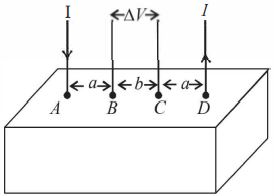
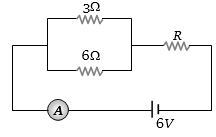
- 9If the ammeter in the given circuit reads $2\, A$, the resistance $R$ is ............ $ohm$View Solution
- 10The figure shows a network of four resistances and three batteries The electrical power dissipated as heat is .............. $W$View Solution