MCQ
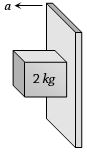
A rough vertical board has an acceleration $‘a’$ so that a $2$ kg block pressing against it does not fall. The coefficient of friction between the block and the board should be
  • $ > g/a$
  • B
    $ < g/a$
  • C
    $ = g/a$
  • D
    $ > a/g$

Answer

Correct option: A.
$ > g/a$
a
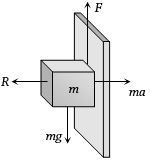
(a) For the limiting condition upward friction force between board and block will balance the weight of the block.

i.e. $F > mg$

==> $\mu (R) > mg$

==> $\mu (ma) > mg$

==> $\mu > \frac{g}{a}$
Need a full question paper?

Generate a complete, print-ready paper with questions like this in minutes — across 16+ boards, with answer keys.
Start Generating Free

Similar questions

The ratio of mean kinetic energy of hydrogen and oxygen at a given temperature is
The isothermal Bulk modulus of an ideal gas at pressure $P$ is
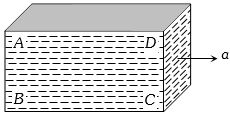
A closed rectangular tank is completely filled with water and is accelerated horizontally with an acceleration a towards right. Pressure is $(i)$ maximum at, and $ (ii) $ minimum at
The $SI$ unit of the inductance, the henry cannot be written as
For which of the two pairs, the angle of contact is same
A block of mass $m$ is connected to another block of mass $M$ by a spring (massless) of spring constant $k$. The block are kept on a smooth horizontal plane. Initially the blocks are at rest and the spring is unstretched. Then a constant force $F$ starts acting on the block of mass $M$ to pull it. Find the force of the block of mass $m.$
$2$ moles of a monoatomic gas are expanded to double its initial volume, through a process $P/V =$ constant. If its initial temperature is $300\,\, K$, then which of the following is not true.
In a hydroelectric power station, the water is flowing at $2\ ms^{-1}$ in the river which is $100m$ wide and $5m$ deep. The maximum power output from the river is:
Given below are two statements: one is labelled as Assertion $A$ and the other is labelled as Reason $R$

Assertion $A$ : A spherical body of radius $(5 \pm 0.1)$ $mm$ having a particular density is falling through a liquid of constant density. The percentage error in the calculation of its terminal velocity is $4\,\%$.

Reason $R$ : The terminal velocity of the spherical body falling through the liquid is inversely proportional to its radius.

In the light of the above statements, choose the correct answer from the options given below on :

A cork is submerged in water by a spring attached to the bottom of a pail. When the pail is kept in a elevator moving with an acceleration downwards, the spring length