Question
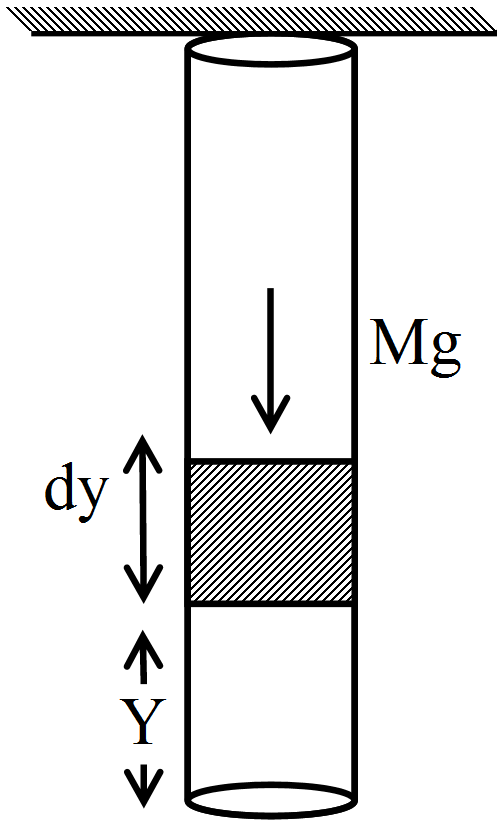
A rubber string 10 m long is suspended from a rigid support at its one end. Calculate the extension in the string due to its own weight. The density of rubber is $1.5 \times 10^3 \mathrm{~kg} / \mathrm{m}$ and Young's modulus for the rubber is $5 \times 100 \mathrm{~N} / \mathrm{m}^2$. The breaking stress for a metal is $7.8 \times 10^9 \mathrm{~N} / \mathrm{m}^2$. Calculate the maximum length of the wire made of this metal with may be suspended without breaking. The density of metal $=7.8 \times 10^3 \mathrm{~kg} / \mathrm{m}^3$.
Answer


$\text{l}=10\text{m}.\rho=1.5\times10^3\text{kg/m}^3$ $\text{Y}=5\times10^6\text{N/m}^2$ We know, $\text{Y}=\frac{\text{F}.\text{l}}{\text{A}.\Delta\text{l}}$ Eficient force = Mg Consider a small length dy at a distance y from free end. The length above this, (l - y) will experience a force of $\text{F}_{\text{dx}}=\frac{\text{M}}{\text{l}}(\text{dy}).\text{gdy}$

Need a full question paper?

Generate a complete, print-ready paper with questions like this in minutes — across 16+ boards, with answer keys.

Start Generating Free

Similar questions

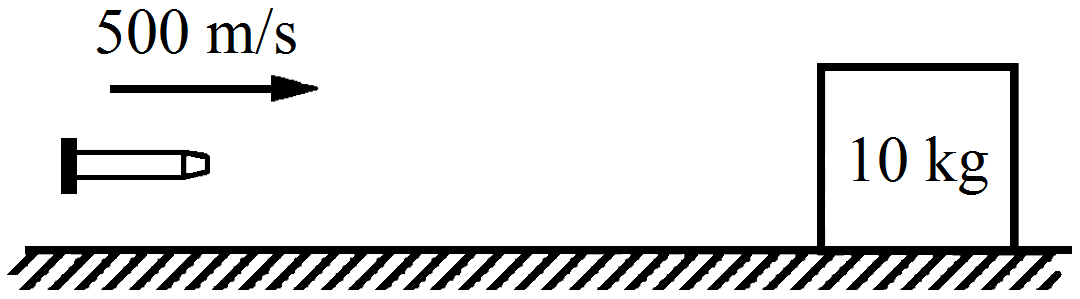
A bullet of mass $20g$ travelling horizontally with a speed of $500m/s$ passes through a wooden block of mass $10.0kg$ initially at rest on a level surface. The bullet emerges with a speed of $100m/s$ and the block slides $20cm$ on the surface before coming to rest. Find the friction coefficient between the block and the surface.
A person of mass $60kg$ wants to lose $5kg$ by going up and down a $10m$ high stairs. Assume he burns twice as much fat while going up than coming down. If $1kg$ of fat is burnt on expending $7000$ kilo calories, how many times must he go up and down to reduce his weight by $5kg$?
Explain why?
  1. Inspite of formula $\nu=\sqrt{\frac{\gamma\text{P}}{\rho}},$ the speed of sound in air independent of pressure.
Where $\gamma=$ ratio of specific heats i.e., $\gamma =\frac{\text{C}_\text{p}}{\text{C}_\nu},$ $\rho=$ density, P = pressure.
  1. Bats can ascertain distances, directions, nature and the size of the obstacles without any "eyes”.
In the given progressive wave $​​​​\text{y}=5\sin(100\pi\text{t+0.4x})$ where y and x are in m, t is in s. What is the:
Particle velocity amplitude.
What is the ratio between the distance travelled by the oscillator in one time period and amplitude?
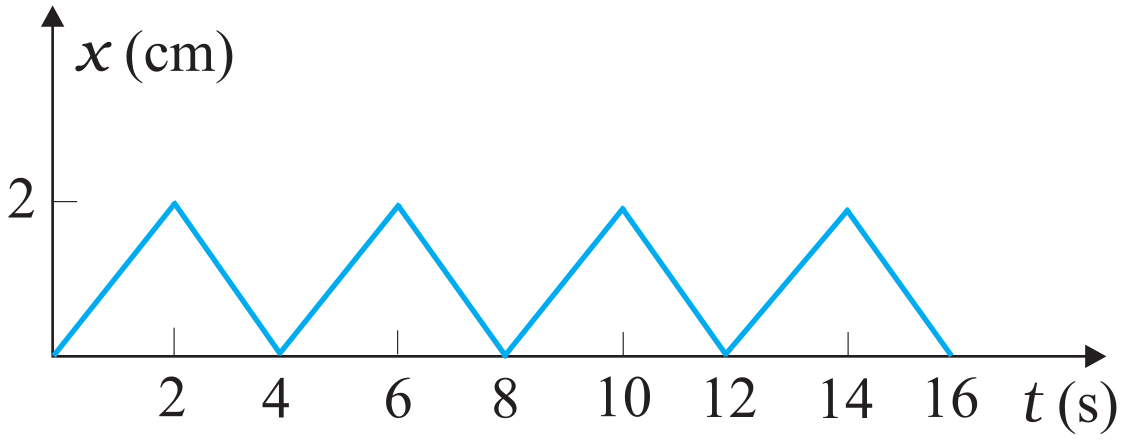
Figure $5.17$ shows the position-time graph of a body of mass $0.04kg$. Suggest a suitable physical context for this motion. What is the time between two consecutive impulses received by the body? What is the magnitude of each impulse?
A tuning fork of unknown frequency makes 5 beats per second with another tuning fork which can cause a closed organ pipe of length 40cm to vibrate in its fundamental mode. The beat frequency decreases when the first tuning fork is slightly loaded with wax. Find its original frequency. The speed of sound in air is 320m/s.
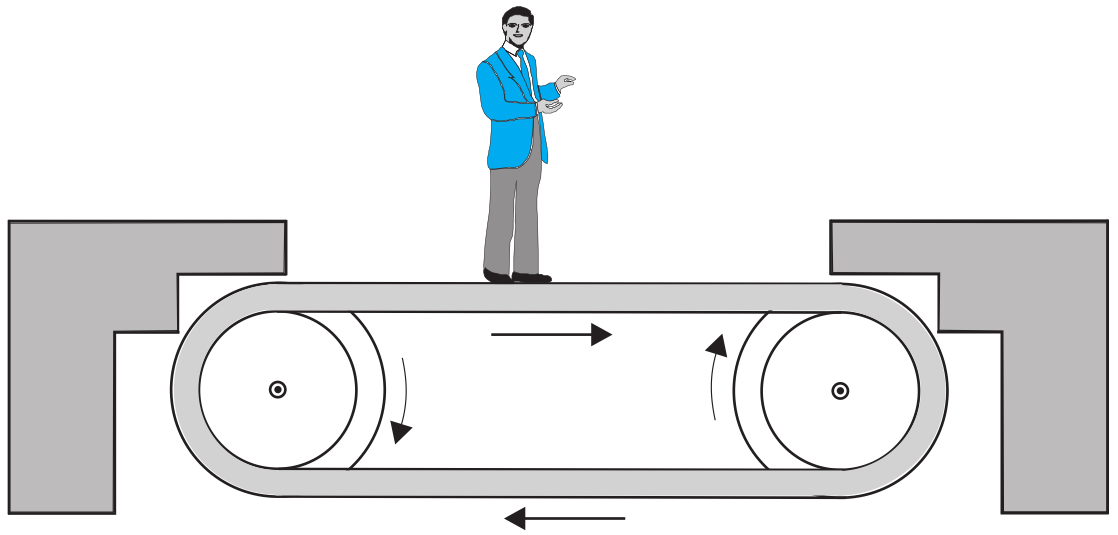
Figure. shows a man standing stationary with respect to a horizontal conveyor belt that is accelerating with $1ms^{-2}$. What is the net force on the man? If the coefficient of static friction between the man’s shoes and the belt is $0.2$, up to what acceleration of the belt can the man continue to be stationary relative to the belt? (Mass of the man = $65kg$.)
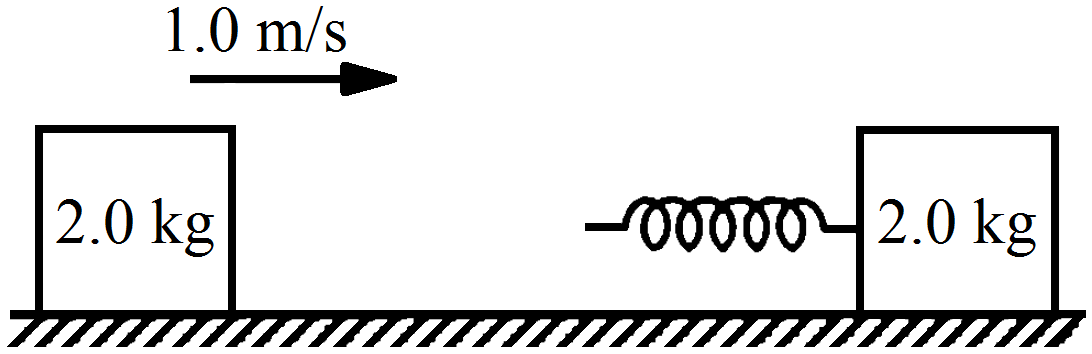
A block of mass $2.0kg$ is moving on a frictionless horizontal surface with a velocity of $1.0m/s$ towards another block of equal mass kept at rest. The spring constant of the spring fixed at one end is $100N/m$. Find the maximum compression of the spring.
Explain:
  1. Why are ball bearings used in machinery?
  2. Why does a horse have to apply more force to start a cart than to keep it moving?
  3. What is the need for banking the tracks?
  4. State two advantages and two disadvantages of friction.