Question
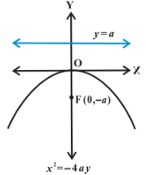
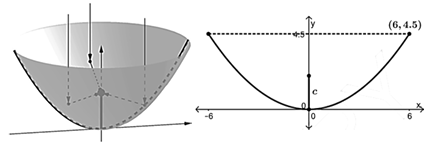
A satellite dish has a shape called a paraboloid, where each cross section is parabola. Since radio signals $($parallel to axis$)$ will bounce off the surface of the dish to the focus, the receiver should be placed at the focus. The dish is $12$ ft across, and $4.5$ ft deep at the vertex
Image

$i$. Name the type of curve given in the above paragraph and find the equation of curve? $(1)$
$ii.$  Find the equation of parabola whose vertex is $(3, 4)$ and focus is $(5, 4). (1)$
$iii.$ Find the equation of parabola Vertex $(0, 0)$ passing through $(2, 3)$ and axis is along $x-$ axis. and also find the length of latus rectum. $(2)$
OR
$iv$. Find focus, length of latus rectum and equation of directrix of the parabola $x^2=8 y. (2)$

Answer

$i.$ Given curve is a parabola
Equation of parabola is $x^2=4 a y$
It passes through the point $(6, 4.5)$
$\Rightarrow 36=4 \times a \times 4.5$
$\Rightarrow 36=18 a$
$\Rightarrow a=2$
Equation of parabola is $x^2=8 y$
$ii.$ Distance between focus and vertex is $= a =\sqrt{(4-4)^2+(5-3)^2}=2$
Equation of parabola is $(y-k)^2=4 a(x-h)$
where $(h, k)$ is vertex
$\Rightarrow$ Equation of parabola with vertex $(3,4) \ a=2$
$\Rightarrow(y-4)^2=8(x-3)$
$iii$. Equation of parabola with axis along $x -$ axis
$y ^2=4 ax$
which passes through $(2, 3)$
$\Rightarrow 9=4 a \times 2$
$\Rightarrow 4 a =\frac{9}{2}$
hence required equation of parabola is
$y^2=\frac{9}{2} x$
$\Rightarrow 2 y^2=9 x$
Hence length of latus rectum $= 4a = 4.5$
OR
$x^2=8 y$
$a = 2$
Focus of parabola is $(0, 2)$
length of latus rectum is $4 a=4 \times 2=8$
Equation of directrix $y + 2 = 0$

Need a full question paper?

Generate a complete, print-ready paper with questions like this in minutes — across 16+ boards, with answer keys.

Start Generating Free

Similar questions

$24 \ 3 \ 32 \ 1 $ A state cricket authority has to choose a team of $11$ members, to do it so the authority asks $2$ coaches of a government academy to select the team members that have experience as well as the best performers in last $15$ matches. They can make up a team of $11$ cricketers amongst $15$ possible candidates. In how many ways can the final eleven be selected from $15$ cricket players if:
Image

$i$. Two of them being leg spinners, in how many ways can be the final eleven be selected from $15$ cricket players if one and only one leg spinner must be included? $(1)$
$ii$. If there are $6$ bowlers, $3$ wicketkeepers, and $6$ batsmen in all. In how many ways can be the final eleven be selected from $15$ cricket players if $4$ bowlers, $2$ wicketkeepers and $5$ batsmen are included. $(1)$
$iii$. In how many ways can be the final eleven be selected from $15$ cricket players if there is no restriction? $(2)$
OR
In how many ways can be the final eleven be selected from $15$ cricket players if one particular player must be included. $(2)$
Indian track and field athlete Neeraj Chopra, who competes in the Javelin throw, won a gold medal at Tokyo Olympics. He is the first track and field athlete to win a gold medal for India at the Olympics.
Image

Image

$i$. Name the shape of path followed by a javelin. If equation of such a curve is given by $x^2=-16 y,$ then find the coordinates of foci. $(1)$
$ii.$ Find the equation of directrix and length of latus rectum of parabola $x^2=-16 y. (1)$
$iii.$ Find the equation of parabola with Vertex $(0,0)$, passing through $(5,2)$ and symmetric with respect to $y-$ axis and also find equation of directrix.$ (2)$
OR
Find the equation of the parabola with focus $(2,0)$ and directrix $x=-2$ and also length of latus rectum. $(2)$
There are $4$ red, $5$ blue and $3$ green marbles in a basket.
$i.$ If two marbles are picked at randomly, find the probability that both red marbles. $(1)$
$ii.$ If three marbles are picked at randomly, find the probability that all green marbles. $(1)$
$iii$. If two marbles are picked at randomly then find the probability that both are not blue marbles. $(2)$
OR
If three marbles are picked at randomly, then find the probability that atleast one of them is blue. $(2)$
A function $f$ is said to be a rational function, if $f(x)=\frac{g(x)}{h(x)}$, where $g(x)$ and $h(x)$ are polynomial functions such that $h(x) \neq 0$.
Then, $\lim _{x \rightarrow a} f(x)=\lim _{x \rightarrow a} \frac{g(x)}{h(x)}$
$
=\frac{\lim _{x \rightarrow a} g(x)}{\lim _{x \rightarrow a} h(x)}=\frac{g(a)}{h(a)}
$
However, if $h(a)=0$, then there are two cases arise,
(i) $g(a) \neq 0$
(ii) $g(a)=0$. In the first case, we say that the limit does not exist.
In the second case, we can find limit.

Based on above information, answer the following questions.

(i) $\lim _{x \rightarrow-1}\left(\frac{x^{10}+x^5+1}{x-1}\right)$ is equal to
    (a) $\frac{1}{2}$     (b) $\frac{-1}{2}$     (c) 2     (d) $\frac{3}{2}$

(ii) $\lim _{x \rightarrow-1} \frac{(x-1)^2+3 x^2}{\left(x^4+1\right)^2}$ is equal to
    (a) $\frac{7}{4}$     (b) $\frac{6}{5}$     (c) $\frac{4}{7}$     (d) $\frac{3}{4}$

(iii) The value of $\lim _{x \rightarrow 2}\left[\frac{x^2-4}{x^3-4 x^2+4 x}\right]$ is
    (a) 0     (b) 1     (c) 2     (d) Does not exist

(iv) $\lim _{x \rightarrow 1} \frac{x^7-2 x^5+1}{x^3-3 x^2+2}$ is equal to
    (a) 0     (b) 1     (c) 2     (d) 3

(v) $\lim _{x \rightarrow 0} \frac{\sqrt{1+x^3}-\sqrt{1-x^3}}{x^2}$ is equal to
    (a) 1     (b) 0     (c) -1     (d) 2
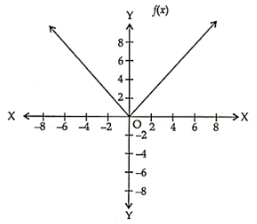
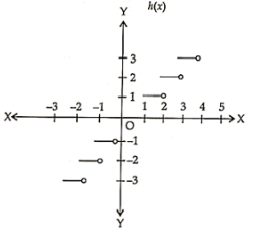
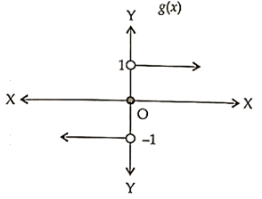
Consider the graphs of the functions f(x), h(x) and g(x). 
Image
Image
Image

i. Find the range of h(x). (1)
ii. Find the domain of f(x). (1)
iii. Find the value of f(10). (2)
OR
Find the range of g(x). (2)
A manufacturing company produces certain goods. The company manager used to make a data record on daily basis about the cost and revenue of these goods separately. The cost and revenue function of a product are given by $C(x)=20 x+4000$ and $R(x)=60 x+2000$, respectively, where $x$ is the number of goods produced and sold.

Based on above information, answer the following questions.

(i) How many goods must be sold to realise some profit?
(a) $\mathrm{x}<\mathbf{5 0}$
(b) $x>50$
(c) $x \geq 50$
(d) $\mathbf{x} \leq \mathbf{5 0}$

(ii) If the cost and revenue functions of a product are given by $C(x)=3 x+400$ and $R(x)=$ $5 x+20$ respectively, where $x$ is the number of items produced by the manufacturer, then how many items must be sold to realise some profit?
(a) $x \leq 190$
(b) $x \geq 190$
(c) $x<190$
(d) $x>190$

(iii) Let $\mathbf{x}$ and $\mathbf{b}$ are real numbers. If $\mathbf{b} > \mathbf{0}$ and $\mathbf{x}< \mathbf{b}$, then
(a) $x$ is always positive
(b) $\mathbf{X}$ is always negative
(c) $\mathrm{x}$ is real number
(d) None of these

(iv) The solution set of $\mathbf{3}-\mathbf{5}<\mathrm{x}+\mathbf{7}$, when $\mathrm{x}$ is a whole number is given by
(a) $\{0,1,2,3,4,5\}$
(b) $(-\infty, 6)$
(c) $[0,5]$
(d) None of these

(v) Graph of inequality $x>2$ on the number line is represented by
(a) Image
(b)Image 
(c) Image
(d) None of the above
The school organised a farewell party for $100$ students and school management decided three types of drinks will be distributed in farewell party ie. Milk $(M),$ Coffee $(C)$ and Tea $(T)$. Organiser reported that $10$ students had all the three drinks $M, C, T. 20$ students had $M$ and $C; 30$ students had $C$ and $T; 25$ students had $M$ and $T. 12$ students.had $M$ only; $5$ students had $C$ only; $8$ students had $T$ only.

Based on the above information, answer the following questions.
  1. The number of students who did not take any drink, is
  1. $20$
  2. $30$
  3. $10$
  4. $25$
  1. The number of students who prefer Milk is
  1. $47$
  2. $45$
  3. $53$
  4. $50$
  1. The number of students who prefer Coffee is
  1. $47$
  2. $53$
  3. $45$
  4. $50$
  1. The number of students who prefer Tea is
  1. $51$
  2. $53$
  3. $50$
  4. $47$
  1. The number of students who prefer Milk and Coffee but not tea is
  1. $12$
  2. $10$
  3. $15$
  4. $20$
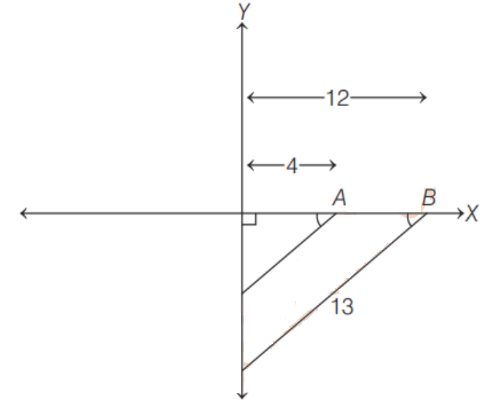
Rajiv constructs two right angled triangles in the fourth quadrant in such a way that the measure of triangle gives $\cos A=\frac{4}{5}$ and $\cos B=\frac{12}{13}$, where $\frac{3 \pi}{2} < A$ and $B > 2 \pi$.
Image
Based on the above information, answer the following questions.
(i) Find the value of $\cos (A+B)$
(ii) Find the value of $\sin (A-B)$
(iii) Find the value of $\tan (\mathbf{A}+\mathbf{B})$