MCQ
A scientist is observing a bacteria through a compound microscope. For better analysis and to improve its resolving power he should. (Select the best option)
  • A
    Increase the wave length of the light.
  • Increase the refractive index of the medium between the object and objective lens.
  • C
    Decrease the focal length of the eye piece.
  • D
    Decrease the diameter of the objective lens.
Answer

Correct option: B.
Increase the refractive index of the medium between the object and objective lens.
b
$P=\frac{2 \mu \sin \theta}{1.22 \lambda}$

Need a full question paper?

Generate a complete, print-ready paper with questions like this in minutes — across 16+ boards, with answer keys.

Start Generating Free

Similar questions

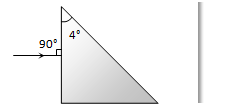
A prism having an apex angle $4^{\circ}$ and refraction index 1.5 is located in front of a vertical plane mirror as shown in figure. Through what total angle is the ray deviated after reflection from the mirror
The frequency of light in a material is $2 \times 10^{14} Hz$ and wavelength is $5,000 A$. The refractive index of the material will be
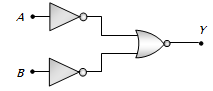
Which logic gate is represented by the following combination of logic gates
The angle between the earth's magnetic and the earth's geographical axes is....$^o$
Two radioactive isotopes $P$ and $Q$ have half Jives $10$ minutes and $15$ minutes respectively. Freshly prepared samples of each isotope initially gontain the same number of atoms. After $30$ minutes, the ratio $\frac{\text { number of atoms of } P}{\text { number of atoms of } Q}$ will be
If a high power heater is connected to electric mains, then the bulbs in the house become dim, because there is a
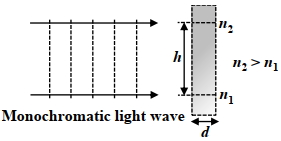
A monochromatic light wave is incident normally on a glass slab of thickness $d$, as shown in the figure. The refractive index of the slab increases linearly from $n_1$ to $n_2$ over the height $h$. Which of the following statement($s$) is (are) true about the light wave emerging out of the slab?

(image)

($A$) It will deflect up by an angle $\tan ^{-1}\left[\frac{\left(n_2^2-n_1^2\right) d}{2 h}\right]$

($B$) It will deflect up by an angle $\tan ^{-1}\left[\frac{\left(n_2-n_1\right) d}{h}\right]$

($C$) It will not deflect.

($D$) The deflection angle depends only on $\left(n_2-n_1\right)$ and not on the individual values of $n_1$ and $n_2$.

Dip angle in vertical plane at an angle ${\cos ^{ - 1}}\,\left( {\frac{1}{{\sqrt 2 }}} \right)$ from magnetic meridian is $60^o$, then actual dip at that place
The $I-V$ characteristic of an $LED$ is
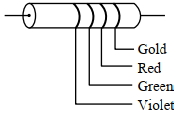
The colour coding on a carbon resistor is shown in the given figure. The resistance value of the given resistor is: