MCQ
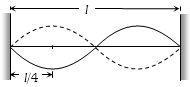
A second harmonic has to be generated in a string of length $l$ stretched between two rigid supports. The point where the string has to be plucked and touched are
  • Plucked at $\frac{l}{4}$ and touch at $\frac{l}{2}$
  • B
    Plucked at $\frac{l}{4}$ and touch at $\frac{{3l}}{4}$
  • C
    Plucked at $\frac{l}{2}$ and touched at $\frac{l}{4}$
  • D
    Plucked at $\frac{l}{2}$ and touched at $\frac{{3l}}{4}$
Answer

Correct option: A.
Plucked at $\frac{l}{4}$ and touch at $\frac{l}{2}$
a
(a) Second harmonic means $2$ loops in a total length
Hence plucking distance from one end $ = \frac{l}{{2p}} = \frac{l}{{2 \times 2}} = \frac{l}{4}.$

Need a full question paper?

Generate a complete, print-ready paper with questions like this in minutes — across 16+ boards, with answer keys.

Start Generating Free

Similar questions

$50\, gm$ of copper is heated to increase its temperature by $10^oC$. If the same quantity of heat is given to $10\; gm$ of water, the rise in its temperature is ........ $^oC$ (Specific heat of copper $= 420 \;Joule-kg^{-1} {°C^{-1}}$)
The angular velocity of a wheel is $70\, rad/sec$. If the radius of the wheel is $0.5\, m$, then linear velocity of the wheel is ....... $m/sec$
The position of a particle related to time is given by $x =\left(5 t ^2-4 t +5\right) m$. The magnitude of velocity of the particle at $t=2\,s$ will be $...........ms^{-1}$
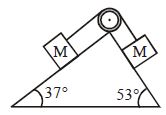
The acceleration of system of two bodies over the wedge as shown in the figure is ....... $m/sec^2$
Two solid cylinders $P$ and $Q$ of same mass and same radius start rolling down a fixed inclined plane form the same height at the same time. Cylinder $P$ has most of its mass concentrated near its surface, while $Q$ has most of its mass concentrated near the axis. Which statement $(s)$ is (are) correct?
A wheel of radius $R$ is trapped in a mud pit and spinning. As the wheel is spinning, it splashes mud blobs with initial speed $u$ from various points on its circumference. The maximum height from the centre of the wheel, to which a mud blob can reach is
At what angle must the two forces $(x + y)$ and $(x -y)$ act so that the resultant may be $\sqrt {({x^2} + {y^2})} $
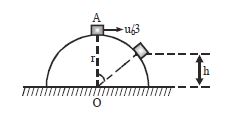
In the given figure for $u\ =\ u_0/3$ , find the height from the ground at which the block leaves the hemisphere [where $u_0\ =\ \sqrt {\frac{{gr}}{3}} ]$
In an experiment, brass and steel wires of length $1\,m$ each with areas of cross section $1\,mm^2$ are used. The wires are connected in series and one end of the combined wire is connected to a rigid support and other end is subjected to elongation. The stress requires to produced a new elongation of $0.2\,mm$ is [Given, the Young’s Modulus for steel and brass are respectively $120\times 10^9\,N/m^2$ and $60\times 10^9\,N/m^2$ ]
The simple sum of two forces acting at a point is $16N$ and their sum is $8N$ and its direction is perpendicular to the smaller force, then the forces are: