Question
A series L-C-R circuit is connected to an AC source. Using the phasor diagram, derive the expression for the impedance of the circuit. Plot a graph to show the variation of current with frequency of the source, explaining the nature of its variation.
Answer

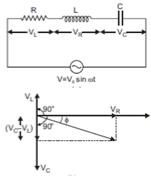
Suppose a resistance R , inductance L and capacitance C in series. An alternating source of voltage $V = V _{ o }$ sin $\omega t$ is applied across it. Since all the components are connected in series, the current flowing through all is same.
Voltage across resistance R is $V _{ R }$, voltage across inductance L is $V _{ L }$ and voltage across capacitance C is $V _{ C }$. 
$V _{ R }$ and $\left( V _{ C }- V _{ L }\right)$ are mutually perpendicular and the phase difference between them is $90^{\circ}$.
Image

From the figure above, we have 
$V^2=V_R^2+\left(V_C-V_L\right)^2 \Rightarrow V=\sqrt{V_R^2+\left(V_C-V_L\right)^2} \ldots \ldots$ (i)
and $V_R=R i, V_C=X_C i$ and $V_L=V_L i \ldots$. (ii)
where $X _{ C }=\frac{1}{\omega C}=$ capacitance reactance and $X _{ L }=\omega L=$ inductive reactance
$\therefore \quad V=\sqrt{(R i)^2+\left(X_C i-X_L i\right)^2}$
$\therefore$ Impendance of circuit, $Z=\frac{V}{i}=\sqrt{R^2+\left(X_C-X_L\right)^2}$
i.e. $Z=\sqrt{R^2+\left(X_C-X_L\right)^2}=\sqrt{R^2+\left(\frac{1}{\omega C}-\omega L\right)^2}$
The phase difference between current and voltage is given by, 
$\tan \phi=\frac{X_C-X_L}{R}$
Image

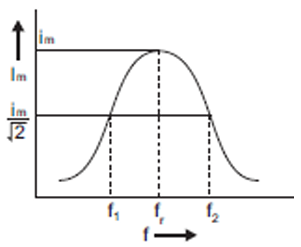
From the graph, we can see that with increase in frequency, current first increases and then decreases. At resonant frequency, current amplitude is maximum.

Need a full question paper?

Generate a complete, print-ready paper with questions like this in minutes — across 16+ boards, with answer keys.

Start Generating Free

Similar questions

A solenoid 60 cm long and of radius 4.0 cm has 3 layers of windings of 300 turns each. A 2.0 cm long wire of mass 2.5 g lies inside the solenoid (near its centre) normal to its axis; both the wire and the axis of the solenoid are in the horizontal plane. The wire is connected through two leads parallel to the axis of the solenoid to an external battery which supplies a current of 6.0 A in the wire. What value of current (with appropriate sense of circulation) in the windings of the solenoid can support the weight of the wire? $g = 9.8\ m\ s^{–2}.$
Find the ratio of the electric and gravitational forces between two protons.
A train starts from rest and moves with a constant acceleration of $2.0m/s^2$ for half a minute. The brakes are then applied and the train comes to rest in one minute. Find:
  1. The total distance moved by the train.
  2. The maximum speed attained by the train.
  3. The position(s) of the train at half the maximum speed.
Figure shows a charge array known as an electric quadrupole. For a point on the axis of the quadrupole, obtain the dependence of potential on r for r/a >> 1, and contrast your results with thatdue to an electric dipole, and an electric monopole (i.e., a single charge).
Verify the Gauss’s law for magnetic field of a point dipole of dipole moment m at the origin for the surface which is a sphere of radius R.
In an experiment to measure the speed of light by Fizeau's apparatus, following data are used:
Distance between the mirrors = 12.0km,
Number of teeth in the wheel = 180.
Find the minimum angular speed of the wheel for which the image is not seen.
Light is incident from glass $(\mu=1.50)$ to water $(\mu=1.33).$ Find the range of the angle of deviation for which there are two angles of incidence.
A sphercial capacitor is made of two conducting spherical shells of radii a and b. The space between the shells is filled with a dielectric of dielectric constant K up to a radius c as shown in figure. Calculate the capacitance.
A particle of charge $2.0 \times 10^{-8}C$ and mass $2.0 \times 10^{-10}g$ is projected with a speed of $2.0 \times 10^3m/s^{-1}$ in a region with a uniform magnetic field of 0.10T. The velocity is perpendicular to the field. Find the radius of the circle formed by the particle and also the time period.
A capacitor of capacitance $5.00\mu\text{F}$ is charged to 24.0V and another capacitor of capacitance $6.0\mu\text{F}$ is charged to 12.0V:
  1. Find the energy stored in each capacitor.
  2. The positive plate of the first capacitor is now connected to the negative plate of the second and vice versa. Find the new charges on the capacitors.
  3. Find the loss of electrostatic energy during the process.
  4. Where does this energy go?