Question
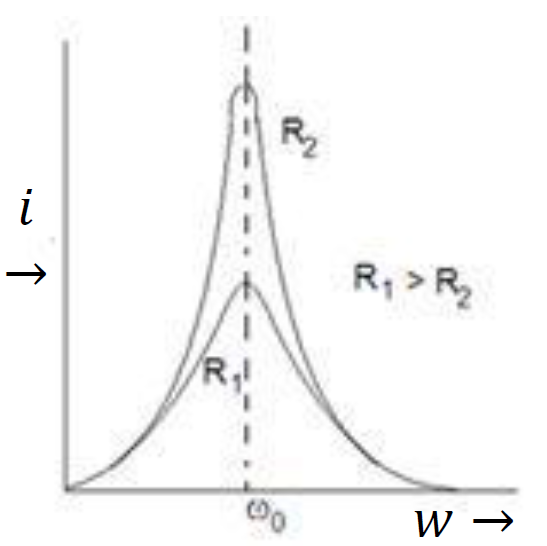
A series $\text{LCR}$ circuit is connected across an $a.c.$ source of variable angular frequency $' \omega'$. Plot a graph showing variation of current $‘i\ ’$ as a function of $' \omega'$ for two resistances $R_1$ and $R2 \ (R_1 > R_2).$
Answer the following questions using this graph:
  1. In which case is the resonance sharper and why?
  2. In which case is the power dissipation more and why?
Answer

  1. Sharper for $R = R_2$
  2. Sharpness of resonance $ = \frac{\omega_{\circ}\text{L}}{\text{R}}\propto\frac{1}{\text{R}}.$
  3. More power dissipation for $\text{R} = \text{R}_{2}$
  4. At Resonance, power dissipation $ = \frac{\text{V}^{2}}{\text{R}}\propto\frac{1}{\text{R}} ($for same $V).$

Need a full question paper?

Generate a complete, print-ready paper with questions like this in minutes — across 16+ boards, with answer keys.

Start Generating Free

Similar questions

Visible light has wavelengths in the range of 400nm to 780nm. Calculate the range of energy of the photons of visible light.
A string of length L fixed at both ends vibrates in its fundamental mode at a frequency v and a maximum amplitude A.
  1. Find the wavelength and the wave number k.
  2. Take the origin at one end of the string and the X-axis along the string. Take the Y-axis along the direction of the displacement. Take t = 0 at the instant when the middle point of the string passes through its mean position and is going towards the positive y-directian. Write the equation describing the standing wave:
A monochromatic light source of intensity $6\ mW$ emits $8 \times 10^{16}$ photons per second. This light ejects photoelectrons from a metal surface. The stopping potential for this setup is $2.0V.$ Calculate the work function of the metal.
Define magnetic susceptibility of a material. Name two elements, one having positive susceptibility and the other having negative susceptibility. What does negative susceptibility signify
The work function for a certain metal is $4.2 eV.$ Will this metal give photoelectric emission for incident radiation of wavelength $330\ nm?$
A resistance of R draws current from a potentiometer. The potentiometer wire $, AB, $ has a total resistance of $R_o. A$ voltage $V$ is supplied to the potentiometer. Derive an expression for the voltage across $R$ when the sliding contact is in the middle of potentiometer wire.
A closely wound solenoid of 2000 turns and area of cross-section$1.6 \times 10^{-4} m^2$, carrying a current of 4.0 A, is suspended through its centre allowing it to turn in a horizontal plane.
(a) What is the magnetic moment associated with the solenoid?
(b) What is the force and torque on the solenoid if a uniform horizontal magnetic field of$7.5 \times 10^{-2} T$ is set up at an angle of $30^{\circ}$ with the axis of the solenoid?

Predict the direction of induced current in the situations described in the following figs.
“Gauss’s law in electrostatics is true for any closed surface, no matter what its shape or size is”. Justify this statement with the help of a suitable example.
A charge of $3.14 \times 10^{-6}C$ is distributed uniformly over a circular ring of radius $20.0\ cm$. The ring rotates about its axis with an angular velocity of $60.0\ rad/s$. Find the ratio of the electric field to the magnetic field at a point on the axis at a distance of $5.00\ cm$ from the centre.