MCQ
A shell is fired from a cannon, it explodes in mid air, its total:
  • A
    Momentum increases.
  • B
    Momentum decreases.
  • $K.E.$ increases.
  • D
    $K.E.$ decreases.

Answer

Correct option: C.
$K.E.$ increases.
On explosion, $K.E.$ increases, as chemical energy of explosives is converted into $K.E.$

Need a full question paper?

Generate a complete, print-ready paper with questions like this in minutes — across 16+ boards, with answer keys.

Start Generating Free

Similar questions

A body of mass $5 \,kg$ falls from a height of $30$ metre. If its all mechanical energy is changed into heat, then heat produced will be........ $cal$
The trajectory of a projectile near the surface of the earth is given as$ y = 2x -9x^2$. If it were launched at an angle $\theta_0$ with speed $v_0$ then $(g = 10\, ms^{-2}$)
An area of cross-section of rubber string is $2\,c{m^2}$. Its length is doubled when stretched with a linear force of $2 \times {10^5}$dynes. The Young's modulus of the rubber in $dyne/c{m^2}$ will be
A tunning fork produces $5\, beats/sec$ when the length of a sonometer wire is either $1\, m$ or $1.05\, m$. Calculate the frequency of tunning fork  .... $Hz$
A cyclist on a level road takes a sharp circular turn of radius $3 \;m \;\left( g =10 \;ms ^{-2}\right)$. If the coefficient of static friction between the cycle tyres and the road is $0.2$, at which of the following speeds will the cyclist not skid while taking the turn?
The relative velocity of two consecutive layers is 8 cm/s. If the perpendicular distance between the layers is $0.1\, cm$, then the velocity gradient will be ......... $sec^{-1}$
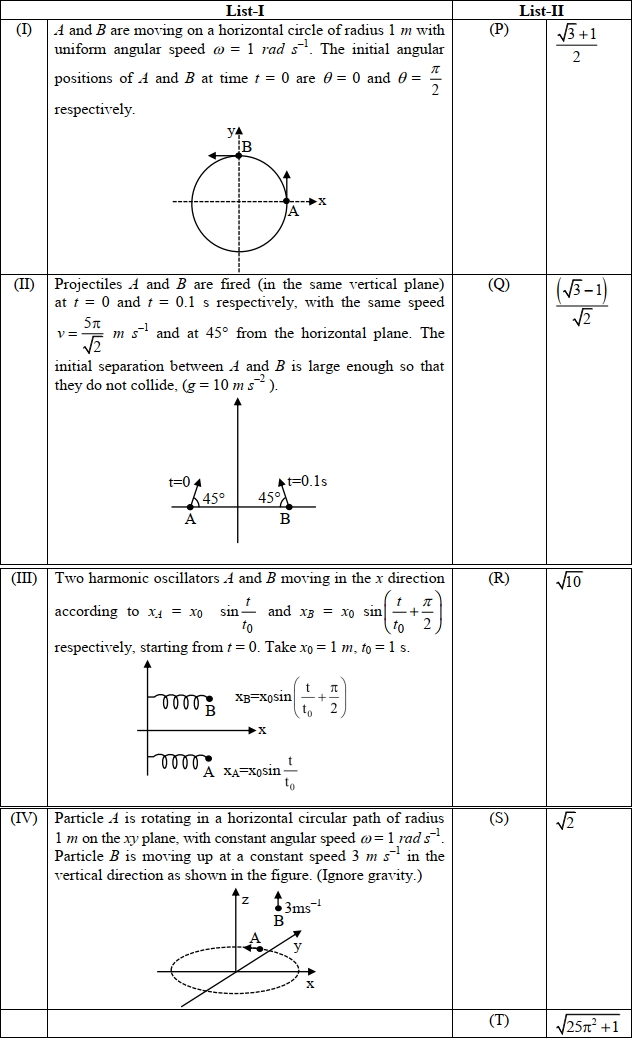
$List I$ describes four systems, each with two particles $A$ and $B$ in relative motion as shown in figure. $List II$ gives possible magnitudes of then relative velocities (in $ms ^{-1}$ ) at time $t=\frac{\pi}{3} s$.

Which one of the following options is correct?
A flywheel gains a speed of $540\ r.p.m. $ in $ 6\ sec. $  Its angular acceleration will be
An engine takes in $5$ moles of air at $20\,^{\circ} C$ and $1$ $atm,$ and compresses it adiabaticaly to $1 / 10^{\text {th }}$ of the original volume. Assuming air to be a diatomic ideal gas made up of rigid molecules, the change in its internal energy during this process comes out to be $X\, kJ$. The value of $X$ to the nearest integer is
If a new planet is discovered rotating around Sun with the orbital radius double that of earth, then what will be its time period (in earth's days)