Question
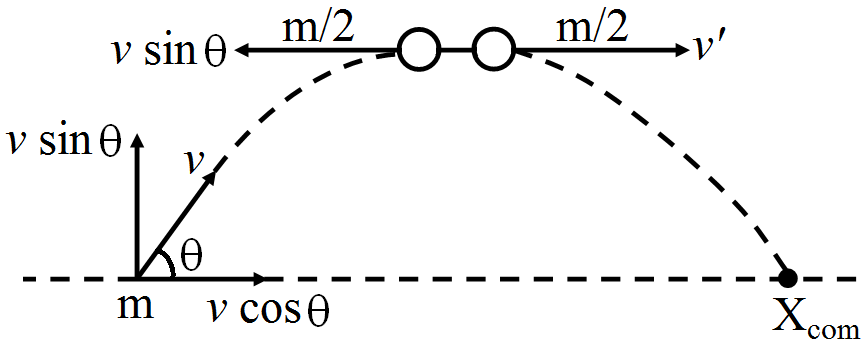
A shell is fired from a cannon with a velocity V at an angle $\theta$ with the horizontal direction. At the highest point in its path, it explodes into two pieces of equal masses. One of the pieces retraces its path to the cannon. The speed of the other piece immediately after the explosion is:

  1. $\text{3V}\cos\theta$

  2. $2\text{V}\cos\theta$

  3. $\frac{3}{2}\text{V}\cos\theta$

  4. $\text{V}\cos\theta$

Answer

  1. $\text{3V}\cos\theta$

Explanation:

The linear momentum is conserved in horizontal direction.

Initial momentum = Final momentum

$\Rightarrow\text{mv}\cos\theta=-\frac{\text{m}}{2}\text{v}\cos\theta+\frac{\text{m}}{2}\text{v}'$

$\Rightarrow\text{v}'=\text{mv}\cos\theta$

Need a full question paper?

Generate a complete, print-ready paper with questions like this in minutes — across 16+ boards, with answer keys.

Start Generating Free

Similar questions

The energy (in $eV$) possessed by a neon atom at $27^{\circ} C$ is ..............
The moment of inertia of a uniform semicircular wire of mass M and radius r about a line perpendicular to the plane of the wire through the centre is:

  1. $\text{Mr}^2$

  2. $\frac{1}{2}\text{Mr}^2$

  3. $\frac{1}4{}\text{Mr}^2$

  4. $\frac{2}{5}\text{Mr}^2$

The equation of motion of a particle of mass $1\,g$ is $\frac{{{d^2}x}}{{d{t^2}}} + {\pi ^2}x = 0$ where $x$ is displacement (in $m$ ) from mean position. The frequency of oscillation is .... $s$ (in $Hz$ )
The temperature of the hydrogen at which the average speed of its molecules is equal to that of oxygen molecules at a temperature of $31\,^oC,$ is  ........ $^oC$
What is the path followed by a moving body, on which a constant force acts in a direction other than initial velocity (i.e. excluding parallel and antiparallel direction)?
A stick has its bottom end attached to a wall by a pivot and is held up by a massless string attached to its other end. Which of the following scenarios has the smallest tension in the string ? (Length of stick is same in all scenarios)
Boyle’s law is applicable for an:
A simple pendulum is oscillating without damping. When the displacement of the bob is less than maximum, its acceleration vector $\vec a$ is correctly shown in
In a semiconductor:
  1. There are no free electrons at 0K.
  2. There are no free electrons at any temperature.
  3. The number of free electrons increases with temperature.
  4. The number of free electrons is less than that in a conductor.
The rms speed of oxygen at room temperature is about 500m/ s. The rms speed of hydrogen at the same temperature is about: