MCQ
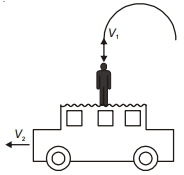
A shell is fired vertically upwards with a velocity $v_1$ from a trolley moving horizontally with velocity $v_2$. A person on the ground observes the motion of the shell as a parabola, whose horizontal range is ....
  • A
    $\frac{2 v_1^2 v_2}{g}$
  • B
    $\frac{2 v_1^2}{g}$
  • C
    $\frac{2 v_2^2}{g}$
  • $\frac{2 v_1 v_2}{g}$

Answer

Correct option: D.
$\frac{2 v_1 v_2}{g}$
d
(d)

There is no acceleration in the horizontal direction.

$S_x=U_x T+\frac{1}{2} a_0 \times T^2$

$R=U_x T \ldots (1)$

$S_y=U_y T+\frac{1}{2} g_y T^2$

$O=V_1 T-\frac{1}{2} g T^2$

$\Rightarrow V_1 T=\frac{1}{2} g T$

$T=\frac{2 V_1}{g}$

We know,

$(R)$ range $=($ Horizontal velocity $4 x) \times$ flight $+$ time $(T)$

i.e., $R=4 x \times T$

$R=V_2 \times \frac{2 V_1}{g} \Rightarrow \frac{2 V_1 V_2}{g}$

Need a full question paper?

Generate a complete, print-ready paper with questions like this in minutes — across 16+ boards, with answer keys.

Start Generating Free

Similar questions

Trajectory of particle in a projectile motion is given as $y=x-\frac{x^2}{80}$. Here, $x$ and $y$ are in metre. For this projectile motion match the following with $g=10\,m / s ^2$.
$Column-I$ $Column-II$
$(A)$ Angle of projection $(p)$ $20\,m$
$(B)$ Angle of velocity with horizontal after $4\,s$ $(q)$ $80\,m$
$(C)$ Maximum height $(r)$ $45^{\circ}$
$(D)$ Horizontal range $(s)$ $\tan ^{-1}\left(\frac{1}{2}\right)$
A student is performing the experiment of resonance column. The diameter of the column tube is $6 \,cm$. The frequency of the tuning fork is $504\, Hz$. Speed of the sound at the given temperature is $336\, m / s$. The zero of the meter scale coincides with the top end of the resonance column tube. The reading of the water level in the column when the first resonance occurs is..........$cm$
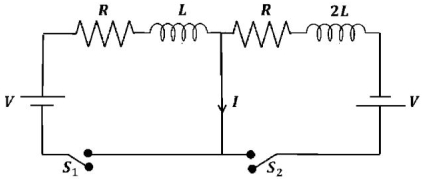
In the figure below, the switches $S_1$ and $S_2$ are closed simultaneously at $t=0$ and a current starts to flow in the circuit. Both the batteries have the same magnitude of the electromotive force (emf) and the polarities are as indicated in the figure. Ignore mutual inductance between the inductors. The current $I$ in the middle wire reaches its maximum magnitude $I_{\max } a x$ at time $t=T$. Which of the following statements is (are) true?

(Image)

$(A)$ $I_{\max }=\frac{V}{2 R}$ $(B)$ $I_{\max }=\frac{V}{4 R}$ $(C)$ $\tau=\frac{L}{R} \ln 2$ $(D)$ $\tau=\frac{2 \mathrm{~L}}{\mathrm{R}} \ln 2$

If collector current is $120\, mA$ and base current is $2\, mA$ and resistance gain is $3$, what is power gain?
Which of the following statement is not true about stopping potential $\left(\mathrm{V}_0\right)$ ?
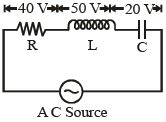
In series $LCR$ circuit, the voltages across $R, L$ and $C$ are shown in fig. The voltage of applied source is........$volt$
A conducting ring of radius $1\, meter$ is placed in an uniform magnetic field $B$ of $0.01$Telsa oscillating with frequency $100\,Hz$ with its plane at right angles to $B$. What will be the induced electric field.....$volt/m$
Three particles, each having a charge of $10\,\mu C$ are placed at the corners of an equilateral triangle of side $10\,cm$. The electrostatic potential energy of the system is.....$J$ (Given $\frac{1}{{4\pi {\varepsilon _0}}} = 9 \times {10^9}\,N - {m^2}/{C^2}$)
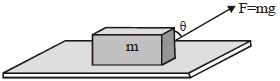
A force $f$ is acting on a block of mass $m$. Coefficient of friction between block and surface is  $\mu$. The block can be pulled along the surface if :-
If the power factor in an $AC$ circuit changes from $\frac{1}{3}$ to $\frac{1}{9}$ then by what percent reactance will change (approximately), if resistance remains constant?