MCQ
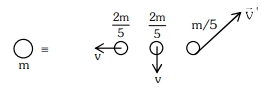
A shell of mass $m$ is at rest initially. It explodes into three fragments having mass in the ratio $2: 2: 1$. If the fragments having equal mass fly off along mutually perpendicular directions with speed $v$, the speed of the third (lighter) fragment is :
  • A
    $\sqrt{2} v$
  • $2 \sqrt{2} v$
  • C
    $3 \sqrt{2} v$
  • D
    $v$

Answer

Correct option: B.
$2 \sqrt{2} v$
b
By conservation of momentum :

$m(0)=\frac{2 m}{5}(-v \hat{i})+\frac{2 m}{5}(-v \hat{j})+\frac{m}{5} \vec{v}^{\prime}$

$\Rightarrow \vec{v}^{\prime}=2 v \hat{i}+2 v \hat{j}$

$\Rightarrow v^{\prime}=\sqrt{(2 v)^{2}+(2 v)^{2}}$

$=2 \sqrt{2} v$

Need a full question paper?

Generate a complete, print-ready paper with questions like this in minutes — across 16+ boards, with answer keys.

Start Generating Free

Similar questions

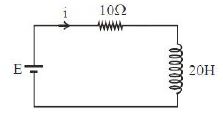
A $20\, Henry$ inductor coil is connected to a $10\, ohm$ resistance in series as shown in figure. The time at which rate of dissipation of energy (Joule’s heat) across resistance is equal to the rate at which magnetic energy is stored in the inductor, is
In adiabatic expansion of a gas
A wire of length $L$ and radius $r$ is clamped rigidly at one end. When the other end of the wire is pulled by a force $f$, its length increases by $l$. Another wire of same material of length $2 L$ and radius $2 r$ is pulled by a force $2 f$. Then the increase in its length will be
A tuning fork of frequency $480\, Hz$ is used in an experiment for measuring speed of sound $(\nu )$ in air by resonance tube method. Resonance is observed to occur at two successive lengths of the air column, ${\ell _1} = 30\,cm$ and ${\ell _2} = 70\,cm$. Then $\nu$ is equal to ..... $ms^{-1}$
From the following diode circuit. Which diode in forward biased condition
There is a uniformly charged non conducting solid sphere made of material of dielectric constant one. If electric potential at infinity be zero, then the potential at its surface is $V$. If we take electric potential at its surface to be zero, then the potential at the centre will be
A particle of mass $10\, g$ moves along a circle of  radius $6.4\, cm$ with a constant tangential acceleration. What is the magnitude of this acceleration if the kinetic energy of the particle becomes equal to $8 \times 10^{-4}\,J$ by the end of the second revolution after the beginning of the motion $?$ .............. $\mathrm{m} / \mathrm{s}^{2}$
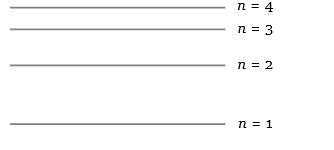
Four lowest energy levels of $H-$atom are shown in the figure. The number of possible emission lines would be
A car travels a distance of $x$ with speed $v_1$ and then same distance $x$ with speed $v_2$ in the same direction. The average speed of the car is
The ratio of escape velocity of a planet to the escape velocity of earth will be:Given : Mass of the planet is $16$ times mass of earth and radius of the planet is $4$ times the radius of earth.