MCQ
A $S.H.M.$ has amplitude $‘a’$ and time period $T$. The maximum velocity will be
  • A
    $\frac{{4a}}{T}$
  • B
    $\frac{{2a}}{T}$
  • C
    $2\pi \sqrt {\frac{a}{T}} $
  • $\frac{{2\pi a}}{T}$

Answer

Correct option: D.
$\frac{{2\pi a}}{T}$
d
(d) ${v_{\max }} = a\omega = \frac{{a\,.\,2\pi }}{T} = \frac{{2\pi a}}{T}$

Need a full question paper?

Generate a complete, print-ready paper with questions like this in minutes — across 16+ boards, with answer keys.
Start Generating Free

Similar questions

The horizontal range and maximum height attained by a projectile are $R$ and $H$, respectively. If a constant horizontal acceleration $a=g / 4$ is imparted to the projectile due to wind, then its horizontal range and maximum height will be
The volume of one litre of gas is constant at 1 Atomos $(10^5 N / m ^2).$ It doubles as it expands under pressure. What will be the work done by the gas?
A thin copper wire of length l metre increases in length by $ 2\%$ when heated through $10^o C$. ......... $\%$ is the percentage increase in area when a square copper sheet of length $l$ metre is heated through $10^o C$
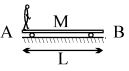
The figure shows a man of mass $m$ standing at the end $A$ of a trolley of mass $M$ placed at rest on a smooth horizontal surface. The man starts moving towards the end $B$ with a velocity $u_{rel}$ with respect to the trolley. The length of the trolley is $L$. As the man walks on the trolley, the centre of mass of the system (man $+$ trolley)
The piston in the cylinder head of locomotive has a stroke of $6\,m$ (which is twice the amplitude). If the piston executing simple harmonic motion with an angular frequency of $200\, rad\, min^{-1}$, its maximum speed is .... $ms^{-1}$
In a normal operation of a transistor:
Which of the following has the maximum momentum?
A symmetrical body of mass $M$ and radius $R$ is rolling without slipping on a horizontal surface with linear speed $v$. Then its angular speed is 
Choose the correct option.
A ball is thrown at an angle $\theta $ and another ball is thrown at an angle $(90^o -\theta )$ with the horizontal from the same point with same speed $40\,ms^{-1}$. The second ball reaches $50\,m$ higher than the first ball. Find their individual heights?