MCQ
A sigma bond is formed by the overlapping of:
  • A
    $s − s$ orbital alone
  • B
    $s$ and $p$ orbital alone.
  • $s − s, s − p$ or $p − p$ orbital along internuclear axis.
  • D
    $p − p$ orbital along the sides.

Answer

Correct option: C.
$s − s, s − p$ or $p − p$ orbital along internuclear axis.
A sigma bond is formed by the overlapping of $s − s, s − p$ or $p − p$ orbital along inter$-$nuclear axis. On the other hand, the lateral overlap of $p − p$ orbitals gives a pi bond.

Need a full question paper?

Generate a complete, print-ready paper with questions like this in minutes — across 16+ boards, with answer keys.
Start Generating Free

Similar questions

A solution containing $30g $ of non $-$ volatile solute exactly in $90g$ of water has a vapour pressure of $2.8kPa$ at $298K$. Further $18g$ of water is then added to the solution and the new vapour pressure becomes $2.9kPa$ at $298k$ Calculate vapour pressure of water at $298K\ ?$
Which one of the following is true about $NaCl$ and $KCl$
For the chemical reaction $3X(g) + Y(g) \to X_3Y(g)$ the amount of $X_3Y$ at equilibrium is affected by
Correct order of $K_a$ value
Common alum is
Which of the following compounds has most acidic hydrogen ?
What is the shape of the $ClF_3$ molecule?
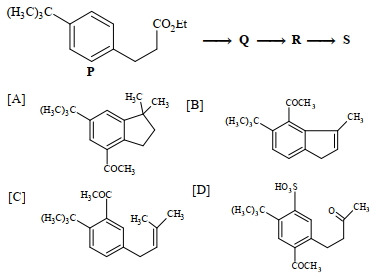
The reaction of compound $\mathbf{P}$ with $CH_3 MgBr$ (excess) in $\left(C_2 \mathrm{H}_5\right)_2 O$ followed by addition of $H_2 O$ gives $Q$. The compound $Q$ on treatment with $H_2 SO_4$ at $0^{\circ} C$ gives $R$. The reaction of $R$ with $CH_3 COC1$ in the presence of anhydrous $AlCl_3$ in $CH_2 Cl_2$ followed by treatment with $H_2 O$ produces compound $S$ [ $Et$ in compound $P$ is ethyl group]

(image)

($1$) The product $S$ is

(image)

($2$) The reactions, $Q$ to $R$ and $R$ to $S$, are

$[A]$ Dehydration and Friedel-Crafts acylation

$[B]$ Aromatic sulfonation and Friedel-Crafts acylation

$[C]$ Friedel-Crafts alkylation, dehydration and Friedel-Crafts acylation

$[D]$ Friedel-Crafts alkylation and Friedel-Crafts acylation

Given the answer quetion ($1$) and ($2$)
In which of the following the photoelectric effect will occur easily?
Consider the following reaction

$N _{2} O _{4}( g ) \rightleftharpoons 2 NO _{2}( g ) ; \Delta H ^{0}=+58 kJ$

For each of the following cases $(a, b),$ the direction in which the equilibrium shifts is:

$(a)$ Temperature is decreased

$(b)$ Pressure is increased by adding $N _{2}$ at constant $T$