Question

A silicon speciman is made into a P-type semi-conductor by dopping, on an average, one Indium atom per 5  silicon atoms. If the number density of atoms in the silicon specimen is 5   then the number of acceptor atoms in silicon per cubic centimetre will be

(a) 2.5

(b) 1.0  

(c) 1.0  

(d) 2.5  

Answer

(c) 1.0  

Need a full question paper?

Generate a complete, print-ready paper with questions like this in minutes — across 16+ boards, with answer keys.

Start Generating Free

Similar questions

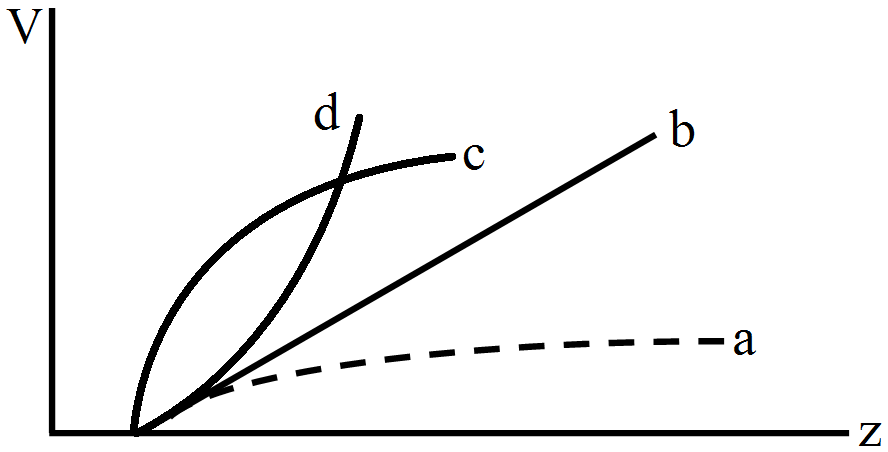
The figure shows the intensity-wavelength relations of X-rays coming from two different Coolidge tubes. The solid curve represents the relation for the tube A in which the potential difference between the target and the filament is VA and the atomic number of the target material is ZA. These quantities are VB and ZB for the other tube. Then:
  1. VA > VB, ZA > ZB
  2. VA > VB, ZA < ZB
  3. VA < VB, ZA > ZB
  4. VA > VB, ZA < ZB
​​​​​​​​​​​​​​

When the light source is kept 20 cm away from a photo cell, stopping potential 0.6 V is obtained. When source is kept 40 cm away, the stopping potential will be

(a) 0.3 V 

(b) 0.6 V

(c) 1.2 V  

(d) 2.4 V

Maximum useable frequency (MUF) in F-region layer is x, when the critical frequency is 60 MHz and the angle of incidence is 70°. Then x is

(a) 150 MHz

(b) 170 MHz

(c) 175 MHz

(d) 190 MHz

In the uranium radioactive series, the initial nucleus is  and the final nucleus is  . When the uranium nucleus decays to lead, the number of α - particles emitted will be

(a) 1 

(b) 2

(c) 4  

(d) 8

The potential difference between the cathode and the target in a Collidge tube is 100 kV. The minimum wavelength of the X-rays emitted by the tube is

(a) 0.66 Å

(b) 9.38 Å

(c) 0.246 Å

(d) 0.123 Å

Consider three quantities $\text{x}=\frac{\text{E}}{\text{B}},\ \text{y}=\sqrt{\frac{1}{\mu_0\in_0}}$ and $\text{z}=\frac{1}{\text{CR}}.$ Here, l is the length of a wire, C is a capacitance and R is a resistance. All other symbols have standard meanings.
Three observers A, B and C measure the speed of light coming from a source to be vA, 0B and vc. The observer A moves towards the source and C moves away from the source at the same speed. The observer B stays stationary. The surrounding space is vacuum everywhere.
Which of the following combinations should be selected for better tuning of an LCR circuit used for communication?
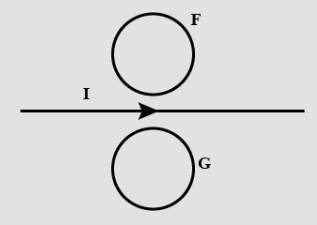
Two conducting circular loops F and G are kept in a plane on either side of a straight current-carrying wire as shown in the figure below.
If the current in the wire decreases in magnitude, the induced current in the loops will be:

Which of the following units denotes the dimensions $\frac{{\text{ML}}^2}{{\text{Q}}^2}$where Q denotes the electric charge?