MCQ
A silver sphere of radius $1\ cm$ and work function $4.7 \ eV$ is suspended from an insulating thread in free-space. It is under continuous illumination of $200 \ nm$ wavelength light. As photoelectrons are emitted, the sphere gets charged and acquires a potential. The maximum number of photoelectrons emitted from the sphere is $A \times 10^2$ (where $1 < A < 10$ ). The value of  $'Z '$ is
  • $7$
  • B
    $8$
  • C
    $9$
  • D
    $1$

Answer

Correct option: A.
$7$
a
Let $x$ be the maximum number of photo electrons emitted.

The potential $V$ of the sphere can be calculated as : $U =\frac{ Kq }{ R }$

$V =\frac{9 \times 10^9 \times x \times 1.6 \times 10^{-1} 19}{10^{-2}}= x \times 14.4 \times 10^{-8} $

$ U = eV = x \times 14.4 \times 10^{-8} \times 1.6 \times 10^{-19}= x \times 23.04 \times 10^{-27} J$

From conservation of energy :

$U =\frac{ hC }{\lambda}-\phi $

$x \times 23.04 \times 10^{-27}=\frac{2 \times 10^{-25}}{200 \times 10^{-9}}-4.7 \times 1.6 \times 10^{-19} $

$x =\frac{10^{-18}-7.52 \times 10^{-19}}{23.04 \times 10^{-27}}=1.076 \times 10^7$

$\therefore Z =7$

Need a full question paper?

Generate a complete, print-ready paper with questions like this in minutes — across 16+ boards, with answer keys.

Start Generating Free

Similar questions

An electric kettle takes 4 A current at 220 V. How much time will it take to boil 1 kg of water from room temperature 20℃ ? The temperature of boiling water is 100℃
For a radioactive material, its activity $A$ and rate of change of its activity $R$ are defined as $A=-\frac{d N}{d t}$ and $R=-\frac{d A}{d t}$, where $N(t)$ is the number of nuclei at time $t$. Two radioactive sources $P$ (mean life $\tau$ ) and $Q$ (mean life $2 \tau$ ) have the same activity at $t=0$. Their rates of change of activities at $t=2 \tau$ are $R_p$ and $R_Q$, respectively. If $\frac{R_p}{R_Q}=\frac{n}{e}$, then the value of $n$ is
The transformation ratio in the step-up transformer is
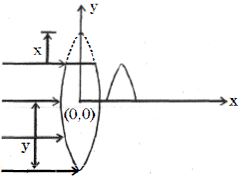
The dotted part of the lens is cut and kept on the $x$ axis as shown in the diagram. If parallel paraxial rays are falling on this systems then the coordinate of image  formed after refraction  from both the lenses is $(30, -1)$ . If $x = 2.5$ then $y=..........cm$ (all the distance is in cm) (Assume lens have no spherical aberration)
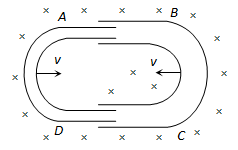
One conducting U tube can slide inside another as shown in figure, maintaining electrical contacts between the tubes. The magnetic field B is perpendicular to the plane of the figure. If each tube moves towards the other at a constant sped v then the emf induced in the circuit in terms of B, l and v where l is the width of each tube, will be
In order to forward bias a PN junction, the negative terminal of battery is connected to
When a bar magnet is broken into two pieces:
Light of two different frequencies whose photons have energies 1eV and 2.5eV respectively, successively illuminates a metal of work function 0.5eV. The ratio of maximum kinetic energy of the emitted electron will be
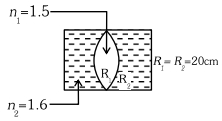
In the figure shown here, what is the equivalent focal length (in $cm$) of the combination of lenses (Assume that all layers are thin)?
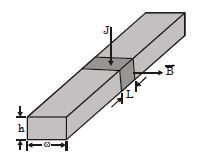
Heart-lung machines and artifical kidney machines employ blood pumps. A mechanical pump can mangle blood cells.Figure represents an electromagnetic pump. The blood is confined to an electrically insulating tube, represented as a rectangle of width $\omega$ and height $h.$ Two electrodes fit into the top and the bottom of the tube. The potential difference between them establishes an electric current through the blood, with current density $J$ over a section of length $L.$ A perpendicular magnetic field exists in the same region. The section of liquid in the magnetic field experiences a pressure increase given by :-