A simple harmonic motion is represented by $y\, = 5\,(\sin \,3\pi t\, + \,\sqrt 3 \,\cos \,3\pi t)\,cm$ The amplitude and time period of the motion are
JEE MAIN 2019, Medium


Download our appand get started for free
Experience the future of education. Simply download our apps or reach out to us for more information. Let's shape the future of learning together!No signup needed.*
Similar Questions
- 1The oscillation of a body on a smooth horizontal surface is represented by the equation $x= Acos$$\omega t$View Solution
where $x=$ displacement at time $t$
$\omega =$ frequency of oscillation
Which one of the following graphs shows correctly the variation $a$ with $t$ ?
Here $a=$ acceleration at time $t$
$T=$ time period
- 2The resultant of two rectangular simple harmonic motions of the same frequency and equal amplitudes but differing in phase by $\frac{\pi }{2}$ isView Solution
- 3The time period of a seconds pendulum is $2\, sec$. The spherical bob which is empty from inside has a mass $50\; gram$, this now is replaced by another solid of same radius but have different mass of $100\; gram$. The new time period will be ..... $\sec$View Solution
- 4An oscillator of mass $M$ is at rest in its equilibrium position in a potential $V\, = \,\frac{1}{2}\,k{(x - X)^2}.$ A particle of mass $m$ comes from right with speed $u$ and collides completely inelastically with $M$ and sticks to it . This process repeats every time the oscillator crosses its equilibrium position .The amplitude of oscillations after $13$ collisions is: $(M = 10,\, m = 5,\, u = 1,\, k = 1 ).$View Solution
- 5View SolutionThe velocity of simple pendulum is maximum at
- 6The function ${\sin ^2}(\omega t)$ representsView Solution
- 7A particle moves such that its acceleration $a$ is given by $a = - bx$, where $x$ is the displacement from equilibrium position and b is a constant. The period of oscillation isView Solution
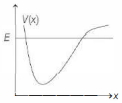
- 8Consider a one-dimensional potential $V(x)$ as shown in the figure below. A classical particle of mass $m$ moves under its influence and has total energy $E$ as shown below. The motion isView Solution
- 9View SolutionFor a particle executing simple harmonic motion, which of the following statements is not correct
- 10A particle executes simple harmonic motion according to equation $4 \frac{d^2 x}{d t^2}+320 x=0$. Its time period of oscillation is .........View Solution