Question
A simple microscope using a single lens often shows coloured image of a white source. Why?

Answer

A simple microscope consists of a single convex lens. Sometimes due to chromatic and spherical aberrations, the image of a white source seems coloured at the corners of the lens and somewhere in between.

Need a full question paper?

Generate a complete, print-ready paper with questions like this in minutes — across 16+ boards, with answer keys.
Start Generating Free

Similar questions

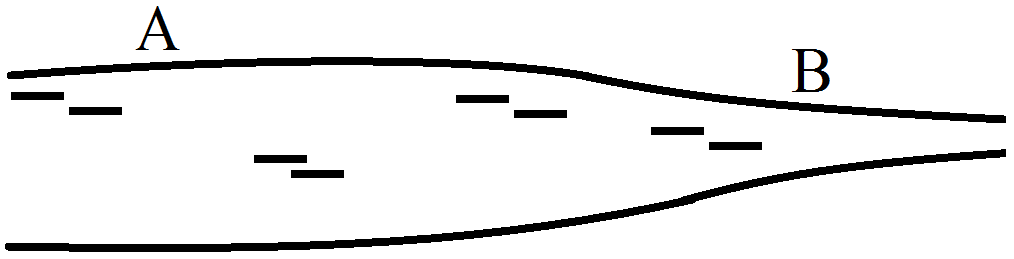
Water flows through a horizontal tube of variable cross-section. The area of cross-section at A and B are 4mm2 and 2mm2 respectively. If 1cc of water enters per second through A, find,
  1. The speed ofwater at A.
  2. The speed of water at B.
  3. Thepressure difference PA - PB.

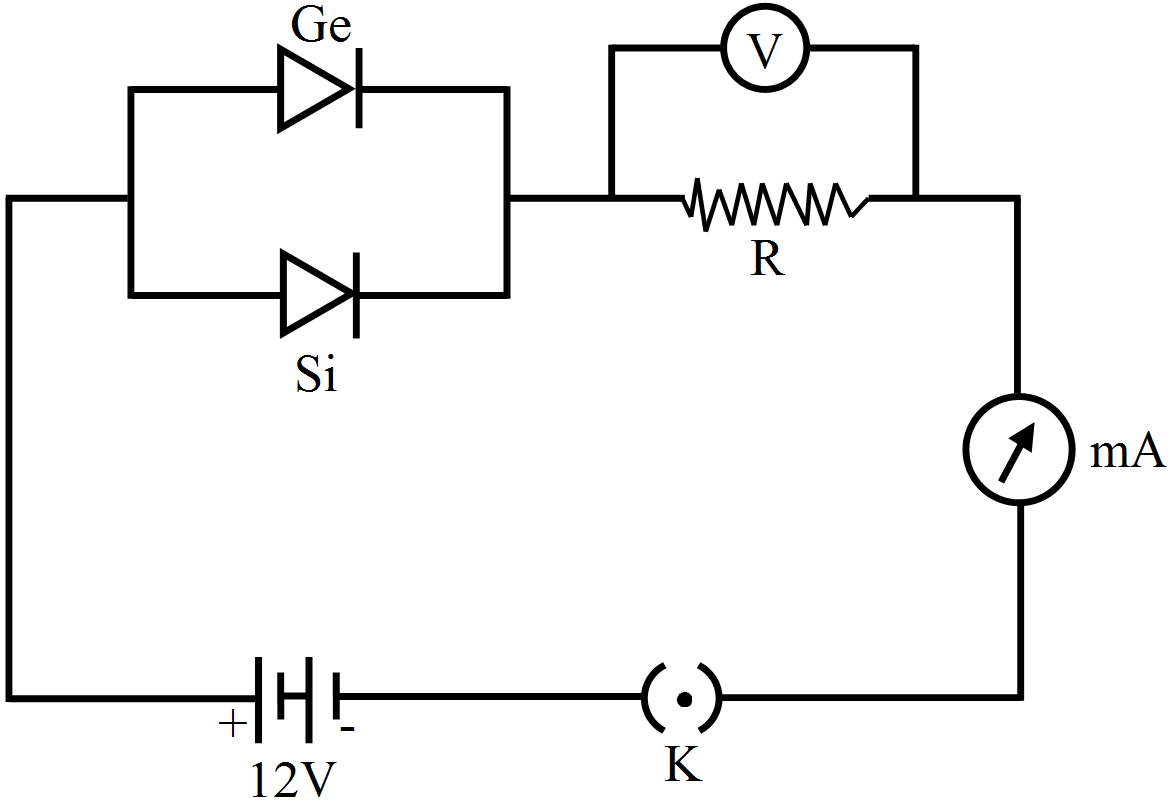
Germanium and silicon junction diodes are connected in parallel. A resistance R, a 12V battery, a milliammeter (mA) and key (K) are connected in series with them (figure). When key (K) is closed, a current begins to flow in the milliammeter. What will be the maximum reading of voltmeter connected across resistance R?

The selling rate of a radioactive isotope is decided by its activity. What will be the second-hand rate of a one month old $\text{ }^{32}\text{P}\big(\text{t}_{\frac{1}{2}}=14.3\text{days}\big)$ source if it was originally purchased for 800 rupees?
Answer the following question:
The refractive index of diamond is much greater than that of ordinary glass. Is this fact of some use to a diamond cutter?
Define the term ‘Half-life’ of a radioactive substance. Two different radioactive substances have half-lives T1 and T2 and number of undecayed atoms at an instant N1 and N2, respectively. Find the ratio of their activities at that instant.
Answer the following question:
In a single slit diffraction experiment, the width of the slit is made double the original width. How does this affect the size and intensity of the central diffraction band?
Explain the effect of dielectric on the capacitance of parallel plate capacitor and derive the equation of dielectric constant.
A neutron having kinetic energy 12.5eV collides with a hydrogen atom at rest. Nelgect the difference in mass between the neutron and the hydrogen atom and assume that the neutron does not leave its line of motion. Find the possible kinetic energies of the neutron after the event.
How does the power of a convex lens vary, if the incident red light is replaced by violet light?
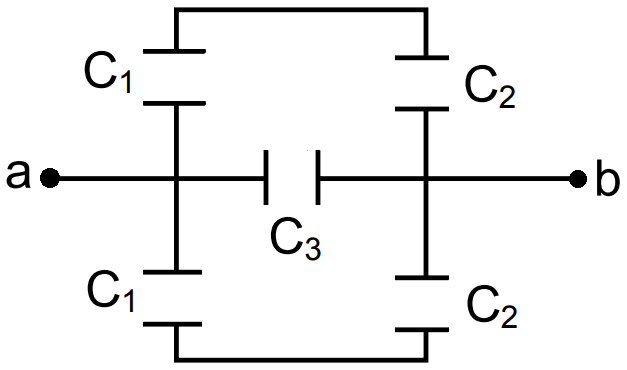
Find the equivalent capacitance of the syatem shown in figure between the points a and b.