MCQ
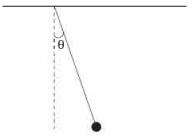
A simple pendulum is released from rest at the horizontally stretched position. When the string makes an angle $\theta$ with the vertical, the angle $\phi$ which the acceleration vector of the bob makes with the string is given by
  • A
    $\phi=0$
  • $\phi=\tan ^{-1}\left(\frac{\tan \theta}{2}\right)$
  • C
    $\phi=\tan ^{-1}(2 \tan \theta)$
  • D
    $\phi=\frac{\pi}{2}$

Answer

Correct option: B.
$\phi=\tan ^{-1}\left(\frac{\tan \theta}{2}\right)$
b
(b)

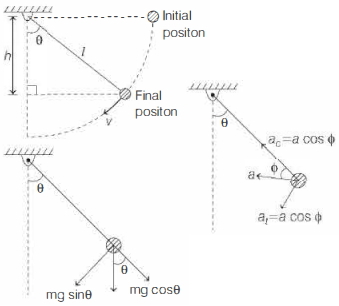
Let $v$ is the velocity of bob at position $\theta$ after being released from horizontal position.

From energy conservation, we have

$m g h=\frac{1}{2} m v^2$

$\Rightarrow m g(l \cos \theta)=\frac{1}{2} m v^2$

$\Rightarrow \quad \frac{v^2}{l}=2 g \cos \theta \quad \dots(i)$

Restoring force on bob is component of weight.

So, tangential component of acceleration is

$a_t=g \sin \theta \quad \dots(ii)$

If total acceleration a makes angle $\phi$ with string. Then,

Tangential component,

$a_t=a \sin \phi$

and radial component, $a_c=a \cos \phi$

So, $\quad \frac{a_t}{a_c}=\frac{a \sin \phi}{a \cos \phi}=\tan \phi$

$\Rightarrow \quad \tan \phi=\frac{a_i}{a_c} \quad \dots(iii)$

Substituting values of $a_t$ and $a_c$ from Eqs.

$(i)$ and $(ii)$ in Eq. $(iii)$, we get

$\tan \phi=\frac{g \sin \theta}{2 g \cos \theta}$

$\Rightarrow \quad \tan \phi=\frac{\tan \theta}{2}$

So, $\quad \phi=\tan ^{-1}\left(\frac{\tan \theta}{2}\right)$
Need a full question paper?

Generate a complete, print-ready paper with questions like this in minutes — across 16+ boards, with answer keys.

Start Generating Free

Similar questions

$Assertion$ : Mountain roads rarely go straight up the slope.
$Reason$ : Slope of mountains are large, therefore more chances of vehicle to slip from roads
A spring when stretched by $2 \,mm$ its potential energy becomes $4 \,J$. If it is stretched by $10 \,mm$, its potential energy is equal to
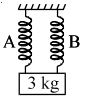
Block of $1 kg$ is initially in equilibrium and is hanging by two identical springs $A$ and $B$ as shown in figures. If spring $A$ is cut from lower point at $t=0$ then, find acceleration of block in $ms^{^{-2}}$ at $t = 0.$
Two stones are thrown up simultaneously from the edge of a cliff $240\ m$ high with initial speed of $10\ m/s$ and $40\ m/s$ respectively. Which of the following graph best represents the time variation of relative position of the second stone with respect to the first ?

(Assume stones do not rebound after hitting the ground and neglect air resistance, take $g = 10\ m/ s^2$)
(The figures are schematic and not drawn to scale)

The maximum height attained by a projectile is increased by $10\,\%$ by increasing its speed of projection, without changing the angle of projection. The percentage increases in the horizontal range will be $...........\,\%$
It is found that $|\text{A}+\text{B}|=|\text{A}|.$ This necessarily implies,
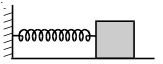
$A$ spring block system is placed on a rough horizontal floor. The block is pulled towards right to give spring an elongation less than $\frac{{2\mu mg}}{K}$ but more than $\frac{{\mu mg}}{K}$ and released. Which of the following laws/principles of physics can be applied on the spring block system
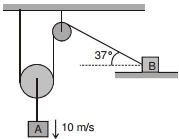
Find velocity of block ' $B$ ' at the instant shown in figure $........\,m/s$
A mass $m = 1.0\,kg$ is put on a flat pan attached to a vertical spring fixed on the ground. The mass of the spring and the pan is negligible. When pressed slightly and released, the mass executes simple harmonic motion. The spring constant is $500\,N/m.$ What is the amplitude $A$ of the motion, so that the mass $m$ tends to get detached from the pan ? (Take $g = 10\,m/s^2$ ). The spring is stiff enough so that it does not get distorted during the motion.
Two balls are projected from the same point simultaneously.First ball is projected vertically upwards and the second ball at an angle of projection $60^o$ to the ground level. Both the balls reach the ground simultaneously. The ratio of their velocities are