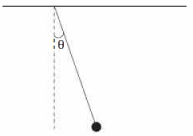
A simple pendulum is set into vibrations. The bob of the pendulum comes to rest after some time due to
Easy
Download our app for free and get started
Air friction causes the oscillating pendulum to damp and thus eventually it comes to rest after some time.

Download our appand get started for free
Experience the future of education. Simply download our apps or reach out to us for more information. Let's shape the future of learning together!No signup needed.*
Similar Questions
- 1Two simple harmonic motions are represented by the equationsView Solution
${x}_{1}=5 \sin \left(2 \pi {t}+\frac{\pi}{4}\right)$ and ${x}_{2}=5 \sqrt{2}(\sin 2 \pi {t}+\cos 2 \pi {t})$
The amplitude of second motion is ....... times the amplitude in first motion.
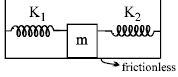
- 2Two springs with negligible masses and force constant of $K_1 = 200\, Nm^{-1}$ and $K_2 = 160\, Nm^{-1}$ are attached to the block of mass $m = 10\, kg$ as shown in the figure. Initially the block is at rest, at the equilibrium position in which both springs are neither stretched nor compressed. At time $t = 0,$ a sharp impulse of $50\, Ns$ is given to the block with a hammer.View Solution
- 3A particle execute $S.H.M.$ along a straight line. The amplitude of oscillation is $2 \,cm$. When displacement of particle from the mean position is $1 \,cm$, the magnitude of its acceleration is equal to magnitude of its velocity. The time period of oscillation is ........View Solution
- 4A plank with a small block on top of it is under going vertical $SHM$ . Its period is $2\ sec$ . The minimum amplitude at which the block will separate from plank isView Solution
- 5A simple pendulum is released from rest at the horizontally stretched position. When the string makes an angle $\theta$ with the vertical, the angle $\phi$ which the acceleration vector of the bob makes with the string is given byView Solution
- 6A particle of mass m is executing oscillations about the origin on the $X-$axis. Its potential energy is $U(x) = k{[x]^3}$, where $k$ is a positive constant. If the amplitude of oscillation is $a$, then its time period $T$ isView Solution
- 7A body is executing simple harmonic motion with frequency $'n',$ the frequency of its potential energy is :View Solution
- 8Two particles are executing simple harmonic motion of the same amplitude $A$ and frequency $\omega $ along the $x-$ axis. Their mean position is separated by distance $X_0 (X_0> A)$. If the maximum separation between them is $(X_0 +A)$, the phase difference between their motion isView Solution
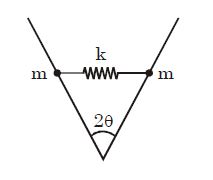
- 9Two particles of mass $m$ are constrained to move along two horizontal frictionless rails that make an angle $2\theta $ with respect to each other. They are connected by a spring with spring constant $k$ . The angular frequency of small oscillations for the motion where the two masses always stay parallel to each other (that is the distance between the meeting point of the rails and each particle is equal) isView Solution
- 10A particle is placed at the lowest point of a smooth wire frame in the shape of a parabola, lying in the vertical $xy-$ plane having equation $x^2 = 5y$ $(x, y$ are in meter). After slight displacement, the particle is set free. Find angular frequency of oscillation.....$rad/s$ (in $rad/sec$ ) (take $g = 10\ m/s^2$ )View Solution