Question
A simple pendulum moves from one $\left(\frac{1}{2}\right)$ end to other in a second, what will be its frequency?
Answer

Period T $=2 \times \frac{1}{2}$ second $=1$ second
Frequency $n=\frac{1}{T}=\frac{1}{1 sec }=1 sec ^{-1}$

Need a full question paper?

Generate a complete, print-ready paper with questions like this in minutes — across 16+ boards, with answer keys.

Start Generating Free

Similar questions

A string is wrapped over the edge of a uniform disc and the free end is fixed with the ceiling. The disc moves down, unwinding the string. Find the downward acceleration of the disc.
Find the dimensions of :
  1. The specific heat capacity $c.$
  2. The coefficient of linear expansion $a$.
  3. The gas constant $R.$
Some of the equations involving these quantities are $\text{Q = mc(T}_2-\text{T}_1),\text{l}_{\text{t}}=\text{l}_0[1+\alpha(\text{T}_2-\text{T}_1)]$ and $\text{PV = nRT}.$
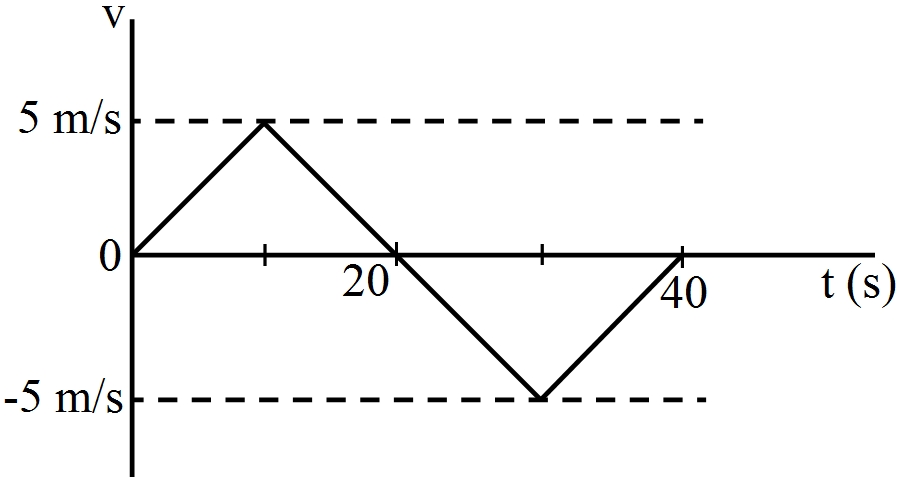
From the velocity-time plot shown in figure, find the distance travelled by the particle during the first 40 seconds. Also find the average velocity during this period.
A, B and C are three non-collinear, non co-planar vectors. What can you say about direction of A × (B × C)?
A current of 10A is established in a long wire along the positive z-axis. Find the magnetic field $\overrightarrow{\text{B}}$ at the point (1m, 0, 0).
Find the temperature at which root mean square velocity of a gas is half of its value at 0°C, while pressure remaining constant.
Write an expression for the moment of inertia of a circular disc of mass $M$ and radius $R.$
  1. About an axis passing through its centre, and perpendicular to its plane.
  2. About its diameter.
  3. About a tangent to its own plane.
  4. About a tangent perpendicular to the plane of the disc.
The earth is acted upon by the gravitational attraction of the sun. Why don't the earth fall into the sun?
Find the scalar product of two vectors $\vec{\text{a}}=(3\hat{\text{i}}-4\hat{\text{j}}+5\hat{\text{k}})$ and $\vec{\text{b}}=(-2\hat{\text{i}}+\hat{\text{j}}-3\hat{\text{k}}).$
Write Avogadro's law