A simple pendulum of length $ l$ has a brass bob attached at its lower end. Its period is $T$. If a steel bob of same size, having density $ x$ times that of brass, replaces the brass bob and its length is changed so that period becomes $2T$, then new length is
Easy
Download our app for free and get started
(b) $T \propto \sqrt l $ Time period depends only on effective length. Density has no effect on time period. If length made $4$ times then time period becomes $2$ times.

Download our appand get started for free
Experience the future of education. Simply download our apps or reach out to us for more information. Let's shape the future of learning together!No signup needed.*
Similar Questions
- 1View SolutionWhen the displacement is half the amplitude, the ratio of potential energy to the total energy is
- 2The function $(sin\,\omega t -cos\,\omega t)$ representsView Solution
- 3A block of mass $0.1\, kg$ is connected to an elastic spring of spring constant $640\, Nm^{-1}$ and oscillates in a damping medium of damping constant $10^{-2}\, kg\,s^{-1}$ . The system dissipates its energy gradually. The time taken for its mechanical energy of vibration to drop to half of its initial value, is closest to ..... $s$View Solution
- 4A simple harmonic oscillator has an amplitude $A$ and time period $6 \pi$ second. Assuming the oscillation starts from its mean position, the time required by it to travel from $x=A$ to $x=\frac{\sqrt{3}}{2} A$ will be $\frac{\pi}{x}$ s, where $x=$__________.View Solution
- 5A body is executing Simple Harmonic Motion. At a displacement $x$ its potential energy is ${E_1}$ and at a displacement y its potential energy is ${E_2}$. The potential energy $E$ at displacement $(x + y)$ isView Solution
- 6View SolutionA system is oscillating with undamped simple harmonic motion. Then the
- 7The equation of a simple harmonic motion is $X = 0.34\cos (3000t + 0.74)$ where $X$ and $t$ are in $mm$ and $sec$. The frequency of motion isView Solution
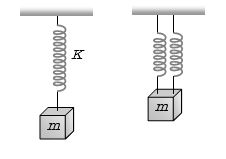
- 8A mass m performs oscillations of period $T$ when hanged by spring of force constant $K$. If spring is cut in two parts and arranged in parallel and same mass is oscillated by them, then the new time period will beView Solution
- 9The maximum speed of a particle executing $S.H.M.$ is $1\,m/s$ and its maximum acceleration is $1.57\,m/se{c^2}$. The time period of the particle will be .... $\sec$View Solution
- 10In the reported figure, two bodies $A$ and $B$ of masses $200\, {g}$ and $800\, {g}$ are attached with the system of springs. Springs are kept in a stretched position with some extension when the system is released. The horizontal surface is assumed to be frictionless. The angular frequency will be $.....\,{rad} / {s}$ when ${k}=20 \,{N} / {m} .$View Solution
